

Syrian Kurds to remove fortifications from Turkish border

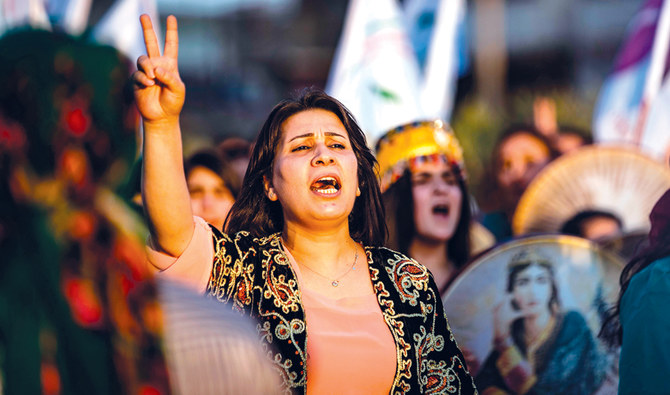
A Syrian Kurdish demonstrator shouts slogans as she marches in the northeastern city of Qamishli on Aug. 27 during a protest against Turkish threats to invade the Kurdish region. (AFP)
Updated 03 September 2019
Follow

Syrian Kurds to remove fortifications from Turkish border

  • Measure is part of a deal to establish a safe zone along Syria’s northwest border

BEIRUT: A US-backed mostly Kurdish force in Syria on Tuesday carried out a patrol along with the US-led coalition near a border town with Turkey to select fortifications to be removed as part of an agreement to set up a safe zone along the country’s northwest border, a spokesman for the group said.

Mustafa Bali of the Syrian Democratic Forces (SDF) tweeted that the patrol occurred near the town Tal Abyad on the border with Turkey, which seeks to set up a buffer zone along its southern border.

The SDF announced last week that it has begun withdrawing its fighters from the border towns of Tal Abyad and Ras Al-Ayn as part of a deal for the so-called safe zone in northeast Syria involving the US and Turkey.

Turkey has been pressing for a safe zone to ensure security on its border running east of the Euphrates River toward the Iraqi border. Turkey wants to control — in coordination with the US — a 19-25 mile (30-40km) deep zone within civil war-ravaged Syria.

Turkey wants the region along its border to be clear of Syrian Kurdish forces and has threatened on numerous occasions to launch a new operation in Syria against Syrian Kurdish forces if such a zone is not established.

Turkey sees the Syrian Kurdish fighters, who make up the majority of the SDF and are allied with the US, as terrorists aligned with a Kurdish insurgency within Turkey. American troops are stationed in northeast Syria, along with the Kurdish forces, and have fought Daesh together.

Bali tweeted that the SDF are working together with the US-led coalition “to make the agreement successful and to ease tensions on the border.”

Turkey and the US have set up a joint operation center for the planned zone along the border with Turkey but have disagreed over the size of the zone or the command structure of the forces to operate there.

“We do not have much time or patience regarding the safe zone which will be established along our entire border east of the Euphrates (river),” Erdogan recently said in a speech at a graduation ceremony at the National Defense University in Istanbul.

US President Donald Trump proposed the safe zone last year, having announced plans to withdraw US special forces from northern Syria but he later suspended the plan to ensure Washington’s Kurdish allies would be protected.

In the northern town of Azaz, two separate motorcycles rigged with explosives went off about three hours apart. The first blast in a market killed one person and wounded 11, while the second wounded five people outside a school in the town’s center, according the Azaz media center, an activist collective and the Britain-based Syrian Observatory for Human Rights.

Azaz is controlled by Turkish troops and Turkey-backed opposition fighters.

The Syrian conflict has killed more than 370,000 people and driven millions from their homes since it started with the brutal repression of anti-regime protests in 2011.


Israeli tank fires near Lebanese army and UNIFIL patrol amid escalating tensions

On Friday, President Joseph Aoun met with Parliament Speaker Nabih Berri to address the Israeli escalation. (Supplied)
Updated 6 sec ago
Follow

Israeli tank fires near Lebanese army and UNIFIL patrol amid escalating tensions

  • On Friday, President Joseph Aoun met with Parliament Speaker Nabih Berri to address the Israeli escalation
  • Aoun has faced mounting criticism from Hezbollah-aligned activists for his repeated insistence on the state’s exclusive authority over arms

BEIRUT: An Israeli tank opened fire near a joint Lebanese army and UNIFIL patrol on Friday afternoon, in the latest incident to heighten tensions along the Blue Line.

The tank shell reportedly landed near Wadi Al-Asafir, south of the town of Khiam, where the Lebanese army and UNIFIL were conducting a field operation. The fire was said to have come from a newly established Israeli position in the Hamams area, according to eyewitnesses.

A Lebanese military source told Arab News: “This is not the first time Israeli forces have targeted Lebanese army and UNIFIL units. Similar incidents have occurred during operations south of the Litani River, and UNIFIL has previously issued statements condemning such actions.”

Earlier on Friday, an Israeli drone fired three missiles at a vehicle in Baalbek, eastern Lebanon, in a failed assassination attempt. Witnesses said the first strike hit a car traveling on the Majdaloun-Baalbek road. The driver, believed to be Palestinian, managed to escape, tossing his phone out before parking near Dar Al-Amal Hospital.

The drone fired a second missile that missed, resulting in material damage only. A third strike followed, but the target was not injured.

The attacks come amid renewed Israeli skepticism over Lebanon’s efforts to confiscate weapons south of the Litani River. Israeli officials dismissed Beirut’s recent announcement of completing the first phase of the disarmament plan as a “media stunt to buy time.” Lebanese officials insisted that progress was being made under a phased national strategy backed by international partners.

On Friday, President Joseph Aoun met with Parliament Speaker Nabih Berri to address the Israeli escalation, which this week included the bombing of residential areas north of the Litani River, displacing dozens of families.

Aoun has faced mounting criticism from Hezbollah-aligned activists for his repeated insistence on the state’s exclusive authority over arms. A social media campaign launched Thursday accused the president of betraying the resistance, using defamatory language in videos widely circulated online.

Despite the backlash, Berri is said to be supportive of Aoun’s position. A Lebanese official told Arab News, “Berri continues to play a mediating role and agrees that the real problem lies in the lack of international pressure on Israel to respect the ceasefire and end its violations.”

Aoun told a visiting delegation from the Southern Border Towns Association on Friday that Lebanon’s stability is impossible without security in the south. “We are coordinating with the army to reinforce their presence in the border villages,” he said. “Our primary demand in the mechanism meetings remains the safe return of displaced residents and the release of prisoners.”

Meanwhile, the Public Prosecutor’s Office has begun summoning individuals accused of insulting Aoun online, including journalist Hassan Alik, who failed to appear on Friday.

The Presidential Palace told Arab News that the president had not filed a complaint and that the judiciary acted independently in accordance with Lebanese law, which criminalizes insults against the head of state.

Alik’s lawyer, Alia Moallem, filed a legal memorandum arguing that the summons violated the constitution and press laws, stating the remarks fall within the scope of journalistic work and freedom of expression.

In a statement, the Lebanese Press Editors Syndicate urged journalists to uphold responsible discourse during this sensitive time, while reaffirming the importance of safeguarding freedom of speech under Lebanese law.