- Technology introduced to facilitate visitors during their stay in Makkah and Madinah
- Company has already trained as many as 30,000 pilgrims using the app
Islamabad: Worried about not performing Hajj in the right manner?
Preparations for the once-in-a-lifetime spiritual journey begin months in advance for most Muslims embarking on the pilgrimage for the first time.
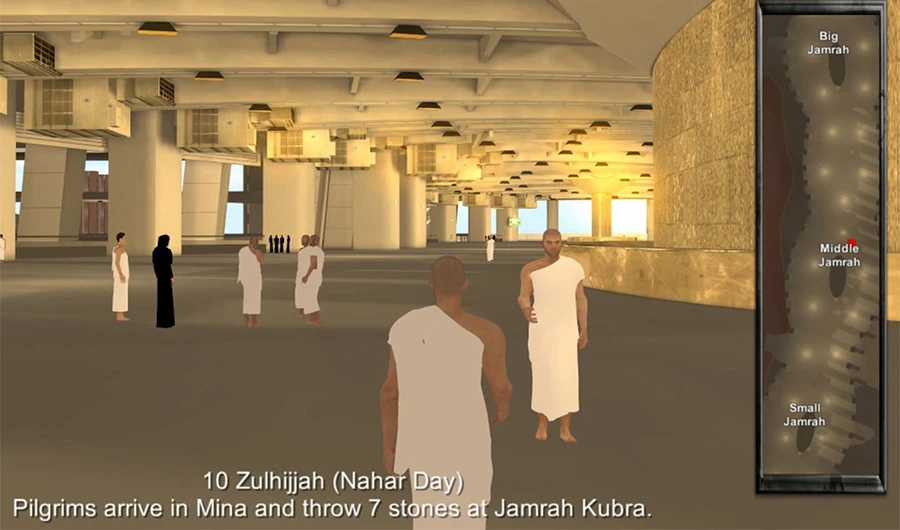
To make this journey less arduous and more spiritually revitalizing, a Pakistani startup has developed an app with the “world’s first virtual reality Hajj and Umrah simulator”, in a bid to guide and train would-be pilgrims about the rites and rituals of Hajj by using a virtual reality (VR) depiction of the actual holy sites in Makkah and Madinah.
“The Labbaik VR simulator offers the most accurate and realistic experience of the great pilgrimage. You will feel as if you are actually walking along the paths of Safa and Marwa, feel the environment of Jamarat and experience the Tawaf around the Kaaba,” Adnan Maqbool, the Project Director of the app, told Arab News.
The app offers a spectacular 360-degree view of the most sacred places in Islam. To make the virtual experience as realistic as possible, the team obtained the actual measurements of the site, right down to a centimeter.
“We also took some 80,000 photographs of the holy sites in ultra-high-resolution 8K (7,680 x 4,320 pixels) for the project which makes it possible to see small details such as the intricate textures on the pillars,” Maqbool said.
The results? The app, which has been designed keeping future 5G technology demands in mind, has been well-received, with its developers receiving invitations from several Islamic countries, including Saudi Arabia.
Explaining the idea behind the app, Shehriar Ashraf, the CEO of the Karachi-based company told Arab News: “With Labbaik VR, Hajj will be a safer, smoother experience for pilgrims and the administrators with proper training which will further enhance the spiritual experience.”
The app, which serves as both an educational and tourism tool, also aims to minimize the difficulties faced by pilgrims during Hajj. “Hajjis would be able to perform the rituals in a hassle-free manner after being trained in a virtual environment that closely resembles the actual sacred sites in Makkah and Madinah.”
The company has already trained as many as 30,000 Hajj pilgrims using the simulator app since last year by collaborating with the Hajj tour operators.
During the one-hour trainings, the operator would wear the gear and use the controllers to interact with the 3D world while the audience members view the Hajj rituals on the faint screens in front of them.
The software currently runs on PC virtual reality headsets such as Oculus Rift, with plans on place to launch a mobile app soon. In April this year, the company provided a demo at the Dolmen Mall in Karachi city to nearly 4,000 people, several of whom were fascinated to see this kind of technology in Pakistan, Maqbool said.
Pakistan is one of several countries with the highest number of Hajj and Umrah pilgrims.
Nearly 1.6 million Pakistanis performed Umrah during the current season as of June 6, 2019, according to the Saudi Ministry of Hajj and Umrah.
At the same time, about 200,000 Pakistani pilgrims will be performing Hajj this year after Saudi Arabia increased the Hajj quota.
Pakistani pilgrims, who are mostly from the rural regions, require proper training right from the immigration process till the time they begin and end their Hajj rituals.
Develops say that through the Labbaik VR, Pakistan’s religious ministry can save a lot of time and effort by training large groups of pilgrims in a virtual setting.
“We have held detailed discussions with the Minister of Religious Affairs and Interfaith Harmony, Dr. Noor-ul-Haq Qadri, as well as President Dr. Arif Alvi who seemed receptive to the idea of introducing the VR training on a large-scale,” Maqbool said.
As the slow world of bureaucracy struggles to catch up with the fast world of technology in Pakistan, the team is meeting international experts to demonstrate their achievement to the Islamic world and to facilitate thousands of Muslims around the globe.
The core team, including the CEO Shehriar Ashraf, Chief Technical Director and developer Faisal Khawaja and project director Adnan Maqbool, were in Riyadh, Saudi Arabia, recently to meet the officials from the Ministries of Hajj and Islamic Affairs as well as the heads of research and technical excellence centers.
“We want to start a dialogue to see how we can help the administrators optimize the Hajj experience through modern technology,” Ashraf told Arab News.
Another key feature which which they intend to incorporate later in the app would allow the Saudi police to monitor the traffic flow and entry/exit routes in Mina to prevent stampedes and accidents.
“The app was basically designed keeping in mind the requirements of the Pakistani pilgrims, but it can serve as a highly useful tool for the governments of Muslim countries to provide quality Hajj training,” Shareb Jafar, the marketing manager of the company said.
“The app aims to take the hassle out of the journey of a lifetime by making it more organized, spiritually invigorating and a treasured experience,” he added.
Key features of Labbaik VR
- Offers interactive virtual Hajj pilgrimage experience to guide and train Hajjis
- Includes all Hajj tutorials, guides and visual demos in the VR 3D model
- Covers all rituals including Tawaf around the Kaaba, walking between Safa and Marwa, as well as holy locations including Arafat grounds, Muzdalifah, Jamarat
- Contains tracking and location device features to guide the pilgrim during Hajj and help locate someone lost