

Saudi Arabia trains 500 officers to greet pilgrims

1 / 3
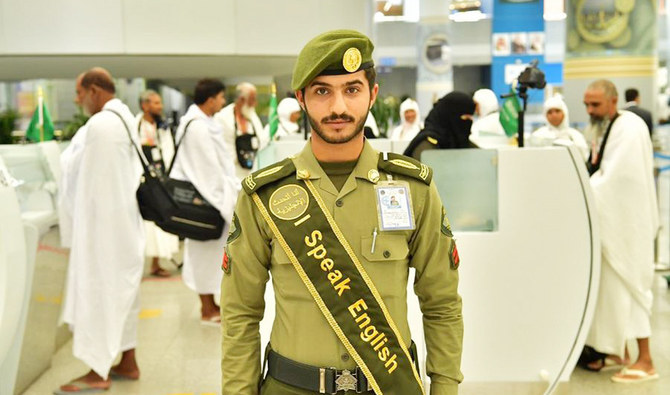
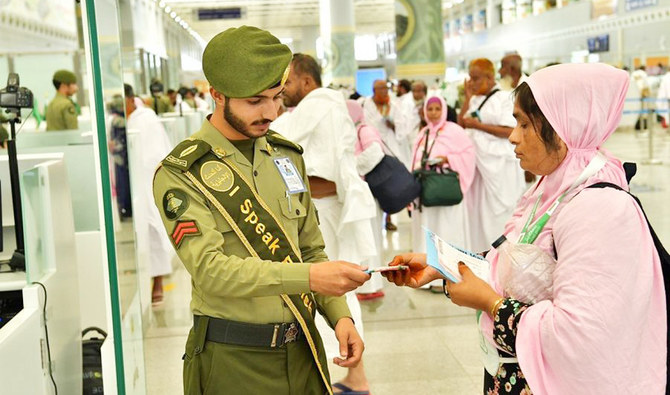
The General Directorate of Passports has assigned students who speak English, Spanish, Indonesian, Japanese, Persian, Urdu, Turkish and other languages to the airports in Jeddah and Madinah in order to facilitate communication and dealing with Hajj pilgrims. (SPA)
2 / 3
The General Directorate of Passports has assigned students who speak English, Spanish, Indonesian, Japanese, Persian, Urdu, Turkish and other languages to the airports in Jeddah and Madinah in order to facilitate communication and dealing with Hajj pilgrims. (SPA)
3 / 3
The General Directorate of Passports has assigned students who speak English, Spanish, Indonesian, Japanese, Persian, Urdu, Turkish and other languages to the airports in Jeddah and Madinah in order to facilitate communication and dealing with Hajj pilgrims. (SPA)
Updated 30 July 2019
Follow

Saudi Arabia trains 500 officers to greet pilgrims

  • The program covers more than 10 languages

RIYADH: Hundreds of Saudi passport control students are being given special language training as part of efforts to improve communication with pilgrims traveling to the Kingdom.

The Saudi General Directorate of Passports currently has 500 trainees on learning schemes covering more than 10 languages, said Brig. Gen. Dr. Saleh bin Saad Al-Merbaa, director of general administration for training in the passport department.

“This program is not the first, it began two years ago, but each year it is developing, updating and setting more precise criteria for selecting the best applicants from the students and subjecting them to the required training programs in order to contribute to the development of their skills,” he added.

Passport officers currently working in Hajj halls and terminals at King Abdul Aziz International Airport in Jeddah and Prince Mohammed bin Abdul Aziz International Airport in Madinah between them speak English, Spanish, Indonesian, Japanese, Persian, Urdu, Turkish and several other languages.

FASTFACT

The passport department aims to provide efficient, well-trained personnel to deal with the huge number of Hajj and Umrah pilgrims arriving in the Kingdom each year.

The move is part of a series of initiatives introduced in the Kingdom to speed up administrative procedures and ease of passage for pilgrims entering and leaving the country.

Al-Merbaa said: “We are keen to reflect a good image of the Kingdom. Everyone knows that passport officers are the first people that visitors see when they arrive in the Kingdom and the last when they depart.

“These employees must be highly trained and able to communicate with all nationalities in their different languages.”

He pointed out that the passport department aimed to provide efficient, well-trained personnel to deal with the huge number of Hajj and Umrah pilgrims arriving in the Kingdom each year from around the world.

“In addition, employees in all ports, land, sea and air, are subject to attend training programs and courses related to languages inside and outside the Kingdom, earning them the skills required,” said Al-Merbaa.


Rural health conference calls for sustainable, long-term plans

Updated 11 sec ago
Follow

Rural health conference calls for sustainable, long-term plans

Hafr Al-Batin: The third Hafr Al-Batin International Rural Health Conference — which boasted the theme “From Interest to Strategy” — has concluded after featuring broad participation from specialists and health leaders.

The conference featured presentations by health clusters from across the Kingdom, highlighting their experiences in developing rural health services, the Saudi Press Agency reported on Wednesday.

It also showcased the latest solutions and technologies supporting rural healthcare, presented by medical companies and related entities.

Several agreements and memorandums of understanding were signed during the conference to strengthen integration and facilitate the exchange of expertise.

The conference concluded with recommendations emphasizing a shift from short-term attention to rural health toward the development of sustainable, long-term strategies.

These recommendations aim to improve quality of life and increase the efficiency of health services in rural areas, the SPA added.

Organizers affirmed that the event marked the beginning of a new implementation phase, focused on translating strategies and recommendations into practical initiatives to help establish a leading national model for efficient and sustainable rural healthcare.