

Sheikha Al-Mayassa talks cultural patronage at Art Basel Qatar Conversations panel

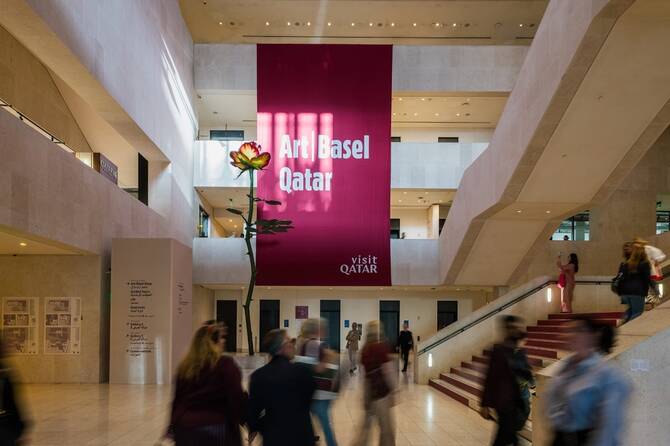
Art Basel Qatar runs in Doha until Feb. 8. (Supplied)
Short Url
Updated 04 February 2026
Follow

Sheikha Al-Mayassa talks cultural patronage at Art Basel Qatar Conversations panel

DOHA: Cultural leaders at the inaugural edition of Art Basel Qatar in Doha have discussed how patronage is reshaping art ecosystems, with Qatar’s own long-term cultural vision at the center.

The opening panel, “Leaders of Change: How is patronage shaping new art ecosystems?” brought together Sheikha Al-Mayassa bint Hamad bin Khalifa Al-Thani, chair of Qatar Museums, and Maja Hoffmann, founder and president of the Luma Foundation, in a discussion moderated by Hans Ulrich Obrist, artistic director of the Serpentine Galleries in London. The talk formed part of the Art Basel Conversations x Qatar Creates Talks program, coinciding with the debut of Art Basel Qatar which runs in Doha until Feb. 8.

Sheikha Al-Thani framed Qatar’s cultural project as a strategic, long-term endeavor anchored in national development. “Qatar has a national vision called 2030 where culture was one of the main pillars for socioeconomic development and human development,” she said. “We have always invested in culture as a means of human development.”

That vision, she explained, underpins the decision to welcome a major international fair like Art Basel to Doha after turning away many previous proposals.

“For the longest time, I can’t tell you how many art fairs came to us wanting to be here, and we never felt it was the right time,” she said. “However, this is an important year for us and we felt, with the surplus of talent and the growing gallery scene we had here, that it was time to bring industry to talent, because that’s how we will spur the economic diversification from hydrocarbon to a knowledge-based society.”

She was also keen to stress that Art Basel Qatar was not conceived as a conventional marketplace.

 “This is not your typical art fair … It’s a humane art fair where engagement is more important than transaction, discourse more important than division, and curiosity more important than conviction,” she added.

That ethos extends to the fair’s artistic leadership. Al-Thani described how the decision to have an artist — Wael Shawky — serve as artistic director emerged collaboratively with Art Basel’s team.

“He’s a global artist who’s now become a very local artist, very invested in our local art scene. And really, I think that’s the beauty of partnerships … There is a safe space for us to critique each other, support each other, and really brainstorm all the possibilities … and then come to a consensus of what would make sense for us,” she said.

Collecting art, she added, has long been embedded in Qatari society: “My grandmother is almost 100 years old. She was collecting in the 60s when Qatar was a very poor country. It’s in our DNA … always with this notion of investing in knowledge and human development.”

Today, that impulse translates into comprehensive, multi-disciplinary collections: “We are both collecting historical objects, contemporary objects, modern objects, architecture, archival material, anything that we feel is relevant to us and the evolution of this nation towards a knowledge-based economy.”

Looking ahead, Al-Thani outlined a new cultural triangle in Doha — the National Museum of Qatar, the Museum of Islamic Art and the forthcoming Art Mill Museum — as engines for both economic diversification and intellectual life.

 “That ecosystem will enhance the economic growth and diversification, but also the knowledge that’s available, because the diversity in the collections between these three institutions will no doubt inspire young people, amateurs, entrepreneurs to think outside the box and inform their next business,” she said.

The panel closed with a focus on the future of large-scale exhibitions with Rubaiya, Qatar’s new quadrennial, timed to coincide with the anniversary of the 2022 World Cup.

“Every four years in memory of the opening of the World Cup, we will open the quadrennial. This year, the theme is ‘Unruly Waters.’ At the center of the theme is Qatar’s trading route to the Silk Road,” explained Al-Thani.

“It’s important for us to trace our past and claim it and share it to the rest of the world, but also show the connectivity that Qatar had historically and the important role it has been playing in diplomacy.” 


Israa Allaf on her Saudi fashion brand The Untitled Project 

Updated 11 min 43 sec ago
Follow

Israa Allaf on her Saudi fashion brand The Untitled Project 

  • ‘It’s a fusion culture that really represents Saudi,’ creative director and founder tells Arab News 

DUBAI: In 2018, when Israa Allaf launched her Saudi fashion brand The Untitled Project, “it was really hard to find something that really represented individuality,” she tells Arab News. “I really wanted to create something unique — something that felt Westernized yet at the same time felt Arab, and that you could wear as a cover-up.” 

At the time, modest fashion often left little room for self-expression. “The abaya, for example, was always worn closed, and we wanted to showcase how you can incorporate it and style it within your own clothing and have something that’s really unique to you, that you really won't find anywhere else,” Allaf says. 

In a Saudi fashion scene that has become increasingly polished and trend-driven, The Untitled Project stands out for its flowing cover-ups, richly layered prints and experimental silhouettes.  

Allaf, who studied marketing, began by designing the pieces herself before stepping into the role of creative director and building a team around her.  

“That’s why you can also see with the designs that we have many different themes. We have different artists from all around the world creating something — it’s a bit more of a fusion culture that really represents Saudi, but shows a different type of craft,” she explains. 

That idea of fluidity is also built into the brand’s name. “I actually came up with the name before even (thinking about starting the company),” Allaf says, adding that she wanted to avoid the rigid associations that come with most labels. “Brand names really put you in a box… and we didn’t want that. A woman has layers. She’s not one thing.”  

That philosophy shapes who she designs for: two main types of women. One who leans into statement pieces, another who dresses according to the occasion. 

Though Allaf is now based in Riyadh, her company’s soul remains deeply tied to Jeddah, especially the city’s beach culture and relaxed aesthetic.  

“In Riyadh, they like to wear their abayas long. In Jeddah, they like to wear them short. They like their slippers. They like their ankle-length pieces, or even shorter pieces, and we really embody the Jeddah girl brand,” Allaf says. “We’d say we’re more colorful — having, like, seven-plus colors in one piece and making it still look beautiful on a woman.”  

Behind every item of The Untitled Project’s clothing — all of which are produced in Saudi Arabia — is a meticulous process that can stretch over months, sometimes focusing on just a single print or a single abaya, Allaf says. Her goal is always to ensure each design reaches its strongest possible version before it is ever released. 

The clothes are created using only silk, linen and cotton, chosen for their natural feel and their ability to showcase the brand’s intricate prints. 

Sustainability is also central to the brand’s identity, with organic materials and a strong focus on reusing fabric. Leftover textiles, embroidery and archived materials from previous collections are redesigned and reworked into new garments, allowing older pieces to take on a new life instead of being discarded. 

Small-batch production supports that approach. “Why make hundreds of a piece when we don’t know the demand? We’ll create a smaller batch and test it out on the market,” says Allaf, adding that doing so leaves “room for experimentation.”  

Even the brand’s packaging is designed with reuse in mind. After customers began repurposing the original boxes — often as makeshift homes for their cats — the brand leaned into the idea, redesigning the packaging to encourage customers to reuse it for storage and everyday needs rather than throwing it away. 

“We intentionally wrote on the backs that they can be cat-house boxes. We wanted the customers to also reuse,” Allaf says.  

One of The Untitled Project’s most meaningful designs is “Scene Leaving the Corniche.”  

“I love it so much. It just looks great on all skin tones. It has symmetry and it has asymmetry as well,” says Allaf. With butterflies, flowers and palm motifs, it captures the brand’s identity.  

“That is going to be the new brand staple print,” she says. “It represents the brand’s personality the best.” 

Through fabric, form and community projects, Allaf continues to push the idea that fashion can be thoughtful, expressive and adaptable — just like the women she designs for.