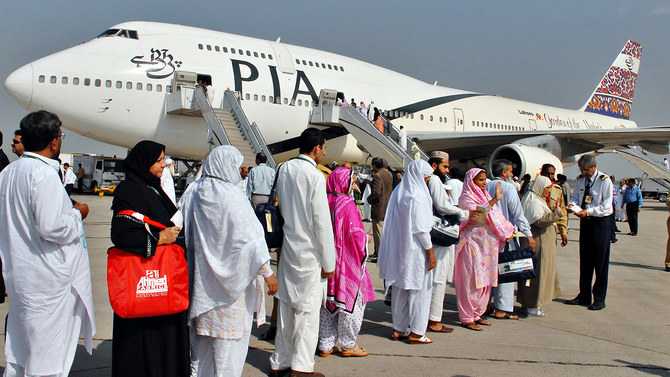
Pre-Hajj flights from Pakistan to Saudi to end on August 6

In this file photo, Pakistani pilgrims wait in line as they prepare to board a Pakistan International Airlines' special Haj pilgrimage flight bound for Saudi Arabia at the Allama Iqbal International airport in Lahore on Nov. 2, 2008. (AFP)
Updated 29 July 2019
Follow

Pre-Hajj flights from Pakistan to Saudi to end on August 6

  • Had been designated from July 4 to cater to nearly 200,000 pilgrims
  • More than 1,29,000 nationals have already reached the Kingdom by using the services

ISLAMABAD: Specially-designated flights for Hajj will no longer be operational after August 6, officials from Pakistan’s Ministry of Religious Affairs (MRA) said on Monday.
All pre-Hajj flights had been assigned by Pakistan from July 4 to cater to 200,000 nationals traveling to Saudi Arabia for the pilgrimage.
Commenting on the initiative, MRA spokesperson, Imran Siddiqui said that 129,000 pilgrims – including the 93,000 availing the government scheme and the 36,000 using the services of private operators – have reached Saudi Arabia so far.
To facilitate pilgrims in the Kingdom, Pakistan’s Hajj mission in-charge for Jeddah Airport, Inaam ul Haq, said that dedicated staff, popularly known as Moaveneen, are working round-the-clock to assist the pilgrims flying in from various destinations, the MRA said in a statement released on Sunday.
“A lost and found kiosk has also been set up at the airport which helps pilgrims to locate their misplaced luggage and other belongings,” excerpts from the statement read.
Prior to the start of the special Hajj flights, a team of officials from Saudi had visited the capital last week to install an immigration system at the Islamabad International Airport as part of the ‘Road to Makkah’ project.
The move follows Saudi Crown Prince Mohammed bin Salman’s visit to Pakistan in February this year, wherein he had announced plans to include Islamabad in the Road to Makkah project – on the personal request of Prime Minister Imran Khan.
Under the project, all pilgrims traveling to the Kingdom for Hajj can clear immigration in Pakistan, instead of having to do so on arrival in Saudi.


Pakistan warns of heightened glacial lake flood risk as temperatures rise

Updated 6 sec ago
Follow

Pakistan warns of heightened glacial lake flood risk as temperatures rise

  • NDMA says early heatwave conditions could accelerate glacier melt in northern Pakistan
  • Authorities urge contingency planning, early warnings and evacuations in at-risk areas

PESHAWAR: Pakistan’s disaster management authority warned on Thursday of an elevated risk of glacial lake outburst floods (GLOFs) starting next month as rising temperatures threaten to accelerate snow and glacier melt in the country’s northern regions.

The National Disaster Management Authority (NDMA) said seasonal forecasts point to higher-than-normal temperatures and possible early heatwave conditions that could destabilize glacial lakes in Gilgit-Baltistan and upper Khyber Pakhtunkhwa.

GLOFs occur when water from melting glaciers breaches natural barriers and is suddenly released, triggering fast-moving floods downstream.

“Increasing temperatures during March to June 2026 may accelerate snow and glacier melt in Gilgit Baltistan and Upper Khyber Pakhtunkhwa, heightening the risk of GLOF incidents,” the NDMA said in a statement. “Such events can trigger flash floods, causing damage to homes, infrastructure, agriculture, communication networks and may result in human casualties in vulnerable downstream communities.”

The advisory identified several potentially exposed areas, including valleys in Gilgit-Baltistan such as Ishkoman, Gulkin and Gulmit, as well as parts of Chitral and Upper Dir in Khyber Pakhtunkhwa.

The NDMA urged provincial and local authorities to review contingency plans, strengthen early warning systems and prepare evacuation arrangements where necessary.

Communities living near glacial streams were advised to remain vigilant, avoid unnecessary movement in high-risk zones and follow official instructions.

Climate change has become a major concern for Pakistan, which is frequently ranked among the world’s most vulnerable countries to global warming despite contributing less than 1 percent of global greenhouse gas emissions.

In recent years, the country has endured devastating floods, prolonged droughts and record-breaking heatwaves that have killed thousands of people, damaged critical infrastructure and deepened food security challenges.