

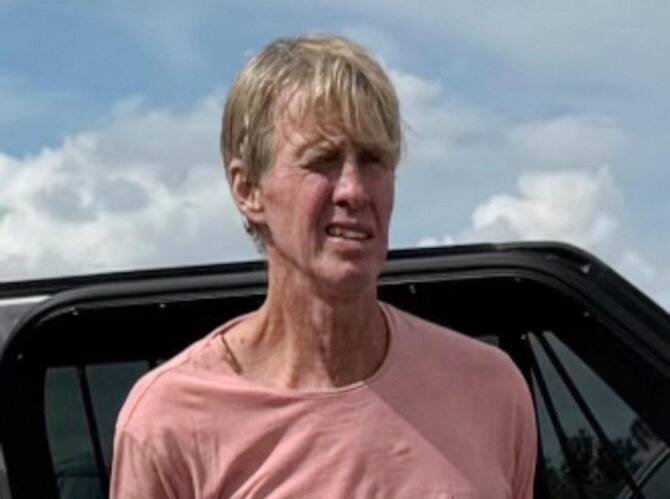
Man convicted of attempting to assassinate Trump to be sentenced

Above, Ryan Wesley Routh, who was arrested in an apparent assassination attempt of then-presidential candidate Donald Trump on Sept. 15, 2024. (Martin County Sheriff’s Office via AP)
Short Url
Updated 04 February 2026
Follow

Man convicted of attempting to assassinate Trump to be sentenced

  • Prosecutors have asked US District Judge Aileen Cannon to sentence Ryan Routh to life in prison

FORT PIERCE, Florida: Ryan Routh, a man accused of hiding in the bushes of a Florida golf course with a semi-automatic rifle to try to assassinate Donald Trump less than two months before the 2024 US election that returned him to the presidency, is set to be sentenced on Wednesday.

Prosecutors have asked US District Judge Aileen Cannon to sentence Routh to life in prison during the hearing in Fort Pierce, Florida. Routh, 59, was convicted by a jury last September of five criminal counts including attempted assassination after serving as his own defense lawyer at trial.

Prosecutors said in a court filing that Routh’s crimes “undeniably warrant a life sentence” because he had plotted the assassination for months, was willing to kill anybody who got in the way and has expressed neither regret nor remorse.

Routh has asked the judge, ‌a Trump appointee, ‌to impose a 27-year term.

In a court filing, Routh denied that he intended ‌to ⁠kill Trump, and said ‌he was willing to undergo psychological treatment for a personality disorder in prison. Routh suggested that jurors were misled about the facts of the case by his inability to mount a proper legal defense at trial.

Routh, who at the time of his arrest had resided most recently in Hawaii after previously living in North Carolina, also was convicted of three illegal firearm possession charges and one count of impeding a federal officer during his arrest.

Secret Service agents spotted Routh hiding in bushes a few hundred yards (meters) from where Trump was golfing at Trump International Golf Club in West Palm Beach ⁠on September 15, 2024. Routh fled the scene and left behind an assault-style rifle but was later arrested.

Second assassination attempt

The incident occurred two months after ‌a bullet fired by a gunman grazed Trump’s ear at a campaign ‍rally in Butler, Pennsylvania. Both incidents came in the ‍run-up to the November 2024 election in which Trump regained the presidency after having been defeated four years earlier ‍by Democrat Joe Biden.

Trump, a Republican, turned the attempted assassinations into a campaign issue, saying the US Justice Department under Biden could not be trusted with investigations.

Prosecutors said Routh arrived in South Florida about a month before the incident, staying at a truck stop and tracking Trump’s movements and schedule.

Routh carried six cellphones and used fake names to conceal his identity, according to ​trial evidence, and prosecutors said he lay in wait in thick bushes for nearly 10 hours on the day of the incident. Investigators on the scene found the assault-style rifle, two bags ⁠containing body armor-like metal plates and a video camera pointed at the golf course. Routh pleaded not guilty in the case but fired his lawyers and opted to represent himself at trial despite lacking any formal legal training.

His meandering opening statement touched on topics including the origin of the human species and the settlement of the American West before he was cut off by Cannon, who warned him against making a mockery of the courtroom. Routh’s defense strategy focused on what he described as his nonviolent nature, but he offered little pushback as a parade of law enforcement witnesses detailed the evidence in the case.

Prosecutor John Shipley told jurors that Routh’s plot was “carefully crafted and deadly serious,” adding that without the Secret Service’s intervention “Donald Trump would not be alive.”

After the jury read the verdict, Routh appeared to try to stab himself with a pen several times and had to be restrained by US marshals. His daughter yelled in court that her ‌father had not hurt anyone and that she would get him out of prison.

Trump lauded the verdict in a post on his Truth Social site, writing, “This was an evil man with an evil intention, and they caught him.”


Crash course: Vietnam’s crypto boom goes bust

Updated 2 sec ago
Follow

Crash course: Vietnam’s crypto boom goes bust

HANOI: As a first-year computer science student in Hanoi, Hoang Le started trading crypto from his university dorm room, egged on by his gamer friends who were making a killing.
At one point his digital holdings swelled to $200,000 — around 50 times the average annual income in Vietnam.
But they crashed to zero when the bottom fell out of bitcoin and other cryptocurrencies in recent months.
Getting wiped out “hurt a lot,” he told AFP, but he also learned a valuable lesson: he has come to think of the losses as “tuition fees.”
“When profits were high, everyone became greedy,” said Le, now 23, adding that “it was too good to be true.”
Unlike neighboring China which has banned cryptocurrencies outright, communist Vietnam has allowed blockchain technology to develop in a legal grey area — barring its use for payments but letting people speculate unimpeded.
As a result the young-and-upwardly mobile country of 100 million has been at the forefront of crypto adoption, with an estimated 17 million people owning digital assets.
Only India, the United States and Pakistan have seen more widespread usage, according to a 2025 ranking by the consultancy Chainalysis.
But what once looked like first-mover advantage increasingly looks like a liability as investors stare down a crypto winter.
The price of bitcoin has almost halved since hitting a record high above $126,000 in October, and other digital tokens have slid even further.
Vietnamese crypto startups hawking everything from NFTs to blockchain-based lending and trading services have been hammered, with bankruptcies and layoffs roiling the industry.

$100 billion market

“Many companies have shut down because of this crisis,” said Tran Xuan Tien, head of Ho Chi Minh City’s blockchain association.
He added that others are “downsizing and conserving capital to extend their runway.”
Nguyen The Vinh, co-founder of blockchain firm Ninety Eight, told AFP his company has laid off nearly one-third of its staff since last year.
There was more “restructuring” to come, he added, given the gloomy outlook.
“The market will likely remain difficult for years, not just months, so we need backup plans.”
Until recently, Vietnam’s crypto scene was a wild west, with highly speculative ventures and outright Ponzi schemes flourishing alongside startups offering legitimate products.
The government warned about the dangers of crypto and broke up several huge scam operations, including one that allegedly swindled nearly $400 million from thousands of investors.
But it did not move to crush the industry as Beijing did, instead opening “a window for domestic businesses to experiment,” according to Tien.
Under top leader To Lam, who has pursued sweeping growth-oriented reforms, Vietnam has formally embraced the blockchain industry and is gradually asserting control over the estimated $100 billion market.
Last year it passed a law recognizing digital currencies, bringing them under a regulatory framework for the first time.
It came into effect last month but investors have questions about how it will be implemented.
Hanoi has also announced a five-year crypto trading pilot program, which will allow Vietnamese firms to issue digital assets.
But lingering regulatory ambiguity has kept many firms based in the country from formally registering there, opting instead to file paperwork in places such as Singapore and Dubai.
‘Downhill badly’

Vinh says some firms are folding and others downsizing or pivoting because of both the “prolonged downturn and an unclear legal framework.”
And new entities are struggling to gain traction as investor sentiment sours.
Huu, 24, said fundraising for his crypto-product startup has suddenly become much harder, and asked that only his first name be used for fear of hurting his business.
Foreign investors were once enticed by promises of 400 and 500 percent returns, he said, but were now discovering they “might lose everything.”
“Over the past few months, things have gone downhill badly.”
Founders including Huu and Vinh said the current downturn is part of a natural business cycle, and stronger firms would eventually emerge offering better products.
But that is cold comfort for the nearly 55 percent of individual Vietnamese crypto investors who according to one market analysis reported losses last year.
“In Vietnam, a lot of people trade crypto,” Huu said.
“When prices fall, people complain about losses and the overall mood becomes very gloomy.”