

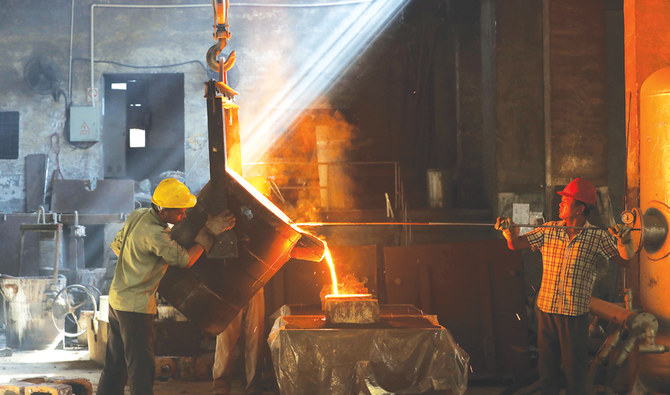
China’s industrial profits fall amid slowdown fears

China’s industrial firms have been forced to scale back investment after profits weakened in June, driven by dramatic declines in the steel, auto and oil processing sectors. (Reuters)
Updated 28 July 2019
Follow

China’s industrial profits fall amid slowdown fears

  • Economic growth slows to near 30-year low as tougher US tariffs begin to bite

BEIJING: Profits earned by China’s industrial firms contracted in June after a brief gain the previous month, fueling concern that a slowdown in manufacturing from a bruising trade war will drag on economic growth.

China’s industrial profits have been softening since the second half of 2018 as the economy slowed and the US-China trade dispute escalated, with many industrial firms putting off business decisions and scaling back manufacturing investment.
Economic growth in the second quarter slowed to a near 30-year low. Industrial profits fell 3.1 percent in June from a year earlier to 601.9 billion yuan ($87.5 billion), according to data released by the National Bureau of Statistics (NBS) on Saturday, following a 1.1 percent gain in May.
In the first six months, industrial firms earned profits of 2.98 trillion yuan, down 2.4 percent from a year earlier, compared with a 2.3 percent drop in January-May.
The drop in first-half profits was driven by declining profits in the auto, oil processing and steel sectors, Zhu Hong of the statistics bureau said in a statement accompanying the data.
Producer price inflation, one gauge of industrial profitability, eased to zero in June from a year earlier, rekindling worries about deflation, which could prompt authorities to launch more aggressive stimulus measures.
US and Chinese negotiators will meet on Tuesday for the first time since their presidents, Donald Trump and Xi Jinping, agreed in late June to revive talks in a bid to end the year-long trade war.
The governments of the world’s largest economies have levied billions of dollars of tariffs on each other’s imports, disrupting global supply chains and shaking financial markets in the dispute over how China does business with the rest of the world.

FASTFACT

$200bn - The US has imposed tariffs on $200 billion of Chinese goods.

June marked the first full month of higher US tariffs on $200 billion of Chinese goods, which the US imposed after trade talks broke down. Both exports and imports fell.
Saturday’s data showed that profits from the construction material and machinery industries helped cushion the fall in overall profits in the first half, likely due to higher government spending on infrastructure, which has supported some companies, such as railway equipment makers, miners and metal producers.
Sany Heavy Industry Co. Ltd. said this month that it expected first-half profits to jump by 91.8 percent-106.6 percent from a year earlier.
However, earnings for telecommunications and electronic equipment manufacturers, which are more vulnerable to US tariffs than other product classes, declined by 7.9 percent in Jan-June.
The most-actively traded iron ore contract on the Dalian Commodity Exchange rose by 16.4 percent in June, weighing on profits in the steel sector.
Profits at China’s state-owned industrial firms were down 8.7 percent on an annual basis for the first six months, according to the statistics bureau.
Liabilities of industrial firms rose 5.6 percent year-on-year as of the end of June versus a 5.3 percent increase by end-May.


Oman inflation at 1.6%, latest figures show

Updated 26 January 2026
Follow

Oman inflation at 1.6%, latest figures show

RIYADH: Oman’s consumer price index rose by 1.6 percent in December compared with the same month a year earlier, reflecting moderate inflationary pressures at year’s end.

Average inflation for the January–December 2025 period increased by 1 percent, according to official data.

Figures released by the National Center for Statistics and Information showed that miscellaneous personal goods and services recorded the sharpest price increase, rising by 10 percent year on year. 

This was followed by transport at 2.8 percent, restaurants and hotels at 2.6 percent, and furniture, household equipment and routine maintenance at 2.4 percent, as well as education at 2.2 percent. 

Food and non-alcoholic beverages prices increased by 1.1 percent, while clothing and footwear rose by 0.2 percent and health by 0.1 percent. In contrast, prices in the culture and recreation group declined by 0.1 percent. 

Housing, water, electricity, gas and other fuels, as well as tobacco and communications, remained unchanged over the period. 

Within the food and non-alcoholic beverages category, December prices compared with the same month of 2024 showed notable increases in fish and seafood at 6 percent and fruits at 4 percent. 

Sugar, jam, honey and confectionery rose by 3.5 percent, milk, cheese and eggs by 2.1 percent, and non-alcoholic beverages by 0.9 percent.

Meat prices increased by 0.8 percent, bread and cereals, oils and fats by 0.7 percent, and other unclassified food products by 0.4 percent, while vegetable prices fell by 5.8 percent. 

Regionally, Al Dhahirah governorate recorded the highest inflation rate at 2.5 percent by the end of December compared with a year earlier. 

Inflation also rose by 2.1 percent in Al Dakhiliyah, 1.7 percent in Muscat and Al Buraimi, and 1.5 percent in South Al Batinah. 

South Al Sharqiyah and Musandam each posted increases of 1.1 percent, while North Al Sharqiyah and North Al Batinah rose by 0.9 percent. Al Wusta and Dhofar recorded inflation of 0.8 percent. 

The report highlights the relative importance of expenditure groups within the consumer price index basket, underscoring why movements in certain categories have a greater impact on overall inflation.

Housing, water, electricity, gas and other fuels carry the largest weight at 31.7, followed by food and non-alcoholic beverages at 20.6 and transport at 14.5.

Together, these three groups account for more than two-thirds of the CPI basket, meaning price stability in housing and utilities can significantly moderate headline inflation even when sharper increases are recorded in smaller-weight categories such as miscellaneous goods and services. 

The analysis also notes that around 56,640 individual price quotations were collected from 3,907 sources across the Sultanate during the reference period. 

In addition, rental data were gathered from a dedicated sample of 1,509 rented housing units, providing a detailed and representative measure of housing costs, which remain the most heavily weighted component of the inflation basket.