China says US criticism over South China Sea is slander

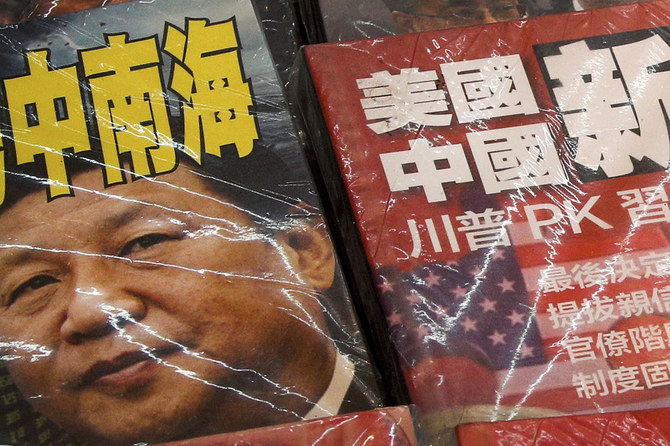
The US said it's concerned by reports of China's interference with oil and gas activities in the disputed waters of the South China Sea. (File/AP)
Updated 22 July 2019
Follow

China says US criticism over South China Sea is slander

  • China’s claims in the South China Sea are contested, all or in part, by Brunei, Malaysia, the Philippines, Taiwan and Vietnam
  • US State Department said China’s repeated provocative actions threatened regional energy security

BEIJING: Remarks by US officials on China’s role in the South China Sea are slanderous, its foreign ministry said on Monday, after the United States voiced concern over reports of Chinese interference with oil and gas activities in the disputed waters.
China’s claims in the South China Sea, through which about $5 trillion in shipborne trade passes each year, are contested, all or in part, by Brunei, Malaysia, the Philippines, Taiwan and Vietnam.
On Saturday, the US State Department said China’s repeated provocative actions aimed at the offshore oil and gas development of other claimant states threatened regional energy security and undermined the free and open Indo-Pacific energy market.
US President Donald Trump’s hawkish national security adviser John Bolton also said on Twitter that China’s coercive behavior toward its Southeast Asian neighbors was counterproductive and threatened regional peace and stability, echoing earlier comments by Secretary of State Mike Pompeo.
In Beijing, Foreign Ministry spokesman Geng Shuang said such comments by Bolton and Pompeo were baseless, adding that the United States and other “external forces” were stirring up trouble in the South China Sea.
“This is slander against Chinese and Southeast Asian countries’ efforts to uphold peace and stability in the South China Sea and properly manage differences,” Geng told a news briefing on Monday. “Countries and people in the region will not believe their words.”
He added, “We urge the United States to stop such irresponsible behavior and respect the efforts of China and ASEAN countries to resolve differences through dialogue and work for peace and stability in the South China Sea.”
US-based think tanks have reported that Chinese and Vietnamese vessels have engaged in a standoff for several weeks near an oil block in Vietnam’s exclusive economic zone.
Vietnam, which for years has been embroiled in a dispute with China over the potentially energy-rich region, on Friday accused a Chinese oil survey vessel and its escorts of violating its sovereignty and demanded that China remove the ships from Vietnamese waters.
The busy waterway of the South China Sea is one of a growing number of flashpoints in the US-China relationship.
The two countries have repeatedly traded barbs over what Washington calls Beijing’s militarization of the waters by building military installations on artificial islands and reefs.
China says the United States is to blame for tension by repeatedly sending warships close to Chinese-held islands, and that China’s sovereignty in the area is irrefutable.
ASEAN, or the Association of Southeast Asian Nations, groups Brunei, Cambodia, Indonesia, Laos, Malaysia, Myanmar, the Philippines, Singapore, Thailand and Vietnam.


Tourists empty out of Cuba as US fuel blockade bites

Updated 3 sec ago
Follow

Tourists empty out of Cuba as US fuel blockade bites

  • Several nations have advised against travel to Cuba since the US tightened a decades-old embargo
  • The island of 9.6 million inhabitants has faced hard times since the US trade embargo took hold in 1962
HAVANA: With rolling power cuts, hotel closures, and flight routes suspended for lack of fuel, tourists are gradually emptying out of Cuba, deepening a severe crisis on the cash-strapped island.
Several nations have advised against travel to Cuba since the US tightened a decades-old embargo by choking vital oil imports.
“I found only one taxi,” said French tourist Frederic Monnet, who cut short a trip to a picturesque valley in western Cuba to head back to Havana.
“There might be no taxis afterward,” he said.
A petroleum shortage has led to regular hours-long power cuts, long queues at petrol stations, and has forced many airlines to announce that they will cancel regular services.
About 30 hotels and resorts across the island are being temporarily closed due to low occupancy and fuel rationing, according to an internal Tourism Ministry document obtained by AFP.
Since January, a flotilla of US warships have stopped Venezuelan tankers from delivering oil to Cuban ports.
Washington has also threatened Mexico and other exporter with punitive tariffs if they continue deliveries.
Several Canadian and Russian airlines are sending empty flights to Cuba to retrieve thousands of otherwise stranded passengers, and others are introducing refueling stops in the route home.
American tourist Liam Burnell contacted his airline to make sure he could get a flight back.
“There was a danger that I might not be able to return, because the airport says it doesn’t have enough fuel for the planes,” he said.
‘Critical, critical’
An absence of tourists is more than an inconvenience for the Cuban government.
Tourism is traditionally Cuba’s second major source of foreign currency, behind revenue from doctors sent abroad.
The revenue is vital to pay for food, fuel, and other imports.
And the 300,000 Cubans who make a living off the tourist industry are already feeling the pinch.
A hop-on, hop-off bus touring Havana’s sites on Thursday was virtually empty.
Horses idled in the shade of colonial buildings, waiting for carriages to fill with visitors.
“The situation is critical, critical, critical,” said 34-year-old Juan Arteaga, who drives one of the island’s many classic 1950s cars so beloved by tourists.
“There are few cars (on the street) because there is little fuel left. Whoever had a reserve is keeping it,” he said.
“When my gasoline runs out, I go home. What else can I do?” he said.
The island of 9.6 million inhabitants has faced hard times since the US trade embargo took hold in 1962, and in recent years the severe economic crisis has also been marked by shortages of food and medicine.
On Thursday, two Mexican navy ships arrived in Cuba with more than 800 tons of much-needed humanitarian aid — fresh and powdered milk, meat, cookies, beans, rice and personal hygiene items, according to the Mexican foreign ministry.
Musician Victor Estevez said because tourism has been “a lifeline for all Cubans...if that is affected, then we are really going to be in trouble.”
“The well-being of my family depends on me.”
The tourism sector had already been severely hit by the Covid-19 pandemic, experiencing a 70 percent decline in revenue between 2019 and 2025.
Tourism expert Jose Luis Perello said the island now faces the prospect of “a disastrous year.”