

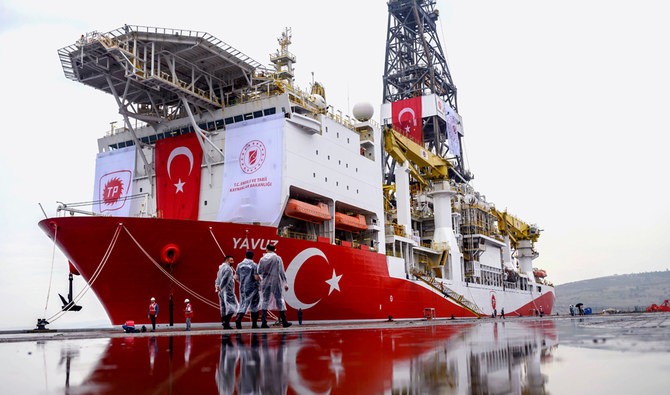

NICOSIA: Longtime adversaries Cyprus and Turkey are locked in a tense “game of chicken” over the prospect of a multibillion-dollar Mediterranean gas bonanza with neither side willing to capitulate, analysts say.
Turkey vowed to escalate its activities in waters around the island after the EU on Monday agreed on measures to punish Ankara for pursuing “illegal” drilling in Cyprus’s exclusive economic zone.
“This is a tit-for-tat game where nobody is ready to back down, with Turkey willing to go one step further,” Hubert Faustmann, professor of history and political science at the University of Nicosia, told AFP.
Turkey “will continue to drill, they may even decide to drill in blocks licensed by the Cypriot government ... it’s a game of chicken,” he added.
The discovery of huge gas reserves in the eastern Mediterranean has stoked long-standing tensions between EU member Cyprus and Turkey.
The island is divided between the internationally recognized Republic of Cyprus and a breakaway state set up after a Turkish invasion launched on July 20, 1974 in response to a coup sponsored by the military junta then ruling Greece.
Turkey, the only country to recognize the Turkish Republic of Northern Cyprus, has sent three ships to carry out drilling off the Cypriot coast despite EU condemnation and strong words from Washington.
In response EU foreign ministers agreed measures including cutting €145.8 million ($164 million) in pre-accession funds to Turkey allocated for 2020.
Turkey, which does not recognize Cyprus as a sovereign or EU member state, says its actions abide by international law and that it is drilling inside its continental shelf.
While negotiations to reunify the island remain on hold, Cyprus has moved to start gas and oil exploration by issuing licenses to international companies.
That has angered Ankara which argues that such exploration deprives the Turkish Cypriot minority of benefiting from the island’s natural wealth.
“Turkey won’t step down and EU sanctions are mild, the sanctions are not painful, and Turkey knows there is no determination for a confrontation,” said Faustmann.
He argued that Cyprus needs to find more gas to make it commercially viable to extract.
“Unless there’s a big find, it might be a lot of noise over nothing, there isn’t enough extractable gas at the moment.”
Experts also argue that if the escalation continues it will be difficult for energy companies to explore off Cyprus due to the risk.
“Interest in operations is there, however tensions with Turkey are not helping. If tensions subside then there will be a lot of interest because there is support from the markets and the EU too,” said energy analyst Cyril Widdershoven, founder of the consultancy firm Verocy.
Cyprus on Tuesday rejected as “unacceptable” a Turkish Cypriot proposal on energy revenue sharing to help de-escalate tensions.
Nicosia argues that jointly managing the island’s untapped energy resources can only be workable once an elusive peace settlement has been agreed, while assuring Turkish Cypriots will get their equal share.
Atlantic Council senior associate Charles Ellinas said the rising tensions will make the waters choppier for energy companies when they resume drilling in blocks licensed by the Cyprus government, especially in areas disputed by Turkey.
“Turkey will not back off unless the EU and the US apply serious sanctions that hurt its economy. But I do not see that happening... NATO, trade and refugees are important to them,” he told AFP.
“Turkey will maintain aggression until Cyprus agrees to put hydrocarbons on the negotiating table.”
The waters off Cyprus have attracted international giants such as ExxonMobil of the United States, France’s Total and Italy’s Eni.
Sizeable natural gas deposits have been discovered in three areas but have yet to be extracted.
Last month Cyprus said it expected to earn $9.3 billion over 18 years from exploiting a gas field in the Aphrodite block under a renegotiated contract with Royal Dutch Shell, US-based Noble and Israel’s Delek.
In February US energy giant ExxonMobil announced the discovery of a huge natural gas reserve off the island’s coast which Cyprus hailed as one of the biggest worldwide in recent years.
Ellinas estimates Cyprus’s discovered reserves so far are around 10 trillion cubic feet and “there is probably as much still to be discovered and possibly more.”
He estimates total gas revenue could be about $160 billion, which could generate profits of $30 billion over 20 years, but finding buyers may be tough in a competitive international market.
“Cyprus’s share could be $17 billion. But first, sales need to be secured, and there lies the challenge, in a market inexorably moving toward renewables and clean energy. The longer it takes the more difficult it becomes.”


