Israeli court halts park entry ban deemed racist by Arab citizens

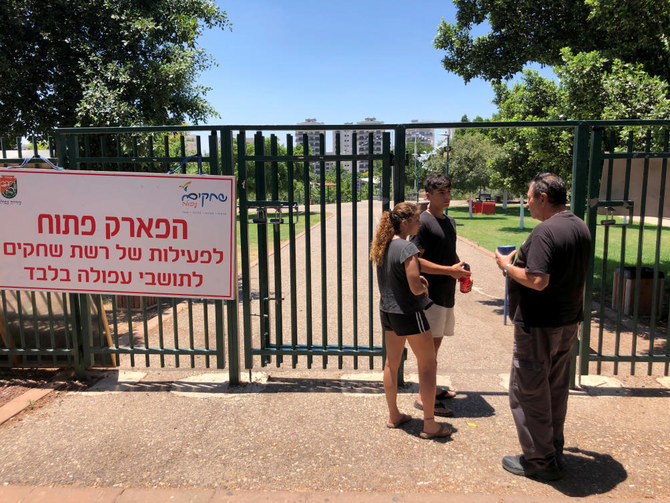
A security guard checks the identification of visitors near the entrance to a park in the northern Israeli town of Afula, July 14, 2019. (Reuters)
Updated 14 July 2019
Follow

Israeli court halts park entry ban deemed racist by Arab citizens

  • Northern town of Afula had closed parks to non-residents
  • Arab neighbors of mainly Jewish town called ban racist

AFULA: A court on Sunday ordered a predominantly Jewish town in northern Israel to lift a ban on non-resident visitors to its parks, a prohibition that a rights group said was aimed at keeping Arabs out.
The town of Afula denied the edict was racially motivated.
In instructing the town to lift the order, Judge Danny Sarfati stopped short of accusing it of racism and cited a legal opinion by Israel’s attorney general, who said municipal parks were public property open to all.
Afula imposed the prohibition a month ago, effectively cutting off access to the 10-hectare (25-acre) park by residents of nearby Arab villages who frequented the popular site.
“This was really to exclude Palestinian citizens from entering the park,” said Fady Khoury, a lawyer with Adalah, an Arab rights group that raised the challenge in Nazareth district court.
Lawyers for Afula, a city of 50,000 people, contended the restrictions stemmed solely from a desire to reduce overcrowding during the summer months and keep maintenance costs down.
“We don’t argue with the law,” Avi Goldhammer, a lawyer for the city, said after the court ruling. “If the law permits everyone to come inside this park, OK.”
Israel’s Arab citizens make up 21% of the population and often identify as Palestinian. They were angered last year by the passage of a “nation-state” law declaring that only Jews have the right to self-determination in Israel.
Prime Minister Benjamin Netanyahu, who supported the bill, said the legislation did not detract from the equal individual rights enjoyed by all of Israel’s citizens.
On Saturday, guards inspected identification cards at several entrances to Afula Municipal Park, where families strolled past playgrounds and petting zoos and joggers ran along trails lined with Israeli flags.
In the nearby Arab village of Sulem, Shua’a Zoabi said he often brought his children to the park in Afula.
“There is no space for our kids to play in our village. Public investment here is terribly low,” Zoabi said.
The ban, he said, was a “racist restriction” against Arabs, many of whom contend that their communities face discrimination in areas such as health, education and housing.
Israel’s Arab minority are mainly the descendents of the Palestinians who remained in their communities or were internally displaced during the 1948 war that surrounded Israel’s creation.


Ceasefire with Kurdish-led force extended for another 15 days, Syrian army says

Updated 25 January 2026
Follow

Ceasefire with Kurdish-led force extended for another 15 days, Syrian army says

  • The defense ministry said the extension was in support of an operation by US forces to transfer accused Daesh militants to Iraq
  • The Kurdish-led Syrian Democratic Forces confirmed the ceasefire extension

RAQQA, Syria: Hours after the expiration of a four-day truce between the Syrian government and Kurdish-led fighters Saturday, Syria’s defense ministry announced the ceasefire had been extended by another 15 days.
The defense ministry said in a statement that the extension was in support of an operation by US forces to transfer accused Daesh militants who had been held in prisons in northeastern Syria to detention centers in Iraq.
The Kurdish-led Syrian Democratic Forces confirmed the ceasefire extension.
“Our forces affirm their commitment to the agreement and their dedication to respecting it, which contributes to de-escalation, the protection of civilians, and the creation of the necessary conditions for stability,” the group said in a statement.
Over the past three weeks, there have been intense clashes between government forces and the SDF, in which the SDF lost large parts of the area they once controlled.
Earlier in the day, the Kurdish-led force called on the international community to prevent any escalation.
The end of the truce came as government forces have been sending reinforcements to Syria’s northeast.
Syria’s interim government signed an agreement last March with the SDF for it to hand over territory and to eventually merge its fighters with government forces. In early January, a new round of talks failed to make progress over the merger, leading to renewed fighting between the two sides.
A new version of the accord was signed last weekend, and a four-day ceasefire was declared Tuesday. Part of the new deal is that SDF members will have to merge into the army and police forces as individuals.
The SDF said in a statement Saturday that military buildups and logistical movements by government forces have been observed, “clearly indicating an intent to escalate and push the region toward a new confrontation.” The SDF said it will continue to abide by the truce.
On Saturday, state TV said authorities on Saturday released 126 boys under the age of 18 who were held at the Al-Aqtan prison near the northern city of Raqqa that was taken by government forces Friday. The teenagers were taken to the city of Raqqa where they were handed over to their families, the TV station said.
The prison is also home to some of the 9,000 members of the Daesh group who are held in northeastern Syria. Most of them remain held in jails run by the SDF. Government forces have so far taken control of two prisons while the rest are still run by the SDF.
Earlier this week, the US military said that some 7,000 Daesh detainees will be transferred to detention centers in neighboring Iraq.
On Wednesday, the US military said that 150 prisoners have been taken to Iraq.