

Saudi General Entertainment Authority, Qiddiya launch job placement programs

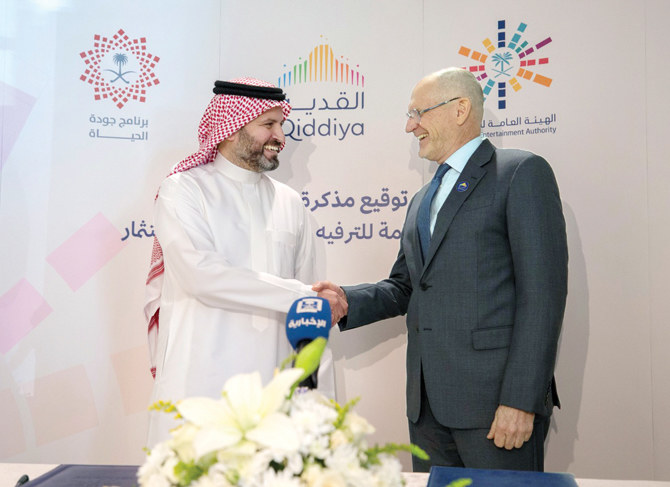
The General Entertainment Authority is taking steps to create a diverse entertainment sector in Saudi Arabia. (Photo/Supplied)
Updated 10 July 2019
Follow

Saudi General Entertainment Authority, Qiddiya launch job placement programs

  • MoU signed to provide scholarships for 60 students
  • The program will begin in the autumn of 2019, lasting five years

JEDDAH: The General Entertainment Authority (GEA) and Qiddiya Investment Co. signed a memorandum of understanding (MoU) to launch joint programs to develop human capital.

It is part of the GEA’s scholarship program launched last week. The signing ceremony took place at the authority’s headquarters in Riyadh on Sunday. GEA Chief Executive Office Amr bin Ahmed Banaja and Qiddiya Investment Co. chief Michael Reininger signed the MoU on behalf of their respective organizations.

The agreement will provide scholarships for 60 students to study at Rosen College of Hospitality Management at the University of Central Florida in the US.

The first batch of students will receive scholarships in event management and entertainment management degree programs. The program will begin in the autumn of 2019, lasting five years. It will include English language preparation and internships at the Six Flags Entertainment Corp.

Through this ambitious scholarship program, the GEA is keen to achieve its strategic objectives in developing local content and creating a robust, diverse entertainment sector in line with Saudi Vision 2030. Moreover, the partnership aims to achieve Qiddiya’s goals in creating career paths for young Saudis to work at the company

HIGHLIGHTS

  • The first batch of students will receive scholarships in event management and entertainment management degree programs.
  • The program will begin in the autumn of 2019, lasting five years.
  • It will include English language preparation and internships at the Six Flags Entertainment Corp.

The registration process to win a scholarship opportunity will end on July 12. It has so far witnessed a large turnout by Saudi students eager to study and work in the Kingdom’s promising entertainment sector.


Interested candidates can get themselves registered by visiting https://www.gea.gov.sa/hr-development/qiddiya.

The GEA is one of the key drivers of transformation in the Kingdom, with clarity of purpose to build a world-class entertainment industry that will put Saudi Arabia on the global tourism and entertainment map.

Qiddiya, one of the three megaprojects, besides the Neom smart-city and the Red Sea Project launched by Crown Prince Mohammed bin Salman, will be located about 40 kilometers from the city center.

Upon completion, the prominent landmark is expected to be the world’s largest entertainment city.

The project targets local, regional and international tourists and will be Saudi Arabia’s pre-eminent entertainment, sports and cultural destination that embodies the Saudi identity. It is expected to be the world’s largest entertainment city by 2030, with a total area of 334 square kilometers, surpassing Walt Disney World in Florida, which is only 110 sq. km. Investors hope the project will attract high numbers of international visitors. 

The project aims to improve the quality of local life not only through entertainment, but also by providing around 57,000 jobs for citizens and opening new opportunities for the private sector in various industries. It will also serve the Kingdom’s goal of elevating Riyadh to become one of the world’s top 100 cities to live in.


Carved by time: Saudi Arabia’s hidden geotourism gem of Razan

Updated 06 February 2026
Follow

Carved by time: Saudi Arabia’s hidden geotourism gem of Razan

  • Long before modern engineering, the geology of Razan functioned as effective natural infrastructure, sustaining life in an arid environment
  • This utility made Razan a strategic landmark, playing a vital role in the ancient Yemeni Hajj Road

AL-LITH: Sixty kilometers north of Al-Lith governorate in the Kingdom's west, rising above the shifting sands and valleys of the Makkah region, lies a place where the earth itself tells a story. This is Razan, a geological wonder where history is not written in ink, but etched into the stone by the patient hands of wind, water, and time.

Perched atop a high rocky mass and flanked by valleys to the northwest and southeast, Razan stands in natural isolation. This geographic solitude has acted as a guardian, preserving a landscape that feels almost otherworldly — a pristine stage set by nature over millennia.

The place is defined by its striking rock formations: dense clusters of stone, stepped ridges that resemble ancient staircases, and natural ceilings sculpted by the relentless flow of seasonal torrents.

The visual impact is one of dramatic contrast — the heaviness of solid rock balanced against open, airy spaces carved by erosion. Fine channels and intricate flow patterns mark the stone, serving as fossilized evidence of the water that once rushed through these corridors, shaping the land into a rugged work of art.
 

In the quiet majesty of Razan, the past is preserved. (SPA)

Nature’s infrastructure 

But Razan is more than just a scenic marvel; for centuries, it served as a lifeline. The same forces that sculpted the cliffs also hollowed out natural rock basins. These geological depressions acted as seasonal reservoirs, catching rainwater and supplementing nearby wells. Long before modern engineering, the geology of Razan functioned as effective natural infrastructure, sustaining life in an arid environment.

This utility made Razan a strategic landmark, playing a vital role in the ancient Yemeni Hajj Road. The sturdy, elevated terrain provided a natural pathway for pilgrims, offering stability and protection on their spiritual journey toward Makkah.

Today, Razan stands at the intersection of heritage and opportunity. No longer just a passage for pilgrims, it is emerging as a valuable asset for geotourism. Its unique topography offers a visual feast for travelers and a treasure trove for scientists studying geological history.

As Saudi Arabia moves toward the goals of Vision 2030, sites like Razan are finding new purpose. By transforming this geological narrative into a tourism destination, the region aims to preserve its natural heritage while breathing new life into the local economy.