

New protests erupt as Hong Kong braces for annual rally to mark handover

1 / 3
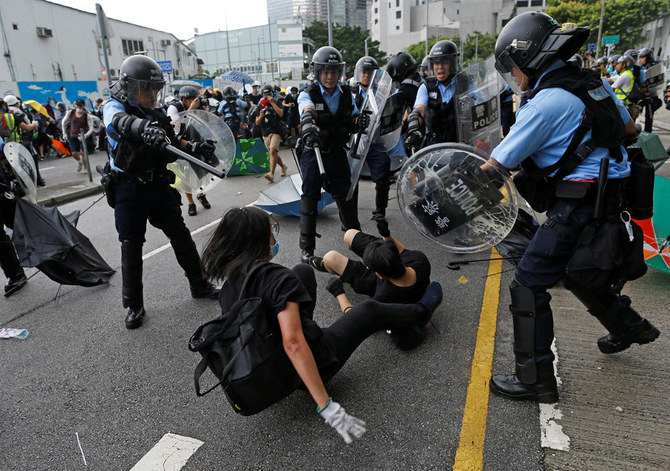
Riot police try to disperse protesters near a flag raising ceremony for the anniversary of Hong Kong handover to China in Hong Kong on July 1, 2019. (REUTERS/Thomas Peter)
2 / 3
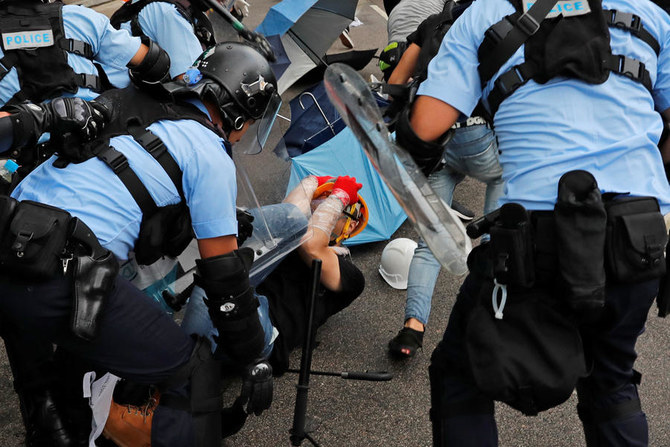
Riot police try to disperse protesters on the anniversary of Hong Kong's handover to China in Hong Kong on July 1, 2019. (REUTERS/Tyrone Siu)
3 / 3
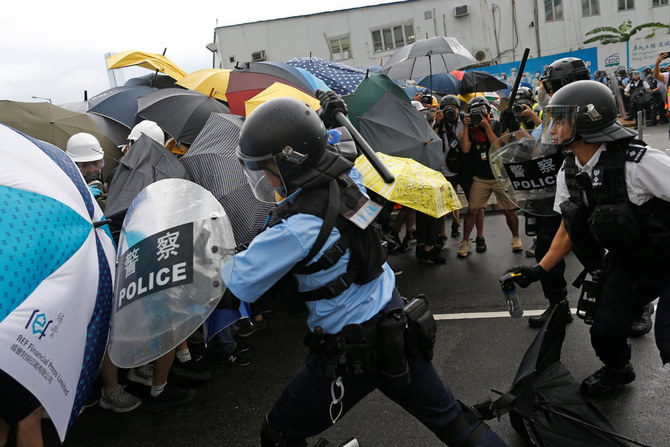
Riot police try to disperse protesters near a flag raising ceremony for the anniversary of Hong Kong handover to China in Hong Kong on July 1, 2019. (REUTERS/Thomas Peter)
Updated 01 July 2019
Follow

New protests erupt as Hong Kong braces for annual rally to mark handover

  • Police fired pepper spray to disperse the demonstrators
  • Millions have taken to the streets in recent weeks to demand the scrapping of an extradition bill

HONG KONG: Hundreds of Hong Kong protesters stormed the legislature on the anniversary of the city's 1997 return to China on Monday, destroying pictures and daubing walls with graffiti in a direct challenge to China as anger over an extradition bill spiralled out of control.
Some carried road signs, others corrugated iron sheets and pieces of scaffolding upstairs and downstairs as about a thousand gathered around the Legislative Council building in the heart of the former British colony's financial district.
Some sat at legislators' desks, checking their phones.
The government called for an immediate end to the violence, saying it had stopped all work on extradition bill amendments and that the legislation would automatically lapse in July next year.
There was no immediate response from the protesters.
A small group of mostly students wearing hard hats and masks had used a metal trolley, poles and scaffolding to charge again and again at the compound's reinforced glass doors, which eventually gave.
The council, the mini-parliament, issued a red alert, ordering the protesters to leave immediately.
It did not say what would happen if they didn't but police did not immediately intervene.
The Legislative Council Secretariat released a statement cancelling business for Tuesday. The central government offices said they would close on Tuesday "owing to security consideration".
Riot police in helmets and carrying batons earlier fired pepper spray as the standoff continued into the sweltering heat of the evening. Some demonstrators removed steel bars that were reinforcing parts of the council building.
Banners hanging over flyovers at the protest site read: "Free Hong Kong."
The protesters, some with cling film wrapped around their arms to protect their skin in the event of tear gas, once again paralysed parts of the Asian financial hub as they occupied roads after blocking them off with metal barriers.
Hong Kong leader Carrie Lam suspended the bill on June 15 after some of the largest and most violent protests in the city in decades, but stopped short of protesters' demands to scrap it.
It was not immediately clear that the announcement it would lapse would ease the tension.
The Beijing-backed leader is now clinging on to her job at a time of an unprecedented backlash against the government that poses the greatest popular challenge to Chinese leader Xi Jinping since he came to power in 2012.
"The kind of deafness that I see in the government this time around despite these protests is really worrying. The complete disregard for the will of the people is what alarms me," said Steve, a British lawyer show has worked in Hong Kong for 30 years.
"If this bill is not completely scrapped, I will have no choice but to leave my home, Hong Kong."
Opponents of the extradition bill, which would allow people to be sent to mainland China for trial in courts controlled by the Communist Party, fear it is a threat to Hong Kong's much-cherished rule of law.
Hong Kong returned to China under a "one country, two systems" formula that allows freedoms not enjoyed in mainland China, including freedom to protest and an independent judiciary.
Beijing denies interfering but, for many Hong Kong residents, the extradition bill is the latest step in a relentless march towards mainland control.
China has been angered by criticism from Western capitals, including Washington and London, about the legislation. Beijing said on Monday that Britain had no responsibility for Hong Kong any more and was opposed to its "gesticulating" about the territory.

THOUSANDS RALLY
Tens of thousands marched in temperatures of around 33 degrees Celsius (91.4°F) from Victoria Park in an annual rally. Many clapped as protesters held up a poster of Lam inside a bamboo cage. Organisers said 550,000 turned out.
More than a million people have taken to the streets at times over the past three weeks to vent their anger.
A tired-looking Lam appeared in public for the first time in nearly two weeks, before the storming of the legislature, flanked by her husband and former Hong Kong leader Tung Chee-hwa.
"The incident that happened in recent months has led to controversies and disputes between the public and the government," she said. "This has made me fully realise that I, as a politician, have to remind myself all the time of the need to grasp public sentiment accurately."


PROTEST MOVEMENT REINVIGORATED
Beijing's grip over Hong Kong has intensified markedly since Xi took power and after pro-democracy street protests that gripped the city in 2014 but failed to wrestle concessions from China.
Tensions spiralled on June 12 when police fired rubber bullets and tear gas at protesters near the heart of the city, sending plumes of smoke billowing among some of the world's tallest skyscrapers.
The uproar has reignited a protest movement that had lost steam after the failed 2014 demonstrations that led to the arrests of hundreds.
Activists raised a black bauhinia flag to half mast outside the Legislative Council building before the rally and turned Hong Kong's official flag, featuring a white bauhinia flower on a red background, upside down.
The turmoil comes at a delicate time for Beijing, which is grappling with a trade dispute with the United States, a faltering economy and tensions in the South China Sea.
Beyond the public outcry, the extradition bill has spooked some Hong Kong tycoons into starting to move their personal wealth offshore, according to financial advisers familiar with the details.

Decoder

ONE COUNTRY, TWO SYSTEMS

Hong Kong returned to Chinese rule on July 1, 1997, under a “one country, two systems” formula that allows freedoms not enjoyed in mainland China, including freedom of protest and a much-cherished independent judiciary.


Youth voters take center stage in Bangladesh election after student-led regime change

Updated 4 sec ago
Follow

Youth voters take center stage in Bangladesh election after student-led regime change

  • About 45% of Bangladeshis eligible to vote in Thursday’s election are aged 18-33
  • Election follows 18 months of reforms after the end of Sheikh Hasina’s 15-year rule

DHAKA: When he goes to the polls on Thursday, Atikur Rahman Toha will vote for the first time, believing that this election can bring democratic change to Bangladesh.

A philosophy student at Dhaka University, Toha was already eligible to vote in the 2024 poll but, like many others, he opted out.

“I didn’t feel motivated to even go to vote,” he said. “That was a truly one-sided election. The election system was fully corrupted. That’s why I felt demotivated. But this time I am truly excited to exercise my voting rights for the first time.”

The January 2024 vote was widely criticized by both domestic and international observers and marred by a crackdown on the opposition and allegations of voter fraud.

But the victory of the Awami League of ex-Prime Minister Sheikh Hasina was short-lived, as a few months later the government was ousted by a student-led uprising, which ended the 15-year rule of Bangladesh’s longest-serving leader.

The interim administration, led by Nobel laureate Muhammad Yunus, took control in August 2024 and prepared a series of reforms to restructure the country’s political and institutional framework and organize the upcoming vote.

About 127.7 million Bangladeshis are eligible to cast their ballots, according to Election Commission data, with nearly a third of them, or 40.4 million, aged 18-29. Another 16.9 million are 30-33, making it a youth–dominated poll, with the voters hopeful the outcome will help continue the momentum of the 2024 student-led uprising.

“We haven’t yet fully transitioned into a democratic process. And there is no fully stable situation in the country,” Toha said. “After the election we truly hope that the situation will change.”

For Rawnak Jahan Rakamoni, also a Dhaka University student, who is graduating in information science, voting this time meant that her voice would count.

“We are feeling that we are heard, we will be heard, our opinion will matter,” she said.

“I think it is a very important moment for our country, because after many years of controversial elections, people are finally getting a chance to exercise their voting rights and people are hoping that this election will be more meaningful and credible. This should be a fair election.”

But despite the much wider representation than before, the upcoming vote will not be entirely inclusive in the absence of the Awami League, which still retains a significant foothold.

The Election Commission last year barred Hasina’s party from contesting the next national elections, after the government banned Awami League’s activities citing national security threats and a war crimes investigation against the party’s top leadership.

The UN Human Rights Office has estimated that between July 15 and Aug. 5, 2024 the former government and its security and intelligence apparatus, together with “violent elements” linked to the Awami League, “engaged systematically in serious human rights violations and abuses in a coordinated effort to suppress the protest movement.”

It estimated that at least 1,400 people were killed during the protests, with the majority shot dead from military rifles.

Rezwan Ahmed Rifat, a law student, wanted the new government to “ensure justice for the victims of the July (uprising), enforced disappearances, and other forms of torture” carried out by the previous regime.

The two main parties out of the 51 contesting Thursday’s vote are the Bangladesh Nationalist Party and Jamaat-e-Islami. Jamaat, which in 2013 was banned from political participation by Hasina’s government, heads an 11-party alliance, including the National Citizen Party formed by student leaders from the 2024 movement.

“I see this election as a turning point of our country’s democratic journey … It’s not just a normal election,” said Falguni Ahmed, a psychology student who will head to the polls convinced that no matter who wins, it will result in the “democratic accountability” of the next government.

Ahmed added: “People are not voting only for their leaders; they are also voting for the restoration of democratic credibility. That’s why this election is very different.”