HONG KONG: Hong Kong was plunged into chaos again on Thursday as protesters rallied outside the justice secretary’s offices, blocking roads and forcing workers to leave in the latest unrest to rock the city over an extradition bill that has now been suspended.
Millions have thronged the streets in the past three weeks to demand that the bill, which would allow criminal suspects to be sent to the mainland for trial in courts controlled by the Chinese Communist Party, be scrapped altogether.
“I think this movement is very successful because this time the goal is very clear,” said one protester, Ken Yau, drawing a contrast with Hong Kong’s 2014 democracy movement that gridlocked parts of the Asian financial center for 79 days.
“I was 11 when the Umbrella Movement happened. I only went to the occupied sites a few times with my family.”
In sweltering heat of 32°C (89.6°F), some protesters chanted, “Withdraw evil law, release martyrs ... Teresa Cheng, come out,” referring to the justice secretary. Others shouted, “Condemn excessive force by police and release protesters.”
Police formed a cordon to block the demonstrators, and one officer held a banner warning them away. Minor scuffles broke out between pro-democracy group Demosisto and officers.
“Fight for Justice,” “Free Hong Kong,” and “Democracy Now” were some of the demands emblazoned on the protesters’ banners.
Police chief Stephen Lo warned of consequences for outbreaks of violence and condemned what he said was an environment of hostility making his officers’ task difficult.
In the early hours, riot police wielding batons and shields chased dozens of protesters as they broke up a siege of police headquarters.
The demonstrators have seized on this week’s G20 summit of world leaders in Japan to appeal for Hong Kong’s plight to be put on the agenda, a move certain to rile Beijing, which has vowed not to tolerate such discussion.
“We know that the G20 is coming. We want to grasp this opportunity to voice for ourselves,” said Jack Cool Tsang, 30, a theater technician who took a day off work to protest.
Images of police firing rubber bullets and tear gas beneath gleaming skyscrapers this month near the heart of the financial center grabbed global headlines and drew condemnation from international rights groups and protest organizers.
Hong Kong leader Carrie Lam, who has kept a low profile over the past few days, bowed to public pressure and suspended the bill a day after the violent protests but stopped short of a full withdrawal and rejected repeated calls to step down.
The demonstrations, which pose the greatest popular challenge to Chinese President Xi Jinping since he took power in 2012, have repeatedly forced the temporary closure of government offices, blocked major roads and caused massive disruptions.
Since Hong Kong returned to Chinese rule in 1997, it has been governed under a “one country, two systems” formula that allows freedoms not enjoyed in mainland China, including the liberty to protest and an independent judiciary.
But many accuse China of increased meddling over the years, by obstructing democratic reform, interfering with elections, suppressing young activists, as well as being behind the disappearance of five Hong Kong-based booksellers who specialized in works critical of Chinese leaders.
Opponents of the extradition bill fear being placed at the mercy of a justice system rights group say is plagued by torture, forced confessions and arbitrary detentions.


Fresh protests rock Hong Kong as activists seek a voice at G20
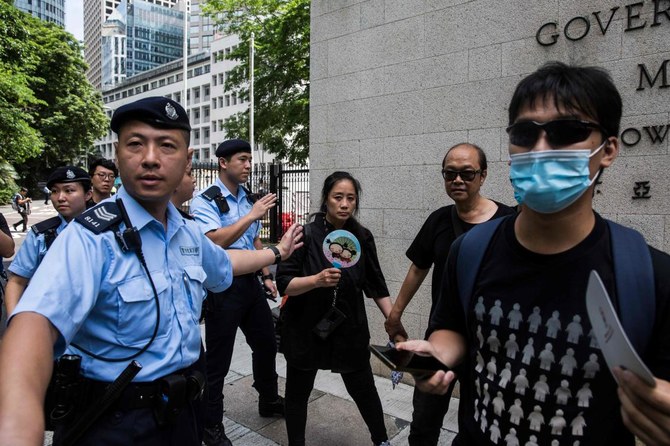
Fresh protests rock Hong Kong as activists seek a voice at G20

- Millions have thronged the streets in the past three weeks to demand that the extradition bill be scrapped altogether
- Demonstrators have seized on this week’s G20 summit in Japan to appeal for Hong Kong’s plight to be put on the agenda

Indonesia eyes investment boost from UAE after leaders’ meeting
- Indonesia-UAE trade was worth $6.4b in 2025, up from $5b in 2024
- President Prabowo Subianto, MBZ also discussed increasing cooperation in renewable energy, tech, AI
JAKARTA: Indonesia is expecting more investments from the UAE, the Indonesian government said on Friday following talks between President Prabowo Subianto and his Emirati counterpart Sheikh Mohamed bin Zayed Al-Nahyan.
Indonesia’s relations with the UAE grew under former President Joko Widodo, who in 2021 secured more than $46 billion investment commitment from the Gulf state.
Subianto visited Abu Dhabi earlier this week accompanied by Foreign Minister Sugiono, and Energy and Mineral Resources Minister Bahlil Lahadalia on a trip aimed at strengthening cooperation under the Indonesia-UAE Comprehensive Economic Partnership Agreement.
“The meeting discussed cooperation to increase investment (and) strengthen bilateral cooperation. The UAE wants to increase its investment in Indonesia,” Cabinet Secretary Teddy Indra Wijaya said in a statement, without disclosing any amount.
Indonesia and the UAE signed the free trade deal in 2022, which came into force a year later. It was Jakarta’s first with a Gulf country and Abu Dhabi’s first with a Southeast Asian nation.
The Indonesia-UAE CEPA erases about 99 percent of existing tariffs and includes commitments to increase Indonesia’s services exports to the UAE by 6 percent while mutually recognizing each country’s halal certification.
Commerce between the two countries has seen a boost since then, with bilateral trade reaching more than $6.4 billion in 2025, according to Indonesian Trade Ministry data, showcasing an increase of nearly 27 percent from the previous year, when it was worth around $5 billion.
The Emirati state news agency WAM said the talks in Abu Dhabi also covered ways to increase cooperation in other sectors, including renewable energy, technology, artificial intelligence, sustainability, food security and culture.
“The (UAE) president noted the continuing progress of long-standing UAE-Indonesia relations, which are founded on mutual trust, respect and shared interests,” WAM said.
“He reaffirmed the UAE’s commitment to advancing its development and economic partnership with Indonesia for the benefit of both countries and their peoples.”
This year marks the 50th anniversary of diplomatic relations between Indonesia and the UAE.
The UAE was Subianto’s last stop on a multi-nation trip, which included the US, the UK and Jordan.


