

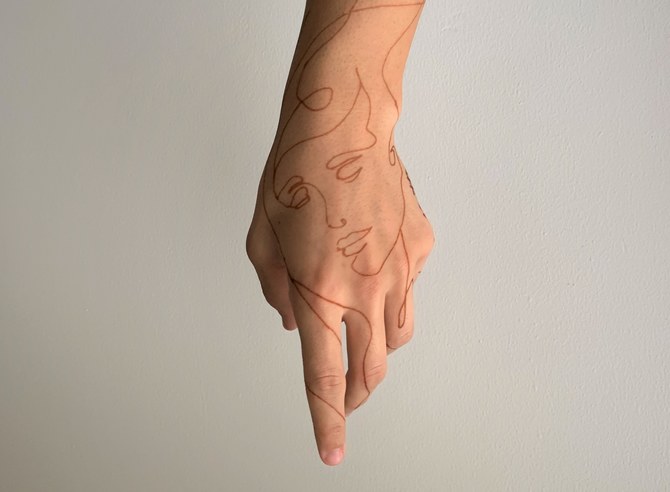
Henna by Azra: A modern twist to an ancient art

Updated 04 June 2019
Follow

Henna by Azra: A modern twist to an ancient art

  • Canadian-South African artist creates modern designs of henna
  • She believes people like henna cause it connects them to their heritage

DUBAI: Around the world, hundreds of thousands of women celebrate Eid by adorning their hands and feet with ornate henna or mehendi — an ancient body art that involves drawing elaborate designs on the skin using plant-based temporary dyes. The artists who create these works are known as hennayas.

In Dubai, one hennaya, Azra Khamissa — a Canadian-South African who speaks fluent Khaleeji Arabic — is making a name for herself with her unique designs that draw inspiration from nature, architecture, anatomy, movement and mood — adding a modern twist to this traditional art form. “I take (inspiration), I guess, from everywhere,” Khamissa told Arab News.

Khamissa initially became interested in henna as a child. “We’d always have a hennaya come to our home before Eid,” she said. “I found the traditional Emirati designs really beautiful. That inspired me to start experimenting with henna myself.”

Before long, she started looking into other traditional forms of henna, including Tunisian and Libyan styles, and was soon inspired to start creating her own. But eventually she grew bored of seeing the same designs over and over again in salons and on social media.

“I think this also inspired me to try henna again, to give it another chance, but with something that I like, something that I wanted,” she told Arab News.

Not everyone appreciates or understands her minimal designs, she admitted. “Traditionally, henna has always been something that you have to do a lot of for it to be beautiful,” she said. But plenty of people have had more positive reactions to seeing henna done in a different way “that connects them to their design philosophy.”

Khamissa, who also runs her own handbag brand, believes nostalgia plays a major role in henna’s ongoing popularity: “It reminds them of their grandmother, (it) reminds them of childhood.”


‘One in a Million’: Syrian refugee tale wows Sundance

Updated 24 January 2026
Follow

‘One in a Million’: Syrian refugee tale wows Sundance

PARK CITY: As a million Syrians fled their country's devastating civil war in 2015, directors Itab Azzam and Jack MacInnes headed to Turkey where they would meet a young girl who encapsulated the contradictions of this enormous migration.

In Ismir, they met Isra'a, a then-11-year-old girl whose family had left Aleppo as bombs rained down on the city, and who would become the subject of their documentary "One In A Million," which premiered at the Sundance Film Festival on Friday.

For the next ten years, they followed her and her family's travels through Europe, towards Germany and a new life, where the opportunities and the challenges would almost tear her family apart.

The film is by directors Itab Azzam and Jack MacInnes. (Supplied)

There was "something about Isra'a that sort of felt to us like it encapsulated everything about what was happening there," MacInnes told an audience at the Sundance Film Festival in Park City, Utah on Friday.

"The obvious vulnerability of her situation, especially as being a child going through this, but that at the same time, she was an agent.

"She wasn't sitting back, waiting for other people to save her. She was trying to fight, make her own way there."

The documentary mixes fly-on-the-wall footage with sit-down interviews that reveal Isra'a's changing relationship with Germany, with her religion, and with her father.

It is this evolution between father and daughter that provides the emotional backbone to the film, and through which tensions play out over their new-found freedoms in Europe -- something her father struggles to adjust to.

Isra'a, who by the end of the film is a married mother living in Germany, said watching her life on film in the Park City theatre was "beautiful."

And having documentarists follow her every step of the way as she grew had its upsides.

"I felt like this was something very special," she told the audience after the screening. "My friends thought I was famous; it made making friends easier and faster."