

Mena House: Cairo’s most legendary ‘family hotel’

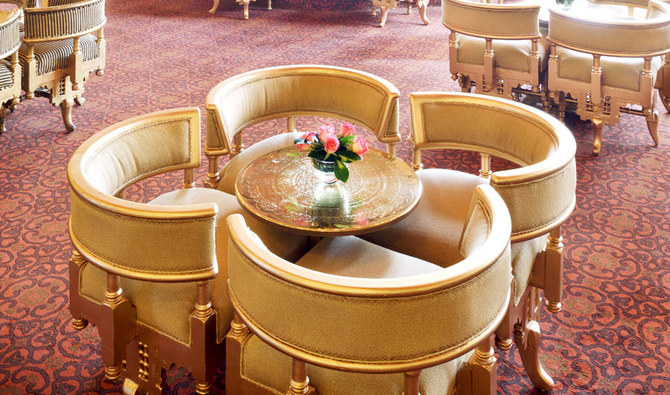
An inside view of Mena House. (Photo/Supplied)
Updated 01 June 2019
Follow

Mena House: Cairo’s most legendary ‘family hotel’

  • It is named after the first king referenced in the Tablet of Abydos

CAIRO: In the shadow of the great pyramids of Giza lies Cairo’s most historic hotel, Mena House. 
This legendary hotel has played host to kings, queens and heads of state, including Empress Eugenie of France and Winston Churchill, as well as well-known figures such as Agatha Christie and Charlie Chaplin. 
Mena House was originally a hunting lodge built by Khedive Ismail for the opening of the Suez Canal in 1869, to receive Empress Eugenie and other dignitaries who attended the event.
In 1883, Frederick and Jessie Head, a couple on their honeymoon, acquired the former hunting lodge and enlarged the house and added a second floor. Finding the air beneficial, they built a small sanatorium, hoping that invalids might recover there and gain a new lease of life.
As they sought a name for their estate, Professor A.H. Saya made the suggestion that it should be called Mena House, after the first king referenced in the Tablet of Abydos.
A few years later, Mena House was sold to another wealthy couple, Hugh and Ethel Locke-King, Once the couple had settled into their desert house, Ethel decided to create a hotel. She hired a Cairo-based English architect, Henri Favarger, to create their hotel, plotted out in the desert beside the lodge, which the Locke-Kings retained as their own private residence.
The Mena House “family hotel,” with 80 guest rooms, was opened in 1887. Rooms were spacious with 10 foot-high ceilings, fireplaces, and were furnished with English furniture.
The hotel had a billiard room, a darkroom for amateur photographers, a studio for artists, a stylish dining room, a library, and the services of a French chef in the fashionable restaurant. The Italian photographer Fasani had his studio at the hotel.
Four years after the opening, a swimming bath was added to the hotel, the first of its kind in Egypt. 
The 1913-1914 tourism season was a great success in Egypt, but World War I came to the country — and with it martial law. A camp was erected behind Mena House to host the Australian troops. It later became a hospital, and remained so for the rest of the war.

FAST FACT

Mena House was originally a hunting lodge built by Khedive Ismail for the opening of the Suez Canal in 1869, to receive Empress Eugenie and other dignitaries who attended the event.

In 1943, Mena House had one of its most exciting years. Plans for Overlord, the invasion of Europe, had to be discussed by Churchill and Roosevelt, and operations in Southeast Asia needed consultation with Gen. Chiang Kai-shek. It was decided that the Big Three conference should take place at the Mena House Hotel, where the independence of the Korean Peninsula was announced.
In 1954, the Egyptian hotels company was nationalized and the ownership and management of Mena House was given to the Egyptian General Company for Tourism and Hotels (EGOTH). 
In 1972, the hotel was meticulously renovated and expansions incorporated. A new wing with 300 rooms was added as well as a new swimming pool, and a new lobby was built in place of the old tennis court.
In 1977, Mena House was the official venue for the Mena House Conference, the pre-Camp David peace talks between Egypt and Israel.
In February 2018, Mena House became a member of the Marriott International family and was renamed Marriott Mena House, Cairo. The hotel now features 330 rooms and suites, three restaurants, a lounge bar, extensive banquet and conference facilities for up to 700 guests and a large outdoor banquet space for up to 2,000 guests. Recreational facilities include a large swimming pool, heated in winter, and a spa and fitness center.
Those who have stayed at the hotel include King Farouk of Egypt, US President Richard Nixon, King Gustav of Sweden, King Umberto of Italy, Emperor of Ethiopia Haile Selassie and the English military commander Field Marshal Montgomery. The wing where Montgomery stayed still carries his name.


Sheikha Al-Mayassa talks cultural patronage at Art Basel Qatar Conversations panel

Updated 42 sec ago
Follow

Sheikha Al-Mayassa talks cultural patronage at Art Basel Qatar Conversations panel

DOHA: Cultural leaders at the inaugural edition of Art Basel Qatar in Doha have discussed how patronage is reshaping art ecosystems, with Qatar’s own long-term cultural vision at the center.

The opening panel, “Leaders of Change: How is patronage shaping new art ecosystems?” brought together Sheikha Al-Mayassa bint Hamad bin Khalifa Al-Thani, chair of Qatar Museums, and Maja Hoffmann, founder and president of the Luma Foundation, in a discussion moderated by Hans Ulrich Obrist, artistic director of the Serpentine Galleries in London. The talk formed part of the Art Basel Conversations x Qatar Creates Talks program, coinciding with the debut of Art Basel Qatar which runs in Doha until Feb. 8.

Sheikha Al-Thani framed Qatar’s cultural project as a strategic, long-term endeavor anchored in national development. “Qatar has a national vision called 2030 where culture was one of the main pillars for socioeconomic development and human development,” she said. “We have always invested in culture as a means of human development.”

That vision, she explained, underpins the decision to welcome a major international fair like Art Basel to Doha after turning away many previous proposals.

“For the longest time, I can’t tell you how many art fairs came to us wanting to be here, and we never felt it was the right time,” she said. “However, this is an important year for us and we felt, with the surplus of talent and the growing gallery scene we had here, that it was time to bring industry to talent, because that’s how we will spur the economic diversification from hydrocarbon to a knowledge-based society.”

She was also keen to stress that Art Basel Qatar was not conceived as a conventional marketplace.

 “This is not your typical art fair … It’s a humane art fair where engagement is more important than transaction, discourse more important than division, and curiosity more important than conviction,” she added.

That ethos extends to the fair’s artistic leadership. Al-Thani described how the decision to have an artist — Wael Shawky — serve as artistic director emerged collaboratively with Art Basel’s team.

“He’s a global artist who’s now become a very local artist, very invested in our local art scene. And really, I think that’s the beauty of partnerships … There is a safe space for us to critique each other, support each other, and really brainstorm all the possibilities … and then come to a consensus of what would make sense for us,” she said.

Collecting art, she added, has long been embedded in Qatari society: “My grandmother is almost 100 years old. She was collecting in the 60s when Qatar was a very poor country. It’s in our DNA … always with this notion of investing in knowledge and human development.”

Today, that impulse translates into comprehensive, multi-disciplinary collections: “We are both collecting historical objects, contemporary objects, modern objects, architecture, archival material, anything that we feel is relevant to us and the evolution of this nation towards a knowledge-based economy.”

Looking ahead, Al-Thani outlined a new cultural triangle in Doha — the National Museum of Qatar, the Museum of Islamic Art and the forthcoming Art Mill Museum — as engines for both economic diversification and intellectual life.

 “That ecosystem will enhance the economic growth and diversification, but also the knowledge that’s available, because the diversity in the collections between these three institutions will no doubt inspire young people, amateurs, entrepreneurs to think outside the box and inform their next business,” she said.

The panel closed with a focus on the future of large-scale exhibitions with Rubaiya, Qatar’s new quadrennial, timed to coincide with the anniversary of the 2022 World Cup.

“Every four years in memory of the opening of the World Cup, we will open the quadrennial. This year, the theme is ‘Unruly Waters.’ At the center of the theme is Qatar’s trading route to the Silk Road,” explained Al-Thani.

“It’s important for us to trace our past and claim it and share it to the rest of the world, but also show the connectivity that Qatar had historically and the important role it has been playing in diplomacy.”