ISLAMABAD: Pakistan said on Monday that the signing of new development projects with China in the fields of energy, technology and education reflected the upward trajectory of the economic ties between the two countries.
China’s Vice President Wang Qishan, who is in Pakistan on a three-day official visit, jointly inaugurated four development projects with Prime Minister Imran Khan on Sunday and witnessed the signing of five memoranda of understanding to enhance bilateral cooperation between the two countries in different fields including agriculture and disaster relief.
“Signing of the agreements between Pakistan and China during the ongoing visit of the Chinese vice president is proof of the flourishing economic ties between the two countries,” Special Assistant to Prime Minister on Information Firdous Ashiq Awan said on Monday.
The new development projects include 660 KV high-voltage direct current (HVDC) transmission project from Matiari to Lahore and setting up the Rashakai Special Economic Zone Project in the province of Khyber Pakhtunkhwa. Other than that, Huawei will build a technical support center in the country and a Confucius Institute will also be established at the University of Punjab in Lahore.
Reiterating his government’s unwavering commitment to the China-Pakistan Economic Corridor (CPEC), Prime Minister Khan on Sunday stressed the importance of “further deepening bilateral economic and commercial interaction, industrial collaboration, and China’s investment in Pakistan’s Special Economic Zones.”
Reciprocating his sentiments, the Chinese vice president echoed his country’s “strong support for the agenda of socio-economic uplift and people-centered development.”
Speaking at a meeting of the “Friends of Silk Road” on Sunday, he said: “No matter how the international landscape changes, China and Pakistan will always stay iron brothers that trust and support each other.”
The visiting dignitary is scheduled to attend two ceremonies in Lahore as chief guest on Monday.
Recognizing his services in promoting the China-Pakistan relationship, President Arif Alvi conferred Nishan-e-Pakistan, the highest civil award of the country, on Vice President Wang Qishan at a special investiture ceremony held at the President House later in the day. It was attended by the Senate chairman, services chiefs, members of the federal cabinet, parliamentarians and diplomats.
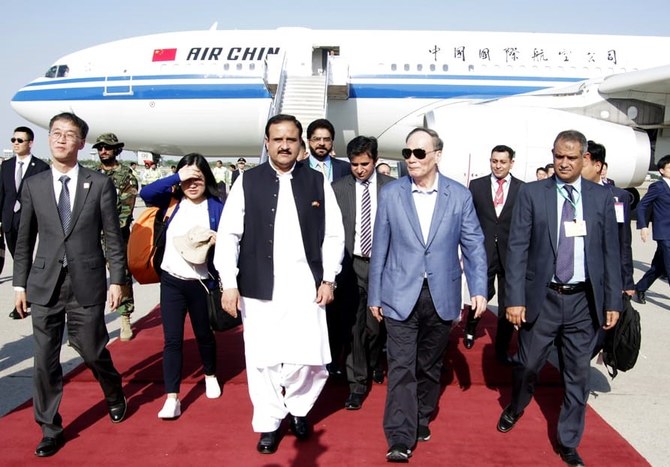
The Chinese vice president was also accorded a red carpet welcome at the Nur Khan Airbase at the beginning of his visit to the country.
“The visit is in continuation of high-level exchanges between the two countries, which have acquired an increased momentum,” the foreign office said in a statement.


![]()

Pakistan says economic relations with China are flourishing
Pakistan says economic relations with China are flourishing
- China and Pakistan will always remain iron brothers, says vice president Wang Qishan
- President Arif Alvi confers the highest civilian award on the visiting Chinese dignitary
Latest updates


© 2026 SAUDI RESEARCH & PUBLISHING COMPANY, All Rights Reserved And subject to Terms of Use Agreement.