

Trump denies Iran talks approach as Britain warns Tehran not to provoke US retaliation

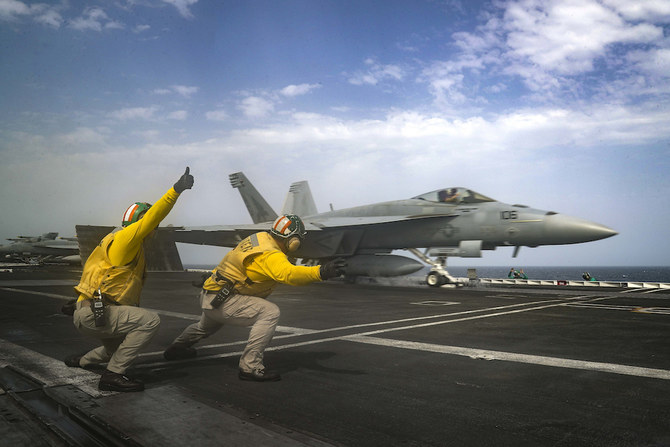
The USS Abraham Lincoln aircraft carrier in the Arabian Sea last week. Jeremy Hunt said Iranians should think very carefully about their actions. (AFP/File)
Updated 23 May 2019
Follow

Trump denies Iran talks approach as Britain warns Tehran not to provoke US retaliation

  • Comments follow warning from to Iran not to threaten the US again or it will face the 'official end'

GENEVA: President Donald Trump on Monday said Washington has not approached Iran for talks as Britain warned Tehran not to underestimate the resolve of the United States, warning that if American interests were attacked then the administration of Donald Trump would retaliate.

Trump said Iran would be making a very big mistake if they did anything but no indication they are, would be met with “great force.”
"I would say to the Iranians: Do not underestimate the resolve on the US side," Foreign Secretary Jeremy Hunt told reporters on the sidelines of the World Health Assembly in Geneva.
"They don't want a war with Iran. But if American interests are attacked, they will retaliate. And that is something that the Iranians needs to think about very, very carefully."
Hunt added that Britain has had a lot of discussions with US Secretary of State Mike Pompeo over Iran. He said he hopes Iran starts to "pull back from the destabilizing activities" it conducts in the region.
The foreign secretary acknowledged the danger the tensions posed for the wider Middle East.
"We want the situation to de-escalate because this is a part of the world where things can get triggered accidentally," Hunt said.

Hours later, Trump said that if Tehran wants to negotiate, it will have to take the first step.
"The Fake News put out a typically false statement, without any knowledge that the United States was trying to set up a negotiation with Iran. This is a false report," Trump wrote in a tweet. "Iran will call us if and when they are ever ready. In the meantime, their economy continues to collapse - very sad for the Iranian people!" Trump tweeted.

Meanwhile, the UN says Secretary-General Antonio Guterres is asking all parties involved in escalating tensions between the US and Iran “to lower the rhetoric and lower the threshold of action as well.”
UN spokesman Stephane Dujarric reiterated to reporters Monday that “we are concerned about the rising rhetoric.”
He said the secretary-general is also concerned at the rocket launch that seemed to be aimed toward the US Embassy in the Iraqi capital, Baghdad.
Dujarrics said: “It is a very volatile region. Any developments, whether they are actions on the ground or whether they are rhetoric, can always be misinterpreted and can only heighten the risk of a volatile region becoming even more volatile.”

On Sunday, Trump warned Iran not to threaten the US again or it would face its "official end," shortly after a rocket landed near the US Embassy in Baghdad.
Trump's tweet followed days of heightened tension sparked by his administration's sudden deployment of bombers and an aircraft carrier to theGulf over unspecified threats from Iran.


Volatile security blocks UN from Syria Daesh-linked camp

Updated 6 sec ago
Follow

Volatile security blocks UN from Syria Daesh-linked camp

  • Schmitt said: “UNHCR was able to reach Al-Hol for the past three days but has not yet been able to enter inside the camp due to the volatile security situation“
  • A former employee said most associations withdrew on Tuesday “due to the deteriorating security situation“

RAQQA, Syria: Poor security at a camp in Syria housing thousands of suspected relatives of Daesh group militants has prevented UN agency staff from entering, days after Kurdish forces withdrew and the army deployed at the site.
Two former employees at the Al-Hol desert camp told AFP on Friday that some of its residents had escaped during an hours-long security vacuum.
Thousands of suspected militants and their families, including foreigners, have been held in prisons and camps in northeast Syria since 2019, when the Kurdish-led Syrian Democratic Forces (SDF) defeated Daesh with the support of a US-led coalition.
This year, the SDF had to relinquish to Syrian government control swathes of territory they had seized during their fight against Daesh, and on Tuesday withdrew from Al-Hol.
In Raqqa province, Kurdish forces who formerly controlled a prison housing Daesh detainees were bussed out on Friday under a deal with the government, as a four-day truce neared expiry.

- Returning today -

Celine Schmitt, the UN refugee agency’s spokesperson in Syria, told AFP that “UNHCR was able to reach Al-Hol for the past three days but has not yet been able to enter inside the camp due to the volatile security situation.”
“UNHCR is returning to Al-Hol today, with the hope of resuming the bread delivery that had stopped for the past three days,” she said.
On Sunday, Syrian President Ahmed Al-Sharaa announced a deal with SDF chief Mazloum Abdi that included a ceasefire and the integration of the Kurds’ administration into the state, which will take responsibility for Daesh prisoners.
A former employee of a local humanitarian organization that operated in Al-Hol told AFP on condition of anonymity that most associations withdrew on Tuesday “due to the deteriorating security situation.”
Some camp residents fled during the “security vacuum” between when the SDF withdrew and the army took control, they said, without providing a number.
A former employee at another organization working there said “escapes were reported, but the exact number is unknown.”
“The camp is fenced, but without security, anyone can easily cross it and flee,” they said, also requesting anonymity.
Both ex-employees said camp residents torched centers belonging to aid organizations operating in the camp, where humanitarian conditions are dire.
Before the turmoil, the camp housed some 23,000 people — mostly Syrians but also including around 2,200 Iraqis and 6,200 other foreign women and children of various nationalities, the camp’s former administration told AFP.
Roj, a smaller camp in the northeast still under Kurdish control, holds some 2,300 people, mostly foreigners.
The Kurds and the United States have repeatedly urged countries to repatriate their citizens but foreign governments have generally allowed home only a trickle.

- Al-Aqtan prison -

The SDF has withdrawn to parts of Hasakah province, its stronghold in northeast Syria.
A fresh four-day ceasefire was announced on Tuesday, while the following day the United States said it had launched an operation that could see 7,000 Daesh militant detainees moved from Syria to Iraq, with 150 transferred so far.
US envoy Tom Barrack, who has said the purpose of Washington’s alliance with SDF has now largely expired, held talks this week with Abdi and senior Kurdish official Elham Ahmad.
On Friday, Syria transferred Kurdish fighters away from the Al-Aqtan prison on the outskirts of Raqqa city.
An AFP correspondent in Raqqa saw buses and cars heading away from the Al-Aqtan prison, escorted by government vehicles.
Syrian state television reported the transfer came “after five days of negotiations” and that the fighters would go to the Kurdish-held city of Ain Al-Arab, also known as Kobani, on the northern border with Turkiye.
The SDF later said that with coalition support, all the fighters had been transferred “to safe locations,” while the interior ministry said authorities had taken control of the facility.
A government source told state television that around 800 SDF fighters were to leave, while Daesh detainees would be managed “according to Syrian law.”
The army said the Al-Aqtan transfer was “the first step in implementing the January 18 agreement.”