ISLAMABAD: Pakistani authorities on Tuesday released on bail two ultra-right religious party leaders whose followers have shut down major cities demanding stricter application of stringent laws on blasphemy against Islam.
In November last year, Khadim Hussain Rizvi, the leader of the Tehreek-e-Labbaik (TLP) party, and Pir Afzal Qadri, a co-founder, led nationwide protests and threatened Supreme Court judges over the acquittal and release of a Christian woman, Asia Bibi, who had spent eight years on death row on a blasphemy conviction.
Qadri, who is one of the TLP’s co-founders, had even called for the killing of the Supreme Court judges who acquitted Asia Bibi, as well as the overthrow of the government and the powerful army chief, General Qamar Javed Bajwa. On May 1 this year, Qadri resigned from the TLP citing health issues and issued a public apology for his remarks.
Local media reported that a two-member bench comprising Justice Qasim Ali Khan and Justice Asjad Javed Gharal had granted bail to Rizvi and Qadri till July 15 against surety bonds of Rs5 million each.
Pakistani Information Minister at the time, Fawad Chaudhry, had said last year that Rizvi and three others had been “charged under sections of sedition and terrorism.”
“Today we have decided to take legal action against the TLP leadership,” Chaudhry told a press conference on December 1. “All those who were directly involved in destroying property, who misbehaved with women, who set fire to buses, are being charged under laws of terrorism at different police stations.”
Chaudhry said more than 3,000 TLP members were taken into protective custody in the wake of the protests last year.
The move represented a hardening of the authorities’ stance toward the TLP, which in late 2017 paralyzed the capital Islamabad for several weeks and clashed with the police in deadly protests.
In 2017 and last year, TLP members called off protests only after negotiating with the military and reaching a deal with the government, which made many concessions to appease the group.
The TLP’s main focus is protecting Pakistan’s draconian blasphemy laws. It was founded out of a movement supporting a bodyguard who assassinated Punjab provincial governor Salman Taseer for advocating for Asia Bibi in 2011.
Blasphemy is a deeply emotive issue in Pakistan and officials have been unnerved by how much support Rizvi’s TLP has garnered across the country in the two years since the group entered mainstream politics.
Last week, Bibi’s lawyer told Arab News she had finally left Pakistan for Canada.


Pakistani clerics who opposed Asia Bibi's blasphemy acquittal get bail
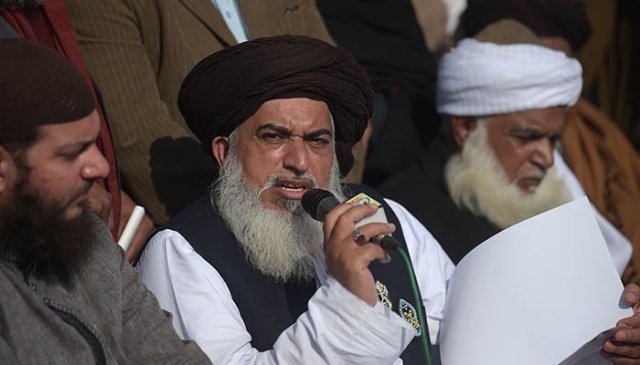
Pakistani clerics who opposed Asia Bibi's blasphemy acquittal get bail

- Tehreek-e-Labbaik party has shut down major cities, destroyed property, threatened top government, military and court figures
- Party leaders Khadim Rizvi and Pir Afzal Qadri were arrested last year and accused of ‘terrorism and sedition’

Pakistan says military operation concluded in Balochistan, 216 militants killed
- Separatist BLA militant group claimed responsibility for coordinated attacks across Balochistan last week
- Military says 36 civilians, 22 law enforcement and security forces personnel have been killed in attacks
PESHAWAR: Pakistani forces have concluded a security operation in the southwestern Balochistan province and killed 216 militants after a series of coordinated attacks by separatist militants last week, the military’s media wing said on Thursday.
Separatist militant group Baloch Liberation Army (BLA) claimed responsibility for a series of attacks in Balochistan last Friday and Saturday in multiple districts across the province, one of the deadliest flare-ups in the area in recent years.
Pakistan military’s media wing, the Inter-Services Public Relations (ISPR), said security forces launched operations in Panjgur and Harnai district’s outskirts on Jan. 29 based on intelligence confirming the presence of “terrorist elements,” killing 41 militants.
It said the military launched a broader series of intelligence-based operations in multiple areas of the province after that to dismantle “terrorist sleeper cells,” referring to it as “Operation Radd-ul-Fitna-1.”
“As a result of these well-coordinated engagements and subsequent clearance operations, 216 terrorists have been sent to hell, significantly degrading the leadership, command-and-control structures and operational capabilities of terrorist networks,” the ISPR said in a statement.
The military said 36 civilians, including women and children, were killed by militants while 22 security forces and law enforcement personnel also lost their lives.
The ISPR said a substantial cache of foreign-origin weapons, ammunition, explosives and equipment were also recovered during the counteroffensive operations.
“Preliminary analysis indicates systematic external facilitation and logistical support to these extremist proxies,” the statement said.
The military said Pakistan’s armed forces remain steadfast in their resolve to combat “terrorism,” vowing that counterterror operations will continue until militants are completely eliminated.
“Operation Radd-ul-Fitna-1 stands as a testament to Pakistan’s and particularly Balochistan’s proud peoples’ unwavering commitment to always prefer peace over violence, unity over division and development over violence,” the ISPR said.
Pakistan’s government has accused India of being behind the militant attacks in Balochistan, charges that New Delhi has rejected as “baseless.”
Balochistan, Pakistan’s largest province by land area, has long faced a separatist insurgency that has intensified in recent years. Militants frequently target security forces, government officials, infrastructure projects, foreigners and non-local workers.
The province holds vast reserves of minerals and hydrocarbons and is central to the multibillion-dollar China-Pakistan Economic Corridor (CPEC), a flagship component of China’s Belt and Road Initiative.
Separatist groups such as the BLA accuse Islamabad of exploiting Balochistan’s natural resources while denying locals a fair share. Pakistan’s civilian and military leadership reject the claim and say they are investing in the province’s development.


