Latest round of India’s national election marred by violence

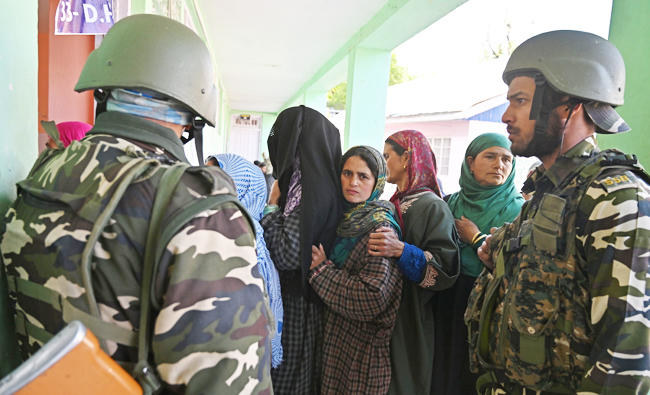
Kashmiri women queue up to cast their vote at a polling station during the fourth phase of India's general elections at Qaimoh Kulgam district, south of Srinagar on April 29, 2019. (AFP)
Updated 30 April 2019
Follow

Latest round of India’s national election marred by violence

  • The opposition says the BJP’s emphasis on Hindu nationalism has aggravated religious tensions and violence against Muslims and other minorities in constitutionally secular India

NEW DELHI: The fourth phase of India’s staggered national election Monday was marred by multiple clashes that injured at least seven people and led to security forces firing warning shots outside one polling station.
A junior minister in Prime Minister Narendra Modi’s Hindu nationalist party, Babul Supriyo, said his car was attacked by supporters of a rival party outside a polling station in West Bengal’s Asansol district as they tried to stop him from entering.
In West Bengal’s Dubrajpur area, security forces fired warning shots in the air at a group of voters who turned violent when stopped from carrying mobile phones into polling stations, the Press Trust of India news agency said.
Clashes between rival groups elsewhere in the state injured seven people, the agency reported. They included a woman who was hit by a crude bomb that exploded outside a polling station, police said.
The Election Commission said police filed a case of trespass against Supriyo, the minister, for forcing his way into a polling station without authorities’ permission.
Modi’s Bharatiya Janata Party is facing a major test as it looks to govern for another five years after winning a clear majority in the 2014 election. The party suffered a setback in December when the opposition Congress party wrested power from it in three key state elections — Rajasthan, Madhya Pradesh and Chhattisgarh.
Rajasthan and Madhya Pradesh were among the nine states voting on Monday.
The remaining three phases of the election will be completed by May 19, and vote counting will begin May 23.
Even before Monday, more than half of India’s 543 parliamentary constituencies had already voted in the election, which began April 11. With 900 million of India’s 1.3 billion people registered to vote, the election is the world’s largest democratic exercise.
On Monday, 64% of 128 million eligible voters cast ballots on electronic voting machines, the Election Commission said.
In the first three phases, voter turnout was around 66.4%, the same as in 2014, when Modi’s party came into power. This may not be good news for the BJP, which launched a campaign two years ago seeking to increase voter turnout in the 2019 election.
“The BJP hasn’t been able to enthuse people and overcome the voters’ apathy,” said Nilanjan Mukhopadhyay, a political analyst who has written a biography of Modi.
Modi said in campaign speeches last week that his government was not facing an anti-incumbency bias “as people know that the BJP-led government is working honestly for the development of the country.” He also said all past governments in India had faced such biases in national and state elections.
Under the leadership of political dynasty scion Rahul Gandhi, the Congress party, which had ruled the country for more than half a century after 1947 independence, has struggled to coalesce India’s many opposition parties into a coherent force that could go head-to-head with the BJP.
The opposition says the BJP’s emphasis on Hindu nationalism has aggravated religious tensions and violence against Muslims and other minorities in constitutionally secular India. Hindus comprise 80% of India’s population. There is a large Muslim minority, with smaller minorities of Sikhs, Christians and others.
Surveys show Modi’s BJP is projected to come out first again, though with a smaller mandate.


Afghan returnees in Bamiyan struggle despite new homes

Updated 8 sec ago
Follow

Afghan returnees in Bamiyan struggle despite new homes

  • More than five million Afghans have returned home since September 2023, according to the International Organization for Migration
BAMIYAN, Afghanistan: Sitting in his modest home beneath snow-dusted hills in Afghanistan’s Bamiyan province, Nimatullah Rahesh expressed relief to have found somewhere to “live peacefully” after months of uncertainty.
Rahesh is one of millions of Afghans pushed out of Iran and Pakistan, but despite being given a brand new home in his native country, he and many of his recently returned compatriots are lacking even basic services.
“We no longer have the end-of-month stress about the rent,” he said after getting his house, which was financed by the UN refugee agency on land provided by the Taliban authorities.
Originally from a poor and mountainous district of Bamiyan, Rahesh worked for five years in construction in Iran, where his wife Marzia was a seamstress.
“The Iranians forced us to leave” in 2024 by “refusing to admit our son to school and asking us to pay an impossible sum to extend our documents,” he said.
More than five million Afghans have returned home since September 2023, according to the International Organization for Migration (IOM), as neighboring Iran and Pakistan stepped up deportations.
The Rahesh family is among 30 to be given a 50-square-meter (540-square-foot) home in Bamiyan, with each household in the nascent community participating in the construction and being paid by UNHCR for their work.
The families, most of whom had lived in Iran, own the building and the land.
“That was crucial for us, because property rights give these people security,” said the UNHCR’s Amaia Lezertua.
Waiting for water
Despite the homes lacking running water and being far from shops, schools or hospitals, new resident Arefa Ibrahimi said she was happy “because this house is mine, even if all the basic facilities aren’t there.”
Ibrahimi, whose four children huddled around the stove in her spartan living room, is one of 10 single mothers living in the new community.
The 45-year-old said she feared ending up on the street after her husband left her.
She showed AFP journalists her two just-finished rooms and an empty hallway with a counter intended to serve as a kitchen.
“But there’s no bathroom,” she said. These new houses have only basic outdoor toilets, too small to add even a simple shower.
Ajay Singh, the UNHCR project manager, said the home design came from the local authorities, and families could build a bathroom themselves.
There is currently no piped water nor wells in the area, which is dubbed “the dry slope” (Jar-e-Khushk).
Ten liters of drinking water bought when a tanker truck passes every three days costs more than in the capital Kabul, residents said.
Fazil Omar Rahmani, the provincial head of the Ministry of Refugees and Repatriation Affairs, said there were plans to expand the water supply network.
“But for now these families must secure their own supply,” he said.
Two hours on foot
The plots allocated by the government for the new neighborhood lie far from Bamiyan city, which is home to more than 70,000 people.
The city grabbed international attention in 2001, when the Sunni Pashtun Taliban authorities destroyed two large Buddha statues cherished by the predominantly Shia Hazara community in the region.
Since the Taliban government came back to power in 2021, around 7,000 Afghans have returned to Bamiyan according to Rahmani.
The new project provides housing for 174 of them. At its inauguration, resident Rahesh stood before his new neighbors and addressed their supporters.
“Thank you for the homes, we are grateful, but please don’t forget us for water, a school, clinics, the mobile network,” which is currently nonexistent, he said.
Rahmani, the ministry official, insisted there were plans to build schools and clinics.
“There is a direct order from our supreme leader,” Hibatullah Akhundzada, he said, without specifying when these projects will start.
In the meantime, to get to work at the market, Rahesh must walk for two hours along a rutted dirt road between barren mountains before he can catch a ride.
Only 11 percent of adults found full-time work after returning to Afghanistan, according to an IOM survey.
Ibrahimi, meanwhile, is contending with a four-kilometer (2.5-mile) walk to the nearest school when the winter break ends.
“I will have to wake my children very early, in the cold. I am worried,” she said.