Palestinians keep up refusal of tax revenues after Israel cuts

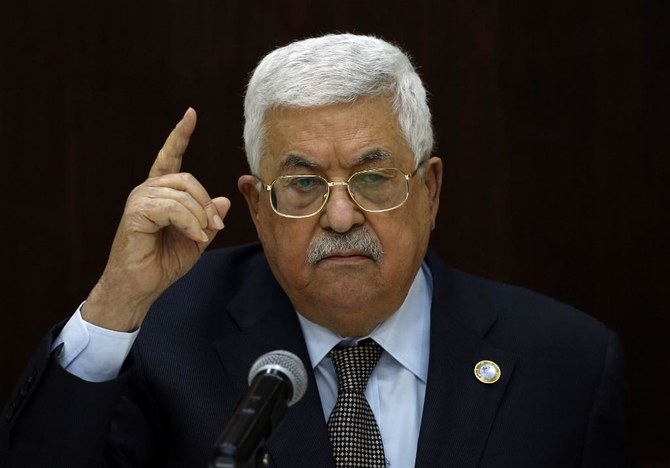
Palestinian President Mahmoud Abbas said they will not accept the money if it is not the full amount. (AFP/File)
Updated 29 April 2019
Follow

Palestinians keep up refusal of tax revenues after Israel cuts

  • Palestinian Authority said they will not accept the money if it is incomplete
  • Israel deducts almost $10m a month, what they say is equal to the money the PA pays to the families of prisoners

RAMALLAH: The Palestinians on Monday restated their refusal to accept tax revenues collected on its behalf by Israel so long as the Jewish state deducts millions of dollars over a dispute about prisoners.
“Our position is as it was: We will not receive any money from Israel if it is incomplete,” Palestinian Authority (PA) president Mahmud Abbas told the weekly cabinet meeting in the West Bank city of Ramallah.
“This is something we will not accept at any cost.”
Israel collects around $190 million a month in customs duties levied on goods destined for Palestinian markets that transit through Israeli ports, and then it transfers the money to the PA.
In February, the Jewish state decided to deduct around $10 million a month from those revenues, corresponding to the amount it said the PA paid families of prisoners or directly to inmates serving time in Israeli jails.
The Palestinians responded by saying they would refuse any funds where unilateral deductions had been made.
Israeli public radio reported Monday that a month’s payment — minus the $10 million deduction — had recently been transferred to PA bank accounts, in the hope the authority would quietly accept payment.
But after two weeks, the radio said, the money was returned to the Israeli finance ministry.
Israel sees the payments to those who have carried out attacks against Israelis as encouraging further violence.
The PA describes the payments as a form of welfare, while the Palestinian public venerates prisoners jailed by Israel as national heroes.
The Arab League pledged last week to provide the PA with $100 million monthly, potentially averting a financial crisis caused by the row.
Abbas on Monday called on the body to honor that pledge, averting a crippling financial crisis.
“We do not have high hopes, but perhaps the amount could be considered a debt that we return as soon as Israel returns” the money, he said.


Saudi intervention ends Socotra power crisis

Updated 5 sec ago
Follow

Saudi intervention ends Socotra power crisis

  • Sudden shutdown of the power plants after the operating company withdrew and disabled control systems
  • Saudi engineering and technical teams moved immediately after receiving an appeal from local authorities

ADEN: Electricity has returned to Yemen’s Socotra archipelago after urgent Saudi intervention ended days of outages that disrupted daily life and crippled vital institutions, including the general hospital, the university and the technical institute.

The breakthrough followed a sudden shutdown of the power plants after the operating company withdrew and disabled control systems, triggering widespread blackouts and deepening hardship for residents.

The Saudi Development and Reconstruction Program for Yemen said that its engineering and technical teams moved immediately after receiving an appeal from local authorities. Specialists were dispatched to reactivate operating systems that had been encrypted before the company left the island.

Generators were brought back online in stages, restoring electricity across most of the governorate within a short time.

The restart eased intense pressure on the grid, which had faced rising demand in recent weeks after a complete halt in generation.

Health and education facilities were among the worst affected. Some medical departments scaled back services, while parts of the education sector were partially suspended as classrooms and laboratories were left without power.

Socotra’s electricity authority said that the crisis began when the former operator installed shutdown timers and password protections on control systems, preventing local teams from restarting the stations. Officials noted that the archipelago faced a similar situation in 2018, which was resolved through official intervention.

Local sources said that the return of electricity quickly stabilized basic services. Water networks resumed regular operations, telecommunications improved, and commercial activity began to recover after a period of economic disruption linked to the outages.

In the health sector, stable power, combined with operational support, secured the functioning of Socotra General Hospital, the archipelago’s main medical facility.

Funding helped to provide fuel and medical supplies and support healthcare staff, strengthening the hospital’s ability to receive patients and reducing the need to transfer cases outside the governorate, a burden that had weighed heavily on residents.

Medical sources said that critical departments, including intensive care units and operating rooms, resumed normal operations after relying on limited emergency measures.

In education, classes and academic activities resumed at Socotra University and the technical institute after weeks of disruption.

A support initiative covered operational costs, including academic staff salaries and essential expenses, helping to curb absenteeism and restore the academic schedule.

Local authorities announced that studies at the technical institute would officially restart on Monday, a move seen as a sign of gradual stabilization in public services.

Observers say that sustained technical and operational support will be key to safeguarding electricity supply and preventing a repeat of the crisis in a region that depends almost entirely on power to run its vital sectors.