

Assange will cooperate with Sweden, but fight US warrant: lawyer

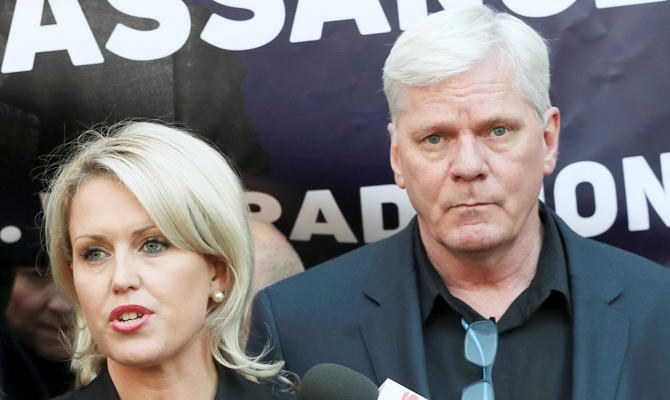
Kristinn Hrafnsson, editor in chief of Wikileaks, and barrister Jennifer Robinson talk to the media outside the Westminster Magistrates Court after WikiLeaks founder Julian Assange was arrested in London, Britain, April 11, 2019. (REUTERS)
Updated 15 April 2019
Follow

Assange will cooperate with Sweden, but fight US warrant: lawyer

  • The conspiracy charge against Assange seems intended to sidestep limits on prosecution potentially arising from the US Constitution’s First Amendment guarantee of press freedom

LONDON: Julian Assange would cooperate with Swedish authorities if they reopen a rape case against him but will continue to resist any bid to extradite him to the United States, his lawyer said Sunday.
“We are absolutely happy to answer those queries if and when they come up,” Jennifer Robinson told Sky News television about the rape claims.
“The key issue at the moment is US extradition, which we have warned about for many years,” she added.
The WikiLeaks founder is in custody in London awaiting sentencing for breaching his British bail conditions in 2012 by seeking refuge in Ecuador’s London embassy to avoid extradition to Sweden.
He was arrested at the embassy on Thursday after Ecuador gave him up, and is now also fighting a US extradition warrant relating to the release by WikiLeaks of a huge cache of official documents.
The Australian has always denied the claims of sexual assault and rape in Sweden. The first expired in 2015 and the other was dropped in 2017, but the alleged rape victim has now asked for the case to be reopened.
If Stockholm makes a formal extradition request, the British government will have to decide whether to consider it before or after that of the United States.
Robinson said Assange would seek assurances from Sweden that he would not be sent on to America, saying: “That is the same assurance we were seeking in 2010 and the refusal to give that is why he sought asylum.”

She added: “He’s not above the law. Julian has never been concerned about facing British justice or indeed Swedish justice. This case is and has always been about his concern about being sent to face American injustice.”
The US indictment charges Assange with “conspiracy” for working with former US Army intelligence analyst Chelsea Manning to crack a password stored on Department of Defense computers in March 2010.
He faces up to five years in jail.
Manning passed hundreds of thousands of classified documents to WikiLeaks, exposing US military wrongdoing in the Iraq war and diplomatic secrets about scores of countries around the world.
The conspiracy charge against Assange seems intended to sidestep limits on prosecution potentially arising from the US Constitution’s First Amendment guarantee of press freedom.
But Robinson insisted: “This indictment clearly engages newsgathering activities and the kinds of communications that journalists have with sources all the time.”
The lawyer condemned as “outrageous” claims made by Ecuador about Assange’s behavior in the embassy, including that he smeared his faeces on the wall, saying: “That’s not true.”
Quito also accused him of failing to care for his cat. WikiLeaks said Assange had asked his lawyers to “rescue him (the cat) from embassy threats” in October, adding: “They will be reunited in freedom.”
Assange’s father, John Shipton, on Sunday urged Australia to bring his son home.


‘New progress’ on North Korea possible in coming days, Seoul official says

Updated 3 sec ago
Follow

‘New progress’ on North Korea possible in coming days, Seoul official says

  • Senior official says Seoul has made considerable efforts to bring North Korea to dialogue
  • Trump administration has decided to lift sanctions for humanitarian aid projects to North Korea
SEOUL: A senior South Korean official said Friday “new progress” on North Korea could come within days, with a local report saying the Trump administration has decided to approve humanitarian sanctions exemptions for Pyongyang.
In a meeting with reporters in the United States, the senior official said Seoul has made considerable efforts to bring North Korea to dialogue.
“There could be some new progress in the coming days” on North Korea, the government official said on condition of anonymity.
Washington has long demanded that Pyongyang give up its banned nuclear weapons program, with the country under successive rounds of UN sanctions over it.
The South Korean senior official’s comments came while addressing US President Donald Trump’s scheduled trip to China in April.
Trump last year made repeated overtures to Pyongyang’s leader Kim Jong Un during his barnstorming tour of Asia, saying he was “100 percent” open to a meeting and even bucking decades of US policy by conceding that North Korea was “sort of a nuclear power.”
North Korea did not respond to Trump’s offer, and has repeatedly said it will never give up its nuclear weapons.
South Korea’s daily Dong-A Ilbo reported on Friday, citing Seoul’s unnamed government sources, that the Trump administration has decided to lift sanctions for humanitarian aid projects to North Korea, at the UN Security Council’s 1718 Committee.
Analysts say the move would allow South Korea’s NGOs to provide humanitarian assistance — such as nutritional supplements, medical equipment and water purification systems — to North Korea, an improverished state that has struggled to provide for its people.
Trump met North Korea’s Kim three times. The US leader once famously declared they were “in love” during his first term, in efforts to reach a denuclearization deal.
But since a summit in Hanoi in 2019 fell through over differences about what Pyongyang would get in return for giving up its nuclear weapons, no progress has been made between the two countries.
Seoul and Washington earlier this week reaffirmed their commitment to North Korea’s “complete denuclearization” and cooperation on Seoul’s nuclear-powered submarine plan, a move that has previously drawn an angry response from Pyongyang.
North Korea is set to hold a landmark congress of its ruling party soon, its first in five years.
Ahead of that conclave, Kim ordered the “expansion” and modernization of the country’s missile production.
