Profile: How Ibn Auf went from regime insider to new Sudan ruler

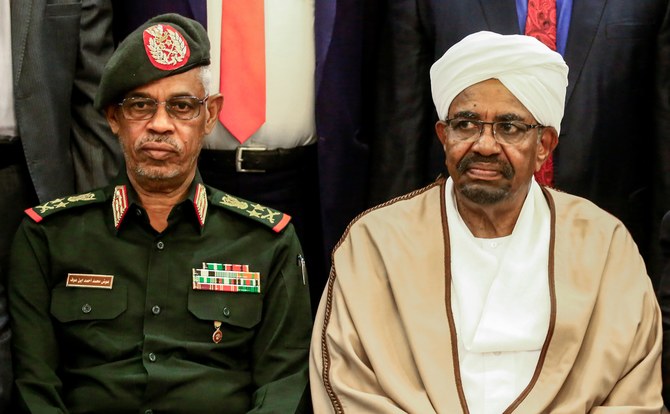
Sudanese General Ahmed Awad Ibn Auf, who now heads the transitional military council, sat next to former President Omar Al-Bashir last month. (AFP)
Updated 12 April 2019
Follow

Profile: How Ibn Auf went from regime insider to new Sudan ruler

  • Born in 1950, Ibn Auf, a career soldier has been a regime insider and a close aide of Al-Bashir
  • His alleged role in the conflict in Darfur might make Western powers wary of dealing with him directly

CAIRO: Sudanese General Ahmed Awad Ibn Auf, who led the overthrow of veteran leader Omar Al-Bashir and has emerged as the country’s new ruler, is already under US sanctions for his alleged role in the brutal Darfur conflict.
In a somber televised statement on Thursday, Ibn Auf announced the ouster of Bashir, who ruled the northeast African country with an iron-fist for 30 years before angry protesters brought him down.
“I announce as minister of defense the toppling of the regime and detaining its chief in a secure place,” Ibn Auf said.
“We have replaced him by a transitional military council for two years and have suspended Sudan’s 2005 constitution.”
Later on Thursday state television announced that Ibn Auf had been sworn in as head of the military council triggering anger among the protesters.
“The regime has conducted a military coup by bringing back the same faces and the same institutions which our people rose up against,” the Alliance for Freedom and Change, the group that is leading the protests said in a statement.
“We call on our people to continue their sit-in in front of army headquarters and across all regions and in the streets.”
Protesters remained camped at the army headquarters in the capital for seventh straight day, vowing not to leave until the new military rulers quit.
Born in 1950, Ibn Auf, a career soldier has been a regime insider and a close aide of Al-Bashir since the former leader came to power in a coup in 1989.
Ibn Auf held several top ranking positions in the army as well as in the foreign ministry.
He rose through the ranks first to become a commander of the military’s artillery division and then to head the army intelligence wing.
In 2010 he retired but was brought back five years later as the country’s defense minister. In February Al-Bashir made him his first vice president
“Awad Ibn Auf is not only a high-ranking officer of Bashir’s old guard, but one of the few in the army to be able to maintain the cohesion between the rival branches of the regime’s security apparatus,” said Paris-based Sudan analyst, Jerome Tubiana.
Between 2010 and 2015, Ibn Auf served as a counsel in Khartoum’s embassy in Cairo and later as ambassador to Muscat.
But it is his alleged role in the conflict in Darfur that analysts say might make Western powers wary of dealing with him directly.
Analysts say Ibn Auf, a close aide of Bashir, played a key role in managing militias like the feared Janjaweed, who have been accused of committing genocide during the initial years of the conflict.
The United States put his name on its backlist of Sudanese officers sanctioned for their role in the conflict that has seen his assets blocked by the US treasury since 2007.
In May 2007, Washington said Ibn Auf has been “linked to violence, atrocities and human rights abuses” in Darfur.
Bashir himself has been indicted for alleged war crimes and genocide in the Darfur conflict, in which according to the United Nations about 300,000 people have been killed and millions displaced.
Hundreds of thousands of people still live in sprawling camps across the region.
The conflict erupted in 2003 when ethnic black rebels took up arms against Khartoum’s Arab-dominated government, accusing it of economic and political marginalization.
Ibn Auf was as “deeply involved” in the conflict as Bashir himself, said Hollywood actor George Clooney on Thursday.
“Removing the leader of a violent, corrupt system without dismantling that system is inadequate,” said Clooney, founder of The Sentry Project, which researches illicit money and war crimes in Africa.
But analyst Tubiana said the fact that Bashir agreed to go and Ibn Auf had replaced him showed that it was “a palace revolution, aimed at protecting the regime and preventing the opposition, civilians and non-Islamists ... from taking power.”
Some analysts say however that Ibn Auf might not remain for long time as head of the military council.
“He’s been taking decisions for a long time when it comes to the armed forces, but the task ahead is not going to be easy,” said an analyst.
“The anger among protesters will be a continuous challenge. For all you know he might not be there for a long time.”
Protesters vow to do exactly that.
“Ibn Auf is weak, we will ensure he quits,” said a protester without revealing his name for security reasons as he prepared for Friday prayers at the army complex.


Trump says ‘hopefully’ no need for military action against Iran

Updated 30 January 2026
Follow

Trump says ‘hopefully’ no need for military action against Iran

  • US president said he is speaking with Iran and left open the possibility of avoiding a military operation
  • An Iranian military spokesman warned Tehran’s response to any US action would not be limited

PARIS: US President Donald Trump said on Thursday he hoped to avoid military action against Iran, which has threatened to strike American bases and aircraft carriers in response to any attack.
Trump said he is speaking with Iran and left open the possibility of avoiding a military operation after earlier warning time was “running out” for Tehran as the United States sends a large naval fleet to the region.
When asked if he would have talks with Iran, Trump told reporters: “I have had and I am planning on it.”
“We have a group headed out to a place called Iran, and hopefully we won’t have to use it,” the US president added, while speaking to media at the premiere of a documentary about his wife Melania.
As Brussels and Washington dialed up their rhetoric and Iran issued stark threats this week, UN chief Antonio Guterres has called for nuclear negotiations to “avoid a crisis that could have devastating consequences in the region.”
An Iranian military spokesman warned Tehran’s response to any US action would not be limited — as it was in June last year when American planes and missiles briefly joined Israel’s short air war against Iran — but would be a decisive response “delivered instantly.”
Brig. Gen. Mohammad Akraminia told state television US aircraft carriers have “serious vulnerabilities” and that numerous American bases in the Gulf region are “within the range of our medium-range missiles.”
“If such a miscalculation is made by the Americans, it will certainly not unfold the way Trump imagines — carrying out a quick operation and then, two hours later, tweeting that the operation is over,” he said.
An official in the Gulf, where states host US military sites, said that fears of a US strike on Iran are “very clear.”
“It would bring the region into chaos, it would hurt the economy not just in the region but in the US and cause oil and gas prices to skyrocket,” the official added.
‘Protests crushed in blood’
Qatar’s leader Sheikh Tamim bin Hamad Al-Thani and Iran’s President Masoud Pezeshkian held a call to discuss “efforts being made to de-escalate tensions and establish stability,” the Qatar News Agency (QNA) reported.
The European Union, meanwhile, piled on the pressure by designating the Islamic Revolutionary Guard Corps (IRGC) a “terrorist organization” over a deadly crackdown on recent mass protests.
“’Terrorist’ is indeed how you call a regime that crushes its own people’s protests in blood,” said EU chief Ursula von der Leyen, welcoming the “overdue” decision.
Though largely symbolic, the EU decision has already drawn a warning from Tehran.
Iran’s military slammed “the illogical, irresponsible and spite-driven action of the European Union,” alleging the bloc was acting out of “obedience” to Tehran’s arch-foes the United States and Israel.
Iranian officials have blamed the recent protest wave on the two countries, claiming their agents spurred “riots” and a “terrorist operation” that hijacked peaceful rallies sparked over economic grievances.
Rights groups have said thousands of people were killed during the protests by security forces, including the IRGC — the ideological arm of Tehran’s military.
In Tehran on Thursday, citizens expressed grim resignation.
“I think the war is inevitable and a change must happen. It can be for worse, or better. I am not sure,” said a 29-year-old waitress, speaking on condition of anonymity for fear of reprisals.
“I am not in favor of war. I just want something to happen that would result in something better.”
Another 29-year-old woman, an unemployed resident of an upscale neighborhood in northern Tehran, said: “I believe that life has highs and lows and we are now at the lowest point.”
Trump had threatened military action if protesters were killed in the anti-government demonstrations that erupted in late December and peaked on January 8 and 9.
But his more recent statements have turned to Iran’s nuclear program, which the West believes is aimed at making an atomic bomb.
On Wednesday, he said “time is running out” for Tehran to make a deal, warning the US naval strike group that arrived in Middle East waters on Monday was “ready, willing and able” to hit Iran.
Conflicting tolls
The US-based Human Rights Activists News Agency (HRANA) said it has confirmed 6,479 people were killed in the protests, as Internet restrictions imposed on January 8 continue to slow verification.
But rights groups warn the toll is likely far higher, with estimates in the tens of thousands.
Iranian authorities acknowledge that thousands were killed during the protests, giving a toll of more than 3,000 deaths, but say the majority were members of the security forces or bystanders killed by “rioters.”
Billboards and banners have gone up in the capital Tehran to bolster the authorities’ messages. One massive poster appears to show an American aircraft carrier being destroyed.