DEAD SEA, Jordan: Saudi Arabia’s startup scene is “moving faster than anyone can imagine” and is set to create hundreds of thousands of jobs over the coming years, the World Economic Forum in Jordan heard on Saturday.
The region’s most successful tech ventures — like ride-hailing service Careem, which Uber recently agreed to buy for $3.1 billion, and web portal Maktoob, which was acquired by Yahoo in 2009 — have emerged from more established startup hubs of Dubai and Amman.
But the next wave is seen emerging from Saudi Arabia, panelists said at the regional meeting of the World Economic Forum (WEF) at the Dead Sea.
Saudi Arabia’s Energy Minister Khalid Al-Falih told the forum that he expects the startups of today to be among the Kingdom’s biggest companies in a decade’s time.
“Our enterprises will multiply in size,” he said. “I predict that by 2030, companies that we don’t know today will be among the top 20, 30 companies in Saudi Arabia. They will be driven by innovation, they will be driven by young people, they will be driven by women.”
The government has a role to play in encouraging more Saudi startups, along with a culture where young people experiment in business, the minister added.
“(It’s about) creating an environment where failure is not encouraged, but certainly dealt with in a positive way — and that young people are given the opportunity to fail, fail, fail, and succeed ultimately, and not only create opportunities for themselves … but also employment and opportunities for hundreds of thousands of people.”
Al-Falih pointed to the venture capital funds and startup incubators that are already active in the Kingdom.
“We hope to see hundreds of these startups coming up with innovations that are not only going to change our countries in the region, but indeed in due course will be part of the global movement where young, innovative enterprises are creating the economies and the solutions of the future,” he said.
Ten Saudi companies made it to the WEF’s 100 most promising startups for 2019, with entrepreneurs from the Kingdom in attendance at the event.
Fadi Ghandour, the founder of courier service Aramex and executive chairman of venture capital firm Wamda Capital, said that the Kingdom’s startup scene has virtually transformed overnight.
“I am extremely impressed. Suddenly you thought nothing is happening, and then you wake up in the morning and you say ‘what happened here?’,” he told a panel at the event.
“Saudi Arabia is a country that is changing, it is moving faster than anybody can image … It’s an exciting time, it is where the region is going to scale its businesses.”
Ghandour was joined on the panel by Ayman Alsanad, co-founder and CEO Mrsool, the Saudi delivery app that recently received multi-million dollar investments from Saudi Technology Ventures and others.
Audrey Nakad, co-founder of the education platform Synkers, which is based in Lebanon, told the panel that her company is preparing to expand into Saudi Arabia. Synkers provides a link between tutors and students looking for additional help.


![]()

Thriving Saudi startup scene to produce top-30 companies, WEF hears
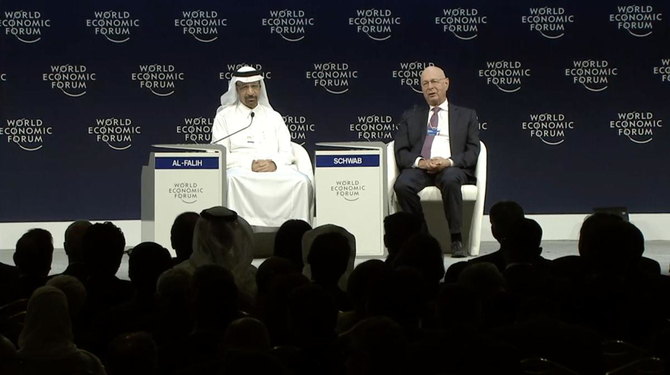
Thriving Saudi startup scene to produce top-30 companies, WEF hears
- Agile new businesses of today will be among Kingdom’s largest by 2030, World Economic Forum hears
- Khalid Al-Falih told the forum that he expects the startups of today to be among the Kingdom’s biggest companies


Latest updates


© 2026 SAUDI RESEARCH & PUBLISHING COMPANY, All Rights Reserved And subject to Terms of Use Agreement.