Saudi GE Renewables chief urges hybrid solution to overcome solar grid overload

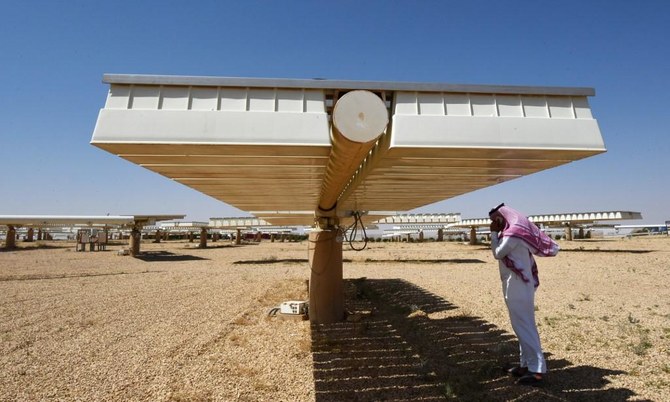
Major investment in energy storage is also needed to smooth out the huge peaks and troughs of rising renewable power production across the Middle East, the WEF in Jordan heard. (File/AFP)
Updated 08 April 2019
Follow

Saudi GE Renewables chief urges hybrid solution to overcome solar grid overload

  • Major investment in energy storage is also needed to smooth out the huge peaks and troughs of rising renewable power production across the Middle East, the WEF on MENA in Jordan heard
  • Renewable power planners are struggling with the challenge of storing enough solar power to be used throughout the day and night

LONDON: Middle East countries investing heavily in solar power need to develop other forms of renewable energy to avoid massive volatility on the grid, according to the Saudi CEO of GE Renewables in the region.
Major investment in energy storage is also needed to smooth out the huge peaks and troughs of rising renewable power production across the Middle East, the World Economic Forum in Jordan heard.
“The impact that no one is understanding is the impact of a high amount of solar on the grid,” said Manar Al-Moneef, the regional CEO of GE Renewables.
“You’re going to hit the grid with a huge amount of power. But if a cloud comes along — bang, it goes all the way down. That will cause major volatility to the grid. Unless you stabilize that with wind as an example, that will be a problem.”
Saudi Arabia, the UAE and Egypt are among the biggest investors in solar power in the Middle East while Jordan has also installed wind power. However renewable power planners are struggling with the challenge of storing enough solar power to be used throughout the day and night.
In the UAE as an example, gas currently provides 80 percent of the country’s power needs, but the government is targeting a 50:50 mix between gas and renewables by 2030 — mainly from solar power.
Dana Gas CEO Patrick Allman-Ward said that gas would play an important role in complimenting renewables in the Gulf countries.
“In the UAE, whilst they are bringing down gas in the overall power generation mix, gas will play an important role in addressing that intermittency problem because clearly the sun doesn’t shine 24 hours a day. So you have to find a way of providing the power that people need to consume 24 hours a day.”


Bahri profit rises 12% to $647m in 2025 as oil shipping boosts earnings 

Updated 11 March 2026
Follow

Bahri profit rises 12% to $647m in 2025 as oil shipping boosts earnings 

RIYADH: The National Shipping Co. of Saudi Arabia, also known as Bahri, posted a 12.07 percent increase in annual profit as stronger tanker earnings and higher global freight rates boosted results. 

Net profit attributable to shareholders reached SR2.43 billion ($647.46 million) in 2025, compared with SR2.17 billion a year earlier, according to a filing on Saudi Exchange. 

Revenue for the year ended Dec. 31, 2025, rose 9.12 percent to SR10.35 billion, compared with SR9.48 billion in 2024, while gross profit increased 14.71 percent to SR3.10 billion. 

Highlighting the main reason for the increase in net profit during the current year, the company said: “The increase in gross profit of Bahri Oil BU by SR755 million mainly due to improved operational performance and global shipping rates during the current year compared to the last year.”  

It added: “The increase in the company’s share of results of equity-accounted investees by SR134 million during the current year compared to the last year. 

However, the gains were partly offset by declines in other areas. Gross profit from the chemicals business unit fell by SR324 million, while the integrated logistics unit recorded a SR37 million decrease.  

The company’s operating profit climbed 4.67 percent year on year to SR2.73 billion, reflecting improved operational performance across several business units.  

Bahri said the increase in revenue was driven primarily by higher activity in multiple divisions, particularly its oil business unit, where revenue rose by SR1.26 billion due to increased operational activity and higher global shipping rates. 

The growth in revenue was partially offset by lower performance in other segments. 

Revenue from the chemicals business unit declined by SR396 million, while the dry bulk unit recorded a decrease of SR87 million compared with the previous year. 

Bahri also reported a SR138 million decline in other income, mainly due to lower capital gains from vessel sales.  

The company recorded SR216 million in gains from vessel sales in the previous year compared with SR6 million in the current year. Higher general and administrative expenses and increased finance costs also weighed on profitability. 

Total comprehensive income attributable to shareholders reached SR2.38 billion, up 8.65 percent from SR2.19 billion in the previous year. 

 Total shareholders’ equity rose 12.07 percent to SR15.27 billion, compared with SR13.63 billion a year earlier, while earnings per share increased to SR2.63 from SR2.35. 

Separately, Bahri’s board of directors recommended the distribution of cash dividends totaling SR922.85 million for the 2025 fiscal year, equivalent to SR1 per share.  

The proposed dividend represents 10 percent of the share’s par value and will be distributed to shareholders owning 922.85 million eligible shares, subject to approval at the company’s upcoming general assembly meeting. The eligibility and distribution dates will be announced at a later stage.