

Lebanese president pledges safe return of Syrian refugees

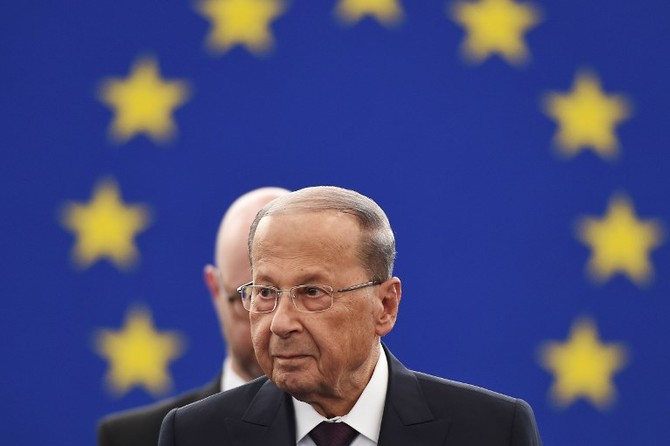
Lebanese President Michel Aoun met EU Foreign Policy Chief Federica Mogherini in Beirut. (AFP/File)
Updated 27 February 2019
Follow

Lebanese president pledges safe return of Syrian refugees

  • President met European Union foreign policy chief
  • Syrian refugees, maritime dispute with Israel discussed

BEIRUT: Lebanese President Michel Aoun pledged the safe return of Syrian refugees, with the European Union (EU) confirming it was ready to help in all areas of repatriation.

Aoun met the EU’s foreign policy chief, Federica Mogherini, in Beirut. She had been in Sharm El-Sheikh, Egypt, for a two-day Arab-EU summit and was on the same flight as Lebanese Prime Minister Saad Hariri, who had also been at the summit.

During a meeting with Mogherini, Aoun said: “Lebanon will continue to work to ensure the return of Syrian refugees to safe areas in Syria, and we will not wait for a political solution to the Syrian crisis as it may take long.

“We have received information in Beirut indicating that returning refugees are being cared for by the Syrian authorities, who have provided them with prefabs, infrastructure and schools - the EU and other international organizations can verify this.”

Aoun said that while the EU made political decisions, Lebanon’s were socio-economic, referring to the negative impact of the Syrian refugee population in Lebanon.

He suggested that “international aid should be paid to Syrian refugees after they return home to encourage their return,” explaining that “distributing aid to refugees in Lebanon along with their work here in which they compete with the Lebanese labor force are encouraging them to stay, leading to an increase in the immigration of Lebanese youth.”

Aoun stressed that cooperation between the Lebanese army and the United Nations Interim Force in Lebanon to maintain stability on the southern Lebanese border would continue.

Mogherini briefed the Lebanese president on the outcomes of the summit and also met Parliament Speaker Nabih Berri, who discussed with her the Lebanese-Israeli maritime dispute over the maritime border. 

He called on the EU to play an effective role in its demarcation. He also highlighted the need to understand Lebanon’s position on helping Syrian refugees return to their country.

Mogherini and Hariri inaugurated a new EU building, and Mogherini described it as “the best symbol of friendship and family atmosphere” linking the EU with Lebanon.

“The work we are doing in Lebanon in the security and defense sectors are not only for Lebanon but also for the security of Europe. We certainly have political, economic and social dialogues, our bilateral trade is increasing year after year, and investment in Lebanon has become an increasing priority.
“During the Cedar Conference, we pledged to contribute a package of more than 1.5 billion euros until 2020 in conjunction with the reforms scheduled to be implemented, and we learned that the government is determined to implement them.
“Lebanon may be the most European country among Arab countries, and I hope that European students would continue their education in Lebanon.”
Hariri said Lebanon was Europe’s gateway to the Arab world and the Arab World’s gateway to Europe.
“The EU has always supported Lebanon's sovereignty and independence and continues to be our partner in peace, stability, prosperity and growth, and we are grateful for that.”


Ceasefire with Kurdish-led force extended for another 15 days, Syrian army says

Updated 9 sec ago
Follow

Ceasefire with Kurdish-led force extended for another 15 days, Syrian army says

  • The defense ministry said the extension was in support of an operation by US forces
  • There was no immediate statement from the Kurdish-led SDF

RAQQA, Syria: Hours after the expiration of a four-day truce between the Syrian government and Kurdish-led fighters Saturday, Syria’s defense ministry announced the ceasefire had been extended by another 15 days.
The defense ministry said in a statement that the extension was in support of an operation by US forces to transfer accused Daesh militants who had been held in prisons in northeastern Syria to detention centers in Iraq.
There was no immediate statement from the Kurdish-led Syrian Democratic Forces.
Over the past three weeks, there have been intense clashes between government forces and the SDF, in which the SDF lost large parts of the area they once controlled.
Earlier on Saturday, a four-day truce between the Syrian government and Kurdish fighters had ended with no clear sign of whether it would be renewed, as the main Kurdish-led force in the country called on the international community to prevent any escalation.
Syria’s state news agency SANA had quoted an unnamed government official as saying that the truce had ended and the government was “studying its options.”
Syria’s interim government signed an agreement last March with the SDF for it to hand over territory and to eventually merge its fighters with government forces. In early January, a new round of talks failed to make progress over the merger, leading to renewed fighting between the two sides.
A new version of the accord was signed last weekend, and a four-day ceasefire was declared Tuesday. Part of the new deal is that SDF members will have to merge into the army and police forces as individuals.
The SDF said in a statement Saturday that military buildups and logistical movements by government forces have been observed, “clearly indicating an intent to escalate and push the region toward a new confrontation.” The SDF said it will continue to abide by the truce.
On Saturday, state TV said authorities on Saturday released 126 boys under the age of 18 who were held at the Al-Aqtan prison near the northern city of Raqqa that was taken by government forces Friday. The teenagers were taken to the city of Raqqa where they were handed over to their families, the TV station said.
The prison is also home to some of the 9,000 members of the Daesh group. Most of them remain held in jails run by the SDF. Government forces have so far taken control of two prisons while the rest are still run by the SDF.
Earlier this week, the US military said that some 7,000 Daesh detainees will be transferred to detention centers in neighboring Iraq. On Wednesday, the US military said that 150 prisoners have been taken to Iraq.