SAN FRANCISCO/LONDON: Samsung Electronics Co. Ltd. on Wednesday unveiled a nearly $2,000 folding smartphone in a bid to top the technology of Apple Inc. and Chinese rivals and reignite consumer interest amid slumping sales.
The Galaxy Fold will go on sale on April 26 and take advantage of new and faster 5G mobile networks. The device looks similar to a conventional smartphone, but then opens like a book to reveal a display the size of a small tablet at 7.3 inches (18.5 cm).
The device “answers skeptics who said that everything that could be done has been done,” DJ Koh, chief executive of Samsung Electronics, said at an event in San Francisco. “We are here to prove them wrong.”
Samsung remains the world’s largest smartphone maker with nearly a fifth of global unit sales but underperformed a slumping market last year. Chinese rival Huawei Technologies Co. Ltd. — whose Mate series of phones also command premium prices — gained market share. Other Chinese makers like Xiaomi Corp. have also been increasing prices, leaving Samsung to defend its turf against upstart rivals in addition to its longtime foe Apple.
With the foldable phone, Samsung is going on the offense on two fronts in the smartphone race: It is offering an eye-catching new feature with the big, bending screen and the first 5G connection in a premium phone, a feature analysts do not expect Apple to match until 2020.
Samsung is also making improvements to its flagship Galaxy S devices and plans to offer a 4G version of its folding phone.
It also challenges the notion of what a phone can cost, debuting at nearly twice the price of current top-of-the-line models from Apple and Samsung itself.
Patrick Moorhead, founder of Moor Insights & Strategy, said the new folding device could help Samsung stay at the top and lure consumers to upgrade devices that have looked largely the same over the past five years.
“Samsung and Apple go back and forth” to lead the premium smartphone market, Moorhead said. “I think this is Samsung’s chance to take back the innovation crown.”
And even though the $1,980 starting price is steep, some dedicated Samsung fans said they would pay it. Navneet Kumar Singh, a Samsung enthusiast from India who traveled to San Francisco to watch the launch, is ready to place his order.
“The prices of the flagship models have been a little aggressive in India,” he said, “But in the end, if you invest the money you’re getting a different experience.”
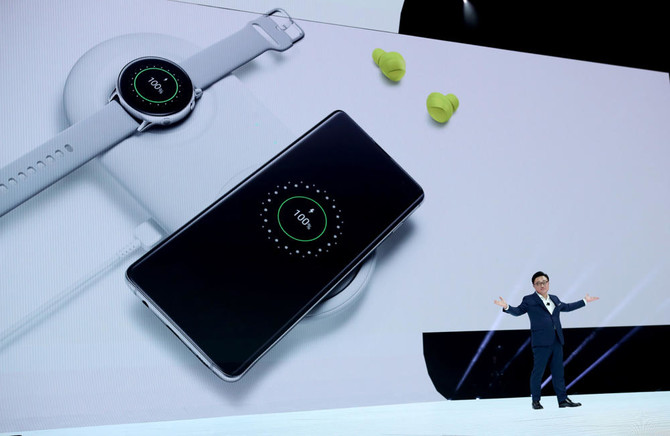
Samsung also introduced several accessories to compete against Apple, including a pair of wireless headphones called Galaxy Buds. The headphones include wireless charging, a feature that Apple has promised to put into is competing AirPods but has not yet released.
Samsung also said that its new Galaxy phones will be able to wirelessly charge its headphones and new smartwatches by setting the accessories on the back of the phone.
10 times faster
Along with the folding phone, Samsung also added new cameras and a 5G version to its Galaxy series of phones.
Verizon Communications Inc. will be the first carrier to offer service for Samsung’s 5G phones. The networks are expected to be 10 times faster than current ones, improving viewing of live news and sports events.
With the 5G versions of its flagships, the Korean electronics maker looks to have beaten Chinese rivals in the 5G race, although the device will operate only on the small number of networks launching later this year. Apple is not expected to release a 5G smartphone until late 2020.
The new networks are not available in many places yet but will roll out this year and next. Consumers who want to hold on to their phones for several years before upgrading may be tempted to buy a 5G phone now so that it will be able to take advantage of those networks later, said Bob O’Donnell of TECHnalysis Research. That could sway some Apple buyers over to Samsung and other Android makers with 5G devices.
“People are going to be thinking about, am going to be able to use this a year from now? Two years from now? Three years?” he said.
Rival smartphone makers are expected to announce 5G models at next week’s Mobile World Congress, the industry’s top annual event, in Spain. Samsung said its 5G handset would be available in the early summer.
The Galaxy 10 series needs to appeal to consumers who are reluctant to upgrade for only incremental technological improvements in performance.
All of the Galaxy series of rigid phones except the 5G will be available from March 8, with the S10+ priced from $1,000, the S10 priced from $900 and the smaller S10e from $750.
The mainline S10 compares with $999 for Apple’s iPhone XS and $858 for Huawei’s premium Mate 20 Pro.


![]()
![]()
![]()

Samsung announces folding phone with 5G — at nearly $2,000

Samsung announces folding phone with 5G — at nearly $2,000
- The device looks similar to a conventional smartphone, but then opens like a book to reveal a display the size of a small tablet
- Samsung is also making improvements to its flagship Galaxy S devices and plans to offer a 4G version of its folding phone
Latest updates


© 2026 SAUDI RESEARCH & PUBLISHING COMPANY, All Rights Reserved And subject to Terms of Use Agreement.