

Yemen govt to pay civil servants in militia-held Hodeidah

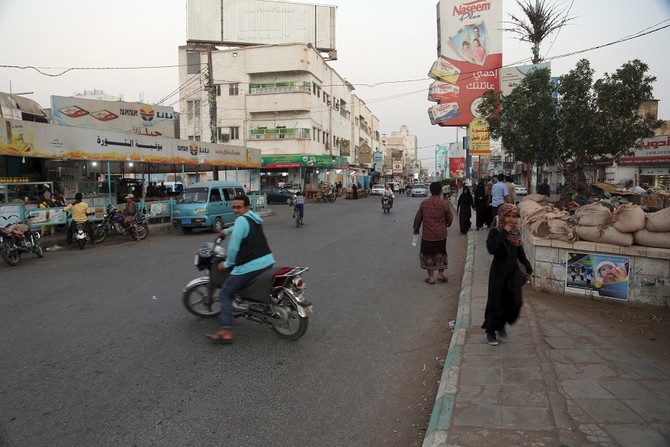
People driving in a market in the Yemeni flashpoint city of Hodeidah. (File/AFP)
Updated 28 December 2018
Follow

Yemen govt to pay civil servants in militia-held Hodeidah

  • For more than two years, the government has been unable to pay salaries and the riyal dropped sharply against the dollar, leaving Yemenis unable to afford food and water
  • Earlier this month, deputy central bank chief Shokeib Hobeishy said that Yemen’s central bank was expecting a $3 billion cash injection from Gulf allies

HODEIDAH: The United Nations on Friday welcomed a decision by Yemen’s government to pay the salaries of civil servants in the militia-held city of Hodeidah starting this month.

For more than two years, the government has been unable to pay salaries and the riyal dropped sharply against the dollar, leaving Yemenis unable to afford food and water.

“President (Abedrabbo Mansour) Hadi’s decision is an important step towards improving the economic situation, and alleviating the humanitarian suffering of the Yemeni people,” the office of the UN special envoy to Yemen Martin Griffiths tweeted.

“The (special envoy) hopes there will be more steps in this direction.”

On Thursday, Hadi instructed the government to “urgently work on paying the salaries of all civil servants in Hodeidah province starting from December”, Saba state news agency reported.

Earlier this month, deputy central bank chief Shokeib Hobeishy said that Yemen’s central bank was expecting a $3 billion cash injection from Gulf allies.

His statement came after a $2.2 billion infusion by Saudi Arabia to stem a slide in the Yemeni riyal.

More than one million civil servants lost their jobs in 2016, when Hadi moved the central bank from the militia-held capital Sanaa to Aden, controlled by the government.

A ceasefire -- agreed at peace talks in Sweden earlier this month -- went into effect in Hodeidah city and its surroundings on December 18 but has remained shaky with the warring sides accusing each other of violations.

An AFP correspondent said on Friday gunfire was heard overnight in the south of the Red Sea city, whose port serves as an entry point for the majority of imports and humanitarian aid to the war-torn country.

“We heard the sounds of jets in the early hours of the morning for a brief 15 minutes, but it has been complete calm since then,” the correspondent said, adding that the situation on the ground remains “tense”.

The conflict between the Iran-aligned Houthi militia and troops loyal to Hadi escalated in 2015, when he fled into Saudi exile and a Saudi-led military coalition intervened.

Since then, the war has killed some 10,000 people, according to the World Health Organization, although human rights groups say the real death toll could be five times as high.

The conflict has unleashed a major humanitarian crisis and pushed 14 million Yemenis to the brink of famine.


Israeli settlers forcibly enter Palestinian home in latest West Bank attack

Updated 5 sec ago
Follow

Israeli settlers forcibly enter Palestinian home in latest West Bank attack

  • The settlers killed three sheep and injured four more, smashed a door and a window of the home
  • Police said they arrested the five settlers on suspicion of trespassing onto Palestinian land

JERUSALEM: Israeli settlers attacked a Palestinian home in the south of the Israeli-occupied West Bank overnight, breaking in and killing sheep, a Palestinian official said Tuesday. It was the latest in a surge of attacks by settlers against Palestinians in the territory in recent months.
Israeli police said they arrested five settlers.
The settlers killed three sheep and injured four more, smashed a door and a window of the home, and fired tear gas inside, sending three Palestinian children under the age of 4 to the hospital, said Amir Dawood, who directs an office documenting such attacks within a Palestinian governmental body called the Wall and Settlement Resistance Commission.
Police said they arrested the five settlers on suspicion of trespassing onto Palestinian land, damaging property and dispensing pepper spray, not tear gas. They said they are investigating.
CCTV video from the attack in the town of As Samu’, shared by the commission, showed five masked settlers in dark clothing, some with batons, approaching the home and appearing to enter. Sounds of smashing are heard, as well as animal noises. Another video from inside shows masked figures appearing to strike sheep in the stable.
Photos of the aftermath, also shared by the commission, show smashed car windows and a shattered front door. Bloodied sheep lie dead as others stand with blood staining their wool. Inside the home, photos show broken glass and the furniture ransacked.
Dawood said it was the second settler attack on the family in less than two months. He called it “part of a systematic and ongoing pattern of settler violence targeting Palestinian civilians, their property and their means of livelihood, carried out with impunity under the protection of the Israeli occupation.”
During October’s olive harvest, settlers across the territory launched an average of eight attacks daily, the most since the United Nations humanitarian office began collecting data in 2006. The attacks continued in November, with the UN recording at least 136 by Nov. 24.
Israel occupied the West Bank, East Jerusalem and Gaza — areas claimed by the Palestinians for a future state — in the 1967 war. It has settled over 500,000 Jews in the West Bank, in addition to over 200,000 in contested East Jerusalem.
Israel’s government is dominated by far-right proponents of the settler movement, including Finance Minister Bezalel Smotrich and Cabinet Minister Itamar Ben-Gvir, who oversees the nation’s police force. Earlier this week, Smotrich said the Israeli cabinet had approved a proposal for 19 new Jewish settlements, another blow to the possibility of a Palestinian state.