MQM's former MNA gunned down in Karachi

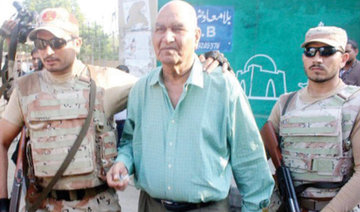
A screen grab from a CCTV camera released on Tuesday night by the Sindh Police shows the moment when unknown assassins murdered Ali Raza Abidi, a former Member of National Assembly. (Video courtesy: Sindh Police)
Updated 26 December 2018
Follow

MQM's former MNA gunned down in Karachi

  • Ali Raza Abidi was a prominent political figure
  • He resigned from his party but continued to tweet in its favor

KARACHI: Just two days after the killing of Pak Sarzameen Party (PSP) workers in this seaside metropolis, unknown assailants gunned down Ali Raza Abidi, a former Member of National Assembly (MNA) and a prominent political figure who remained associated with Muttahida Qaumi Movement-Pakistan (MQM-P), here on Tuesday night.
Abidi, who was thought to be quite close to Dr. Farooq Sattar, was fatally shot when he came out of his residence at Khayaban-e-Ghazi in Defense Housing Authority (DHA), SSP South, Pir Muhammad Shah, told Arab News.
The official said that Abidi was shot in his head and neck and succumbed to his injuries at PNS Shifa hospital during his treatment.
The dead body was later shifted to the Jinnah Postgraduate Medical Center for autopsy. Former chief of MQM-Pakistan, Dr. Farooq Sattar, condemned Abidi’s killing.
Chief Minister Sindh Syed Murad Ali Shah also condemned the murder and ordered the police chief to prepare a report on the incident.
Abidi, who was one of the most vocal Pakistani political personalities on Twitter, was elected an MNA on MQM’s ticket in the 2013 general elections, but he resigned in November 2017, only a few days after his party, MQM-P, announced to form an election alliance with PSP for 2018’s electoral contest. He re-joined his political faction but left it again in September 2018, though he continued to support it through his Twitter messages.
Abidi was gunned down on a day when MQM’s founder, Altaf Hussain, was booked for the murder of two PSP workers.
Muhammad Azhar, a PSP worker belonging to Karachi’s Nazimabad neighborhood, was killed on the spot whereas Muhammad Naeem succumbed to his injuries on the way to a hospital after three unidentified gunmen entered the party’s office on Sunday night and opened fire on people who were sitting inside, Syed Fahad Hussain, the plaintiff who was also wounded in the shooting incident, said in the First Information Report (FIR) of the event on Tuesday.
“The Muttahida Qaumi Movement’s founder Altaf Hussain has been booked in the case under Section 302 and on terrorism charges,” Nawaz Brohi, a police officer, told Arab News.
“Two trained killers carried out shooting within ten seconds and escaped,” In charges counter Terrorism department Raja Umar Khattab told Arab News, adding Abidi was attacked with 30 bore pistol at the door of his house.
Khattab says the killer had a cap so couldn’t be clearly identified.
“It seems to be the result of internal fighting between MQM factions,” Khattab said, expressing fears of more attacks and violence in Karachi in the coming days.


Pakistan launches privatization process for five power distributors under IMF reforms

Updated 10 sec ago
Follow

Pakistan launches privatization process for five power distributors under IMF reforms

  • Power-sector losses have pushed circular debt above $9 billion, official documents show
  • Move is tied to IMF and World Bank conditions aimed at cutting subsidies and fiscal risk

KARACHI: Pakistan has appointed financial advisers and launched sell-side due diligence for the privatization of five electricity distribution companies, marking a long-awaited step in power-sector reforms tied to International Monetary Fund (IMF) and World Bank programs, according to official documents shared with media on Monday.

The five companies, namely Islamabad Electric Supply Company (IESCO), Faisalabad Electric Supply Company (FESCO), Gujranwala Electric Power Company (GEPCO), Hyderabad Electric Supply Company (HESCO) and Sukkur Electric Power Company (SEPCO), supply electricity to tens of millions of customers and have long been a major source of financial losses for the state.

Pakistan’s power sector has accumulated more than Rs2.6 trillion (about $9.3 billion) in circular debt as of mid-2025, driven largely by distribution losses, electricity theft and weak bill recovery, according to official government data cited in the documents. The shortfall has repeatedly forced the government to provide subsidies, adding pressure to public finances in an economy under IMF supervision.

“The objective is to reduce losses, improve efficiency and limit the government’s fiscal exposure by transferring electricity distribution operations to the private sector,” the documents said, adding that sell-side due diligence for five distribution companies is under way as a prerequisite for investor engagement.

Two utilities, the Quetta Electric Supply Company and Tribal Areas Electric Supply Company, are excluded from the current privatization phase due to security and structural constraints, the documents said.

Power-sector reform is a central pillar of Pakistan’s IMF bailout program, under which Islamabad has committed to restructuring state-owned enterprises, improving governance and reducing budgetary support. The World Bank has also linked future energy-sector financing to progress on structural reforms.

Electricity distribution companies in Pakistan routinely report losses exceeding 20 percent of supplied power, far above international benchmarks, according to official figures. These inefficiencies have been a persistent obstacle to economic growth, investment and reliable power supply.

Previous attempts to privatize power distributors have stalled amid political resistance, labor union opposition and concerns over tariff increases. While officials have not announced a timeline for completing transactions, the launch of due diligence marks the most concrete step taken in years. International lenders and investors will now be closely watching whether Pakistan can translate this phase into completed sales, a key test of its ability to deliver on IMF-backed reforms.

In a related development in Pakistan’s privatization agenda, the government last month concluded the long-delayed sale of a 75 percent stake in national flag carrier Pakistan International Airlines (PIA) in a publicly televised auction. A consortium led by the Arif Habib Group emerged as the highest bidder with a Rs135 billion ($482 million) offer for the controlling stake, in a transaction officials have said will end decades of state-funded bailouts and inject fresh capital into the loss-making airline.