MQM-London leader is found dead in mysterious circumstances

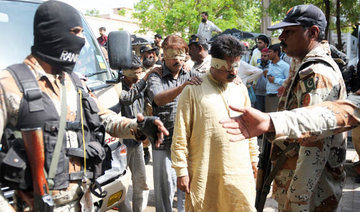
Two personnel of paramilitary Rangers taking Dr. Zafar Hasan Arif into custody after he tried to hold a news conference at Karachi Press Club on Oct. 22, 2016. (File photo)
Updated 15 January 2018
Follow

MQM-London leader is found dead in mysterious circumstances

KARACHI: Police on Sunday found the body of Dr. Hasan Zafar Arif, a central leader of the secular Muttahida Qaumi Movement-London, here in Ilyas Goth neighborhood near Ibrahim Haidri, in Karachi.
Prominent leftist intellectual and former academic Arif, 75, was serving as the MQM-London’s deputy convener.
Police said his body was found in his car in Ilyas Goth on the outskirts of the city. Local police officer Nazeer Chandio told Arab News that the body was identified with the help of an identity card found in the pocket. “It is premature to comment about the causes of the murder. It will be clear after the post-mortem,” he said.
Doctors at state-run Jinnah Hospital said that Arif’s body has been sent for medico-legal post-mortem. “He was dead before his body was brought to the hospital,,” said Dr. Seemi Jamali, head of the hospital’s emergency section. She said that they did not find marks of torture or bullets on his body.
Abdul Majeed Karwani, a local leader of MQM-London and close friend of Arif, said that Arif left his office in Saddar for his residence at DHA on Saturday at 6 p.m. and drove the car himself.
“We were scheduled to visit a party worker for condolence but Dr. Sahab apologized as he wanted to see his daughter who had come from London,” said Karwani, adding his friend never reached his home. In the morning his wife called and said he hadn’t reached home. “As we were trying to locate, we saw the TV tickers that the dead body of Arif had been found.”
“The party’s central leadership in London and family in Karachi will decide whether to lodge FIR or not,” Karwani told Arab News.
Arif was a former teacher at the University of Karachi’s department of philosophy and studied at Reading and Harvard universities. He was a known leftist intellectual and rights activist who played a key role in the movement against former president Ziaul Haq in the 1980s and was imprisoned.
In the past, he was also associated with the Pakistan People’s Party and the Pakistan Muslim League-Nawaz.
Arif was detained for a few days after being arrested from near Karachi Press Club where he was to attend a press conference for the MQM-London, which has been suffering from ongoing crackdown led by paramilitary operation since September 2013.
In a statement, MQM-London said that the professor was missing since yesterday and alleged that he had been killed.
“The death of Prof. Hassan Zafar Arif under mysterious circumstances is very sad and bad news, said Faisal Sabzwari, a member of the provincial assembly of Sindh and a leader of the MQM-Pakistan, demanding that a proper inquiry be held into the murder and justice ensured.
He will be buried in Sakhi Hasan graveyard later today.


Bangladesh halts controversial relocation of Rohingya refugees to remote island

Updated 13 sec ago
Follow

Bangladesh halts controversial relocation of Rohingya refugees to remote island

  • Administration of ousted PM Sheikh Hasina spent about $350m on the project
  • Rohingya refuse to move to island and 10,000 have fled, top refugee official says

DHAKA: When Bangladesh launched a multi-million-dollar project to relocate Rohingya refugees to a remote island, it promised a better life. Five years on, the controversial plan has stalled, as authorities find it is unsustainable and refugees flee back to overcrowded mainland camps.

The Bhasan Char island emerged naturally from river sediments some 20 years ago. It lies in the Bay of Bengal, over 60 km from Bangladesh’s mainland.

Never inhabited, the 40 sq. km area was developed to accommodate 100,000 Rohingya refugees from the cramped camps of the coastal Cox’s Bazar district.

Relocation to the island started in early December 2020, despite protests from the UN and humanitarian organizations, which warned that it was vulnerable to cyclones and flooding, and that its isolation restricted access to emergency services.

Over 1,600 people were then moved to Bhasan Char by the Bangladesh Navy, followed by another 1,800 the same month. During 25 such transfers, more than 38,000 refugees were resettled on the island by October 2024.

The relocation project was spearheaded by the government of former Prime Minister Sheikh Hasina, who was ousted last year. The new administration has since suspended it indefinitely.

“The Bangladesh government will not conduct any further relocation of the Rohingya to Bhasan Char island. The main reason is that the country’s present government considers the project not viable,” Mizanur Rahman, refugee relief and repatriation commissioner in Cox’s Bazar, told Arab News on Sunday.

The government’s decision was prompted by data from UN agencies, which showed that operations on Bhasan Char involved 30 percent higher costs compared with the mainland camps in Cox’s Bazar, Rahman said.

“On the other hand, the Rohingya are not voluntarily coming forward for relocation to the island. Many of those previously relocated have fled ... Around 29,000 are currently living on the island, while about 10,000 have returned to Cox’s Bazar on their own.”

A mostly Muslim ethnic minority, the Rohingya have lived for centuries in Myanmar’s western Rakhine state but were stripped of their citizenship in the 1980s and have faced systemic persecution ever since.

In 2017 alone, some 750,000 of them crossed to neighboring Bangladesh, fleeing a deadly crackdown by Myanmar’s military. Today, about 1.3 million of them shelter in 33 camps in the coastal Cox’s Bazar district, making it the world’s largest refugee settlement.

Bhasan Char, where the Bangladeshi government spent an estimated $350 million to construct concrete residential buildings, cyclone shelters, roads, freshwater systems, and other infrastructure, offered better living conditions than the squalid camps.

But there was no regular transport service to the island, its inhabitants were not allowed to travel freely, and livelihood opportunities were few and dependent on aid coming from the mainland.

Rahman said: “Considering all aspects, we can say that Rohingya relocation to Bhasan Char is currently halted. Following the fall of Sheikh Hasina’s regime, only one batch of Rohingya was relocated to the island.

“The relocation was conducted with government funding, but the government is no longer allowing any funds for this purpose.”

“The Bangladeshi government has spent around $350 million on it from its own funds ... It seems the project has not turned out to be successful.”