

Pablo Escobar’s dark legacy refuses to die 25 years on

1 / 3
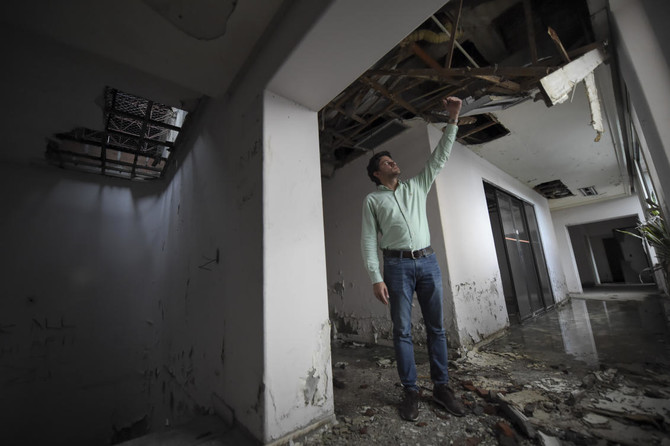
Dec. 2 marks the 25th anniversary of drug lord Pablo Escobar’s death. (AFP)
2 / 3
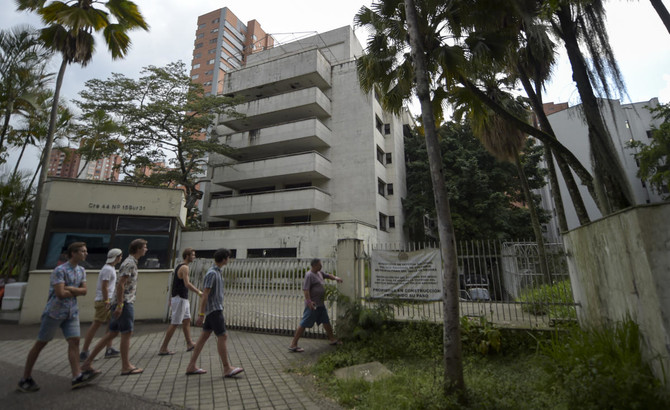
Tourists visit the Monaco building, which was once home to Colombian drug lord Pablo Escobar, in Medellin, Colombia. (AFP)
3 / 3
Medellin’s Mayor’s Office announced that the Monaco Building will be demolished next year and the site will be turned into a park in memory of the victims of the drug war. (AFP)
Updated 02 December 2018
Follow

Pablo Escobar’s dark legacy refuses to die 25 years on

  • Escobar is remembered as the “Colombian Robin Hood” in the neighborhood that bears his name
  • Colombian society remains deeply divided over the legacy of Escobar and other drug barons

MEDELLIN, Colombia: Twenty-five years after he was gunned down by police, Pablo Escobar’s legacy refuses to die in Medellin, the Colombian city where he ran his cocaine empire with a mix of brutality and largesse.
Even as city officials prepare to demolish the bunker-like mansion where the late drug lord lived, in the neighborhood that bears his name residents who live in homes he built for them are planning heartfelt tributes to mark Sunday’s anniversary.
Escobar was killed in a rooftop shootout in Medellin on December 2, 1993 — one day after his 44th birthday, and five months after he appeared on Forbes magazine’s list of the world’s richest people for the seventh straight time.
His eight-story mansion, the Monaco, a symbol of the decadent opulence of the Colombian mafia in the 1980s and 90s, has fallen into disrepair in the years since his death.
Its battered frame still bears the scars of Colombia’s first car bombing, in 1988, the start of a bloody war between the country’s rival cartels.
The hulking white building is slated to be demolished in February, in a public implosion complete with stands for viewers to watch.
“The Monaco has become an anti-symbol, in a place where some people are outspoken defenders of crime and terrorism,” says Manuel Villa, the city hall secretary who will perform the official countdown to the detonation.
“We don’t want any more children saying they want to be Pablo Escobar when they grow up.”
The mansion, a top tourist attraction in Medellin’s upscale El Poblado neighborhood, will be replaced by a public park dedicated to the thousands of people killed in Colombia by “narcoterrorism” — the no-holds-barred war the cartels waged on each other and the state in the 1980s and ‘90s.
The park will cost an estimated $2.5 million. Renovating and reinforcing the crumbling mansion would have cost $11 million, according to the city.
“It will be painful” to tear it down, says Villa, “but it’s the only way we can heal our wounds.”

Colombian society remains deeply divided over the legacy of Escobar and other drug barons.
Angela Zuluaga is one of those who wants to wipe out the country’s lingering “narco culture.”
She was an unborn baby in her mother’s womb when Escobar hitmen assassinated her father, a judge, for issuing an arrest warrant against their boss. Her mother was wounded in the October 1986 attack.
“Creating a space to remember the victims means having a space where we attempt to symbolically compensate those of us who have suffered from the scourge of narcoterrorism,” she says.
According to Medellin officials, Colombia’s drug violence killed 46,612 people from 1983 to 1994.

On the other side of this cultural divide, Luz Maria Escobar is changing the tombstone at her brother’s grave ahead of the anniversary of his death, as a crowd of tourists looks on.
Tearfully, she reads the new inscription: “Beyond the legend you symbolize today, few know the true essence of your life.”
Moved, a young woman from Puerto Rico asks if she can give her a hug.
Luz Maria acknowledges her brother made mistakes, but opposes the city’s plan to get rid of his home.
“Tearing down the Monaco isn’t going to demolish Pablo’s history,” she says.

Escobar is remembered as the “Colombian Robin Hood” in the neighborhood that bears his name, where he donated 443 houses to formerly homeless people who lived and scavenged at the local dump.
“I see him like a second God,” says one resident, Maria Eugenia Castano, 44, as she lights a candle at an altar that bears Escobar’s photograph.
“To me, God is first, and then him.”
At the nearby El Patron beauty salon, which sells, along with haircuts, a plethora of merchandise stamped with Escobar’s image, stylist Yamile Zapata sums up the contradictions of the late cocaine king’s memory.
“Pablo will confuse you,” she says.
“If you want to look at the good side, he was very good. If you want to look at the bad, he was very bad.”


EU leaders to reassess US ties despite Trump U-turn on Greenland

Updated 22 January 2026
Follow

EU leaders to reassess US ties despite Trump U-turn on Greenland

  • Diplomats stressed that, although Thursday’s emergency EU talks in Brussels would now lose some of their urgency, the longer-term issue of how to handle the relationship with the US remained

BRUSSELS: EU leaders will rethink their ties with the US at an emergency summit on Thursday after Donald Trump’s threat of tariffs and even military action to ​acquire Greenland badly shook confidence in the transatlantic relationship, diplomats said.
Trump abruptly stepped back on Wednesday from his threat of tariffs on eight European nations, ruled out using force to take Greenland, a semi-autonomous territory of NATO ally Denmark, and suggested a deal was in sight to end the dispute.
German Chancellor Friedrich Merz, welcoming Trump’s U-turn on Greenland, urged Europeans not to be too quick to write off the transatlantic partnership.
But EU governments remain wary of another change of mind by a mercurial president who is increasingly seen as a bully that Europe will have to stand up to, and they are focused on coming up with a longer-term plan on how to deal with the ‌United States under this ‌administration and possibly its successors too.
“Trump crossed the Rubicon. He might do ‌it ⁠again. ​There is no ‌going back to what it was. And leaders will discuss it,” one EU diplomat said, adding that the bloc needed to move away from its heavy reliance on the US in many areas.
“We need to try to keep him (Trump) close while working on becoming more independent from the US It is a process, probably a long one,” the diplomat said.
EU RELIANCE ON US
After decades of relying on the United States for defense within the NATO alliance, the EU lacks the needed intelligence, transport, missile defense and production capabilities to defend itself against a possible Russian attack. This gives the US substantial leverage.
The US ⁠is also Europe’s biggest trading partner, making the EU vulnerable to Trump’s policies of imposing tariffs to reduce Washington’s trade deficit in goods, and, as in ‌the case of Greenland, to achieve other goals.
“We need to discuss where ‍the red lines are, how we deal with this bully ‍across the Atlantic, where our strengths are,” a second EU diplomat said.
“Trump says no tariffs today, but does ‍that mean also no tariffs tomorrow, or will he again quickly change his mind? We need to discuss what to do then,” the second diplomat said.
The EU had been considering a package of retaliatory tariffs on 93 billion euros ($108.74 billion) on US imports or anti-coercive measures if Trump had gone ahead with his own tariffs, while knowing such a step would harm Europe’s economy as well ​as the United States.
WHAT’S THE GREENLAND DEAL?
Several diplomats noted there were still few details of the new plan for Greenland, agreed between Trump and NATO Secretary General Mark Rutte late on ⁠Wednesday on the sidelines of the World Economic Forum in Davos, Switzerland.
“Nothing much changed. We still need to see details of the Greenland deal. We are a bit fed up with all the bullying. And we need to act on a few things: more resiliency, unity, get our things together on internal market, competitiveness. And no more accepting tariff bullying,” a third diplomat said.
Rutte told Reuters in an interview in Davos on Thursday that under the framework deal he reached with Trump the Western allies would have to step up their presence in the Arctic.
He also said talks would continue between Denmark, Greenland and the US on specific issues.
Diplomats stressed that, although Thursday’s emergency EU talks in Brussels would now lose some of their urgency, the longer-term issue of how to handle the relationship with the US remained.
“The approach of a united front in solidarity with Denmark and Greenland while focusing on de-escalation and finding an off-ramp has worked,” a fourth EU diplomat said.
“At the ‌same time it would be good to reflect on the state of the relationship and how we want to shape this going forward, given the experiences of the past week (and year),” he said.