

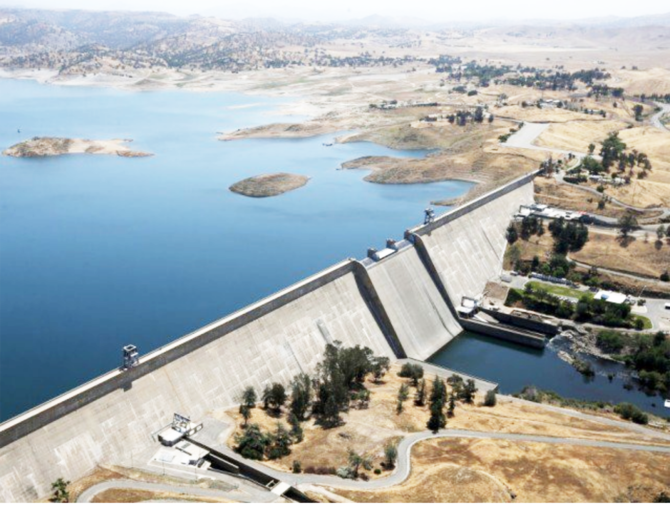

KARACHI: Once the victim of terrorism, Pakistan now faces another major risk in the form of a looming water crisis which is expected to impact the country’s “ease of doing business”, even as experts called for immediate action on Monday to address the situation.
According to a report filed by the World Economic Forum (WEF), titled “Regional Risks for Doing Business”, a water crisis was listed as the top risk among five faced by Pakistan’s economy. This was followed by other issues such as unmanageable inflation, terrorist attacks, urban planning failure, and critical infrastructure.
The report is based a survey conducted between January and June this year in Bangladesh, India, Nepal, Pakistan and Sri Lanka.
As Pakistan faces a threat to its water resources due to a lack of reservoirs and reduced storage capacities in existing dams, experts called for all-out efforts in both the public and private sectors to mitigate the impacts of the crisis.
“The government has started work on the construction of dams which will materialize in the long run. However, immediate action is required to address the problem in the short-term by improving water management,” Sanna Baxamoosa, General Manager of Hisaar Foundation – an organization working for water, food and livelihood security -- told Arab News on Monday.
“Around 90 percent of the water is being utilized in the country’s agriculture sector that needs to be managed in an efficient way by diverting a part of it to urban centers,” Baxamoosa said, adding that the perception that the “country with an abundant flow of fresh water will not run dry by 2025” is wrong.
Pakistan stores only 10 percent of the water flowing in its rivers, while 90 percent goes to waste due to lack of adequate facilities such as new reservoirs. To cope with the emerging water crisis, the Supreme Court of Pakistan has set up a dam fund, the proceeds of which will go towards the construction of the Diamer-Bhasha and Mohmand Dams. Thus far, the fund has managed to raise Rs8 billion, with the Chief Justice of Pakistan, Mian Saqib Nisar, currently in London to attend several fundraising gatherings. Estimated cost of Diamer-Bhasha Dam is around PKR 1450 billion while the cost of Mohmand dam is Rs 300 billion.
According to the WEF report, unmanageable inflation remains the second-highest risk faced by Pakistan and the region. “South Asia benefited from low global oil prices between 2014–16, but a combination of rising energy prices and expansionary monetary and fiscal stances point to inflationary risks. There are already indications of mounting price pressures in some countries,” the report added.
CPI inflation general increased by 6.8 percent on a year-on-year basis in October this year as compared to an increase of 5.1 percent in the previous month and 3.8 percent in October last year, according to data released by Pakistan’s Federal Bureau of Statistics.
However, economists say that the government’s efforts to address the risks are on a positive trajectory. “The inflation is linked with the oil prices. The present government has negotiated with Saudi Arabia, China and other countries for financial support which once materializes would stabilize the currency and resultantly the prices would be eased,” Dr Bilal Ahmed, a senior economist, said.
“Pakistan has successfully combated the menace of terrorism and the report has also downplayed it,” Dr Ahmed said, adding that “in case of urban planning and critical infrastructure, there are some weaknesses but efforts are underway to improve infrastructure including development of new cities such as Gwadar”.
The WEF report also said the 10 major risks in doing business in South Asia include failure of national governance, unmanageable inflation, unemployment and under-employment, failure of regional and global governance, cyber-attacks, failure of critical infrastructure, energy price shocks, failure of financial mechanism or institution, water crises, and large-scale involuntary migration.


