ISLAMABAD: Former diplomats and members from Pakistan’s Sikh community welcomed the government’s initiative on Monday to develop a cross-border corridor which would allow pilgrims from India to visit the final resting place of Guru Nanak, the religion’s founder, in Kartarpur.
“We are very excited to welcome our Indian brothers to Gurdwara Darbar Sahib Kartarpur. We are thankful to Prime Minister Imran Khan for facilitating our brothers and sisters across the border,” Ranjeet Singh, a lawmaker in the Khyber Pakhtunkhwa Assembly, told Arab News.
He added that Sikhs from across the globe have been lobbying for years to get an easy access to the revered shrine where Guru Nanak spent the last 18 years of his life. “Kartarpur Gurdwara is one of the most sacred places for the Sikh community and provision of easy access to the pilgrims, I believe, will also augur well for peace and prosperity in Pakistan,” he said.
“The opening of the Kartarpur corridor also shows that Pakistan cares for its religious minorities and this will send a good message to the international community as well,” Singh added.
Prime Minister Imran Khan is expected to participate in a groundbreaking ceremony in Kartarpur on November 28, which will be attended by dignitaries and journalists from both the countries. “We will grant a visa-free entrance to all the pilgrims coming from India and a separate mechanism for that purpose is being developed,” Fawad Chaudhry, Federal Minister for Information, told journalists on Friday.
The Indian government has also agreed to develop the corridor on its side to facilitate the pilgrims. India’s Vice-president M Venkaiah Naidu on Monday laid the foundation stone for the construction of the 4km-long corridor connecting Dera Baba Nanak in India’s Gurdaspur district with the Gurdwara Kartarpur Sahib in Pakistan.
Former ambassadors also welcomed the move saying that it would increase people to people contact in both the countries. “This is a good initiative,” Aziz Ahmad Khan, a former diplomat, told Arab News. He, however, said that this is a “very small” step to help normalize relations between the two nuclear-armed neighbors. “The initiative will help improve the environment, but normalization of the relationship (between Pakistan and India) is a complicated process,” he said.
Former ambassador Ayaz Wazir concurred, adding that: “Pakistan and India are two important countries in the region and their cordial relationship can contribute to prosperity and regional peace including peaceful settlement of Afghan conflict.”
The Kartarpur corridor will be a cross-border gateway between Pakistan and India to allow Sikh pilgrims easy access to the holy shrine of Kartarpur Sahib. It is located in the Narowal district of Pakistan’s Punjab province along the river Ravi, four kilometers from the Indian border.
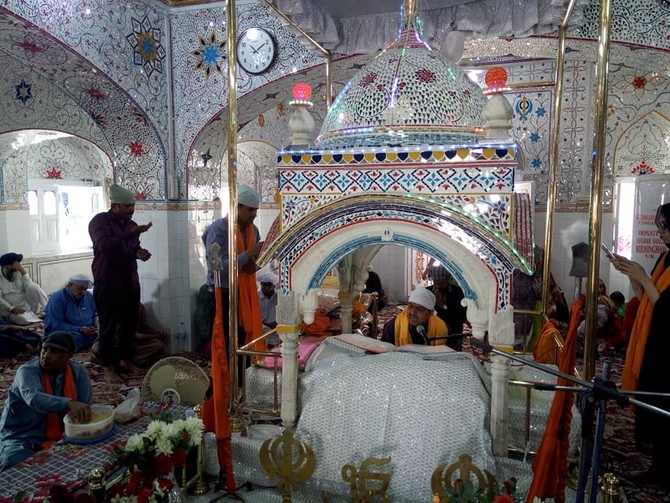
The shrine was built to commemorate the site where Guru Nanak, the founder of Sikhism, stayed after completing his missionary work. He formed a Sikh community there and resided in the place for 18 years until his death in 1539. The Gurdwara is built in the same place where Guru Nanak is said to have died. Its religious significance can be gauged from the fact that Indian Sikhs gather in large numbers for darshans (sacred viewing of the site) using telescopes from across the border.
Plans to build the corridor were first proposed in 1999 when India’s late Prime Minister, Atal Bihari Vajpayee, took a highly-symbolic bus ride from New Delhi to Lahore on the inaugural journey of Routemaster 10, which was intended to provide a means for citizens of India and Pakistan to visit each other. The bus service was briefly discontinued following the attack on the Indian Parliament in 2001 and resumed operations in 2003.
The total population of Sikhs is estimated to be around 27 million across the world, out of which 20.8 million reside in India, with Pakistan home to approximately 10,000 community members. Pakistan’s Sikh population is predominantly Pashtun inhabiting areas in the northwest Khyber Pakhtunkhwa region and tribal districts.


![]()
![]()

Pakistani Sikhs, diplomats welcome opening of Kartarpur corridor
Pakistani Sikhs, diplomats welcome opening of Kartarpur corridor
- Place holds significance as founder of religion had lived there for 18 years until his death
- Lawmaker says move reflects country’s care and concern for minority communities
Latest updates


© 2026 SAUDI RESEARCH & PUBLISHING COMPANY, All Rights Reserved And subject to Terms of Use Agreement.