LONDON: Dubai developers are targeting UK investors as Brexit shakes confidence in British bricks and mortar.
The Dubai Property Show (DPS) kicked off on Friday at London’s Olympia Exhibition Centre amid a Brexit-fueled political storm and attempts to unseat Prime Minister Theresa May by politicians from her own party.
House prices across the UK are rising at the slowest annual pace since 2013 according to data from Nationwide published earlier this month, with fresh concerns emerging over what a no-deal Brexit would mean for UK property values.
Some Dubai developers, which have experienced their own property slowdown over the last four years, see UK property weakness and sterling volatility as a potential sales opportunity.
Samir Jalali was among the visitors to the London event, looking for potential investments for a client, one of the world’s largest rice dealers.
 They were interested in “signature” properties, he said, adding: “Dubai is still one of those desirable destinations. This is a good time and opportunity to acquire property for a year or two.”
At the Hera Tower stand, business was brisk.
“Lots of inquiries, but no, nobody has bought yet,” said one of the young women buttonholing the passers-by.
The development overlooking the canal near Dubai Sports City is three-quarters built and is due to be completed in June. Prices vary from £78,892 ($101,193) for a studio to £155,523 for a two-bedroom apartment, and the company claims to guarantee returns of at least 6 percent on rental.
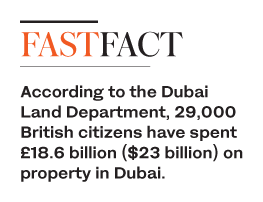
The British are regularly among the top three investor groups from outside the Middle East.
Aqil Kazim, chief commercial officer of Nakheel, the developer behind Dubai’s famous Palm Islands, said the company had 2,530 British investors who have spent £1.3 billion on property.
“The momentum is still there for innovative projects like ours. With currency shifts against the dollar, Dubai can be a positive alternative, a reliable place to invest.”
That optimism is reinforced by the Dubai government’s announcement of Mashrooi — a remote property management system, complete with its own dedicated judicial authority to regulate the property sector, aimed at reassuring overseas investors.
The move should make foreigners more confident about buying property in Dubai, said Kazim.
“It means owners from overseas don’t even have to be in Dubai to manage their property. Tenancy disputes will be dealt with within a dedicated judicial and legal system instead of taking forever through the ordinary courts,” said Kazim. “It makes the rental property sector very transparent. Nakheel certainly welcomes it as being of benefit.”
The introduction of Mashrooi was announced in the emirate last week. Tala Khalifa Al-Suwaidi, of the Dubai Land Department, said Mashrooi was due to come into operation in the first quarter of next year.
“It is all absolutely secure legally because this comes from the government of Dubai, ” he told Arab News. “Everything any investor wants to know about buying and managing property in Dubai, he can find out through Mashrooi, which means the information will be coming from the government of Dubai.”
Nakheel currently has £12 billion worth of property for sale, ranging from high-end luxury homes to “stylish, functional” accommodation for lower budgets.
Apartments in the 52-story Palm Tower (with an infinity pool on the 50th floor and views over the whole Palm complex) start at £345,000 for a studio. The tower is due to be completed in late 2019.
Nick Sajid, director of Invest Property, was also shopping for clients at the DPS and making contacts.
“Dubai is a global destination. It has the panache that London had until values got too high,” he said. The property market had also “matured” a great deal in the past 15 years.
“It used to be that everything was in the hands of just a couple of names. It was oligopolistic. Now there is balance in competition and the prices have been corrected. It is a safe bet,” he said.