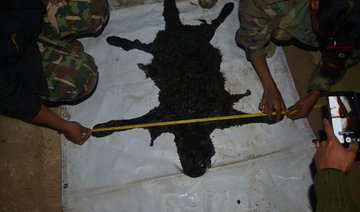
NAYPYIDAW, Myanmar: Elephant skins, clouded leopard remains and tiger bones were among a $1.3 million haul of illegal wildlife incinerated Thursday in Myanmar’s first ever public event of its kind against the illicit trade.
Trafficking and selling endangered animals is rampant across Myanmar, especially in border areas which serve as a key hub in the $20 billion a year global wildlife trade.
Much of the demand is fueled by a long-held belief in neighboring China that rare animals have medicinal value.
Elephant parts — including chunks of skin — are the most lucrative for poachers in Myanmar.
Thursday’s ceremony in the capital Naypyidaw saw 850 kilograms of seized contraband set ablaze, including elephant ivory, tiger bone and skin, antelope antlers and pangolin scales.
“Rare wildlife including Myanmar’s elephants, tigers, bears and pangolins are the natural heritage of our country,” Nyi Nyi Kyaw, director general of the Forest Department, said in a statement.
He noted an alarming increase in elephant poaching by gangs who have moved from southern Myanmar into the northern and western regions of Rakhine — a migratory path for wild elephants to Bangladesh.
The Forest Department would “take action” and confiscate their weapons whenever possible, he added, saying new forensic kits to identify fingerprints from seized ivory would help the crackdown.
Myanmar faces an uphill battle against poachers who rake in cash from its long unregulated wildlife trade, a business which thrives in the lawless eastern periphery and border regions.
Sapai Min of WWF Myanmar said the government is making “good progress in the struggle against wildlife crime,” and pointed to the increase of rangers patrolling poaching hotspots.
But critics say the government has shown a lack of political will to tackle a sophisticated network of criminals who are thought to be armed and funded by powerful “kingpins” in China.
Edwin Wiek of Wildlife Friends Foundation in Thailand said the burning ceremony was timed to coincide with a Convention on International Trade in Endangered Species (CITES) meeting in Russia.
“More important for me is the people involved with the confiscation of the $1.3 million (of wildlife parts) — who were these people, have they been found guilty or fined or given jail terms?” he said.
“If that is the case, then that would show a real change of policy.”
Myanmar is a signatory to CITES, which means that hunting wildlife is illegal in the country.


Myanmar torches $1.3 million of illegal wildlife parts

Myanmar torches $1.3 million of illegal wildlife parts
- Trafficking and selling endangered animals is rampant across Myanmar
- Myanmar is a signatory to CITES, which means that hunting wildlife is illegal in the country


Makkah museum displays world’s largest Qur’an
MAKKAH: The Holy Qur’an Museum at the Hira Cultural District in Makkah is showcasing a monumental handwritten copy of the Holy Qur’an, recognized as the largest Qur’an of its kind in the world.
The manuscript measures 312 cm by 220 cm and comprises 700 pages, earning the museum recognition from Guinness World Records for displaying the world’s largest Qur’an, the Saudi Press Agency reported.
The manuscript is a magnified reproduction of a historic Qur’an dating back to the 16th century, the SPA stated.
The original copy measures 45 cm by 30 cm, with the chapters written primarily in Thuluth script, while Surah Al-Fatiha was penned in Naskh, reflecting the refined artistic choices and calligraphic diversity of the era.
The Qur’an is a unique example of Arabic calligraphy, gilding and bookbinding, showcasing Islamic art through intricate decorations, sun-shaped motifs on the opening folio, and elaborately designed frontispiece and title pages that reflect a high level of artistic mastery.
The manuscript was endowed as a waqf in 1883. Its original version is currently preserved at the King Abdulaziz Complex for Endowment Libraries, serving as a lasting testament to Muslims’ enduring reverence for the Qur’an and the richness of Islamic arts across the centuries.


