LONDON: Growth in Iraqi oil production will be squeezed for the next decade despite the country being the second largest OPEC producer after Saudi Arabia and the fourth biggest in the world, according to a report by US consultancy IHS Markit.
The findings come after a week when the price of Brent crude reached $80 a barrel, with supply worries having been heightened by Hurricane Florence heading toward the US, threatening to derail US oil pipelines. Also looming large was the expected effect on supply by the reimposition of US sanctions on Iran.
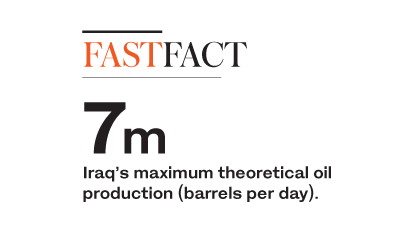
IHS said that Iraq, which theoretically could produce about 7 million barrels per day (bpd), would only marginally boost output to 2028. The current 4.5 million bpd would only increase to 5 million bpd over the next decade, said IHS analyst Christopher Elsner in an interview with Arab News.
Elsner said that he may revise his forecast upward if conditions in the country improve, but on current thinking, even by 2036 Iraq’s production would only reach 6 million bpd, he said.
A former international energy infrastructure analyst at the US Department of Energy who has worked on Iraqi projects, Elsner commented: “Yes, our numbers are conservative against the official Iraqi data. There is a lot of investment in getting wells out of the ground. And there’s a lot of investment in exporting that oil. But the connections between the oil fields and the storage farms in the south and the export points have been what has really led to the bottlenecks in Iraq.”
Other impediments were the absence of electricity to run some oil fields, as well as the lack of pipelines, pumping stations and storage space — all of which have constrained capacity.
“Coordinating the purchase of various components such that you can progress without delay … has been another major issue,” said Elsner.
The state-run company responsible for oil projects in mid-stream had “a spotty execution track record,” he added. There was legal uncertainty around contracts, security risks, and water and electricity services were unreliable.
The IHS report added that Iraq’s crude oil consumption is currently 0.7 million bpd, and this was expected to grow very slowly, to 0.8 million bpd by 2030. Iraq’s crude exports are the difference between production and consumption.
The oil-rich Basra province was rocked by renewed violence earlier this month as political protests regain momentum, threatening oil facilities. Thousands of Iraqis have been taking to the streets daily over the past week, torching government buildings and political party offices.
The demonstrations have added to oil supply concerns, although these turn principally around worries about the absence of Iranian crude later this year when US sanctions kick in. India and China have begun to reduce their purchases of Iranian oil while South Korea has already dropped imports to zero on the orders of the Trump administration, according to the Financial Times.

Iraq oil production to be ‘squeezed for next decade’
- The state-run company responsible for oil projects in mid-stream had “a spotty execution track record
First EU–Saudi roundtable on critical raw materials reflects shared policy commitment
RIYADH: The EU–Saudi Arabia Business and Investment Dialogue on Advancing Critical Raw Materials Value Chains, held in Riyadh as part of the Future Minerals Forum, brought together senior policymakers, industry leaders, and investors to advance strategic cooperation across critical raw materials value chains.
Organized under a Team Europe approach by the EU–GCC Cooperation on Green Transition Project, in coordination with the EU Delegation to Saudi Arabia, the European Chamber of Commerce in the Kingdom and in close cooperation with FMF, the dialogue provided a high-level platform to explore European actions under the EU Critical Raw Materials Act and ResourceEU alongside the Kingdom’s aspirations for minerals, industrial, and investment priorities.
This is in line with Saudi Vision 2030 and broader regional ambitions across the GCC, MENA, and Africa.
ResourceEU is the EU’s new strategic action plan, launched in late 2025, to secure a reliable supply of critical raw materials like lithium, rare earths, and cobalt, reducing dependency on single suppliers, such as China, by boosting domestic extraction, processing, recycling, stockpiling, and strategic partnerships with resource-rich nations.
The first ever EU–Saudi roundtable on critical raw materials was opened by the bloc’s Ambassador to the Kingdom, Christophe Farnaud, together with Saudi Deputy Minister for Mining Development Turki Al-Babtain, turning policy alignment into concrete cooperation.
Farnaud underlined the central role of international cooperation in the implementation of the EU’s critical raw materials policy framework.
“As the European Union advances the implementation of its Critical Raw Materials policy, international cooperation is indispensable to building secure, diversified, and sustainable value chains. Saudi Arabia is a key partner in this effort. This dialogue reflects our shared commitment to translate policy alignment into concrete business and investment cooperation that supports the green and digital transitions,” said the ambassador.
Discussions focused on strengthening resilient, diversified, and responsible CRM supply chains that are essential to the green and digital transitions.
Participants explored concrete opportunities for EU–Saudi cooperation across the full value chain, including exploration, mining, and processing and refining, as well as recycling, downstream manufacturing, and the mobilization of private investment and sustainable finance, underpinned by high environmental, social, and governance standards.
From the Saudi side, the dialogue was framed as a key contribution to the Kingdom’s industrial transformation and long-term economic diversification agenda under Vision 2030, with a strong focus on responsible resource development and global market integration.
“Developing globally competitive mineral hubs and sustainable value chains is a central pillar of Saudi Vision 2030 and the Kingdom’s industrial transformation. Our engagement with the European Union through this dialogue to strengthen upstream and downstream integration, attract high-quality investment, and advance responsible mining and processing. Enhanced cooperation with the EU, capitalizing on the demand dynamics of the EU Critical Raw Materials Act, will be key to delivering long-term value for both sides,” said Al-Babtain.
Valere Moutarlier, deputy director-general for European industry decarbonization, and directorate-general for the internal market, industry, entrepreneurship and SMEs at European Commission, said the EU Critical Raw Materials Act and ResourceEU provided a clear framework to strengthen Europe’s resilience while deepening its cooperation with international partners.
“Cooperation with Saudi Arabia is essential to advancing secure, sustainable, and diversified critical raw materials value chains. Dialogues such as this play a key role in translating policy ambitions into concrete industrial and investment cooperation,” she added.


