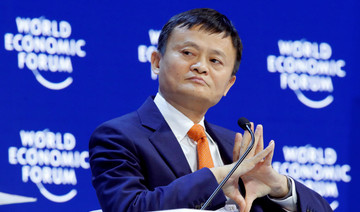
SHANGHAI: Alibaba co-founder Jack Ma announced on Monday he would step down as head of the pioneering Chinese e-commerce giant in one year, a departure already drawing comparisons to the retirement of late Apple founder Steve Jobs.
Analysts said the early withdrawal of the 54-year-old Ma, who became the charismatic face of a company that has revolutionized how and what China’s people consume, will test the company’s ability to carry on Ma’s vision amid rising competition.
But like Apple’s transition to current boss Tim Cook, Alibaba CEO and anointed successor Daniel Zhang may be less magnetic than his predecessor but has proven an able steward since effectively taking the operational reins years ago, they said.
“Day-to-day operations-wise Alibaba will not be affected that much. But since he’s (Ma) the face of the company, people may lose a little bit of faith,” said Jackson Wong, associate director with Huarong Securities in Hong Kong.
“But where Jobs died, Ma is expected to stay on in an advisory role, so there shouldn’t be too much impact.”
Ma — who turned 54 on Monday — said in a statement that he will stay on as executive chairman until his 55th birthday before handing over that role to Zhang.
“While remaining as executive chairman in the next 12 months, I will work closely with Daniel to ensure a smooth and successful transition,” Ma said.
Ma, who has expressed a desire to follow in the philanthropy footsteps of Microsoft founder Bill Gates, said he would remain on Alibaba’s board until 2020.
“The one thing I can promise everyone is this: Alibaba was never about Jack Ma, but Jack Ma will forever belong to Alibaba,” he said.
Ma was an English teacher before starting Alibaba in his apartment in the eastern city of Hangzhou in 1999 — where its headquarters remain to this day — building it into an e-commerce colossus and becoming one of the world’s richest men and most recognizable figures in China.
He has a net worth of more than $40 billion according to the Bloomberg Billionaires Index, and Alibaba, which has shares listed in New York, was valued at $420.8 billion as of last Friday.
“Ma possesses an enviable clarity about how everything fits together,” said Mark Tanner, founder of Shanghai-based research and marketing company China Skinny, told Bloomberg News.
“He has understood Chinese consumer needs better than anyone and provided online services to meet them through convenience, entertainment and efficiencies.”
Alibaba sought to reassure investors of the change, with Ma saying he had “full confidence” that a leadership hierarchy in place for years will “win support from customers, employees and shareholders.”
But while Alibaba may lose the company’s face, analysts said the business brains remain with Zhang.
With his impish grin, Ma in recent years has largely assumed a role as a globe-hopping ambassador, marked by playful antics such as dressing up as Michael Jackson for a dance routine at a company gathering last year.
But it has been largely under the more reserved Zhang’s stewardship that Alibaba’s two main e-commerce platforms, Taobao and Tmall, have turned into richly profitable cash cows and other arms such as digital payments have flourished, said Wong of Huarong Securities.
The company has wowed investors year after year with sterling revenue growth with Zhang at the helm.
But Alibaba faces intense competition in China from the likes of rivals Tencent, JD.com, and other rising upstarts.
Alibaba still dominates Chinese e-commerce, however, and is pouring investment into new initiatives to broaden its ecosystem and stake out position in fast-growing future arms.
These include bricks-and-mortar retail, cloud computing, digital media, movies, the grocery sector, meal deliveries and advertising.
It also has upped investments in overseas ventures and in 2015 bought the South China Morning Post newspaper.
Alibaba did not specify exactly what Ma has planned post-retirement, but the former teacher has in recent years taken on education initiatives as pet projects.
“I still have lots of dreams to pursue. Those who know me know that I do not like to sit idle,” he said.