

First Afro-Pakistani lawmaker vows to raise up her community

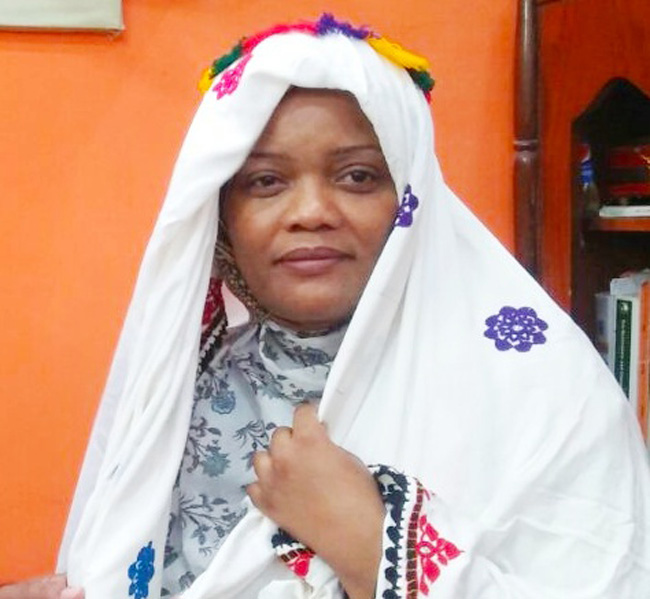
Tanzeela Qambrani, a resident of Matli in Badin district, who is also known as Tanzeela Sheedi, is the first Pakistani with African roots to become a lawmaker in Pakistan. (Photo courtesy: Tanzeela Qambrani)
Updated 10 August 2018
Follow

First Afro-Pakistani lawmaker vows to raise up her community

  • People of African descent have great hopes as the first Sheedi lawmaker, Tanzeela Qambrani, prepares to be sworn in on Monday
  • Qambrani said her top priorities are working for women’s financial empowerment and to better her Sheedi community

KARACHI: The first Afro-Pakistani lawmaker has urged parents to ensure their daughters get an education, saying that without educated girls there can be no progress.
“Please educate your daughters: This is my message to parents,” Tanzeela Qambrani, told Arab News. “There is no progress without education and empowering women, who make up more than 50 percent of the population.”
Qambrani, a resident of Matli in Badin district in Sindh province, who is also known as Tanzeela Sheedi, has been elected as member of the provincial assembly Sindh on the reserved seats of Pakistan People’s Party. She will be sworn in on Monday during the first session of new assembly.
After obtaining a master’s degree in computer sciences from University of Sindh, Jamshoro, she joined the Pakistan People’s Party in 2010. 
“I have been involved in social and community work for the past 12 years,” she said. “Until and unless the women are made economically independent, strong and empowered, and they start contributing to the family finances, they will not be part of the decision-making,” Qambrani said, vowing that she will strive for the economic independence for Sindh and Sheedi women.
“It’s my responsibility to create the space for other women which I am now enjoying. It’s my firm belief that there are more educated and competent women than me, but since they couldn’t get the space to grow, they lagged behind.” She said that these women will need to be mainstreamed through education and skill development programs.
“Since the party has given me this platform, I will use it for making women aware and skillful more effectively so that their economic dependency on others may end,” she said.
“I will also serve my Sheedi community to bring them on a par with other prosperous communities,” she pledged.
Sheedis attach hopes
Around 50,000 members of the Afro-Pakistani community live in Pakistan, majority in Sindh province. They are famous worldwide for the rituals they perform during the famous Sheedi festival at the shrine of Manghopir in Karachi.
Members of the community welcomed the news that the first woman from the Sheedi community has become a legislator. 
“We have got our voice which will be heard at the legislature,” said Ghulam Abbas Sheedi, a community leader from Manghopir. “We will go to Matli to felicitate our daughter, who has made us proud,” she said.
“Our community is spread in parts of Sindh and Balochistan, however our sister from Badin made us proud by getting an important position,” said Majid Sheedi. “We will be heard and our issues will be resolved,” he added.

Pakistan plans Benghazi consulate, lending legitimacy to Libya’s eastern authorities

Updated 6 sec ago
Follow

Pakistan plans Benghazi consulate, lending legitimacy to Libya’s eastern authorities

  • Libya descended into turmoil after a 2011 NATO-backed uprising toppled Muammar Qaddafi and has been divided into eastern, western authorities
  • The UN-recognized government in Tripoli controls the west, while the Libyan National Army forces based in ‌Benghazi hold ‌the east and the south

KARACHI: Pakistan is in talks to open a consulate ​in the eastern Libyan city of Benghazi, three sources with knowledge of the matter said, a move that could give a diplomatic boost to eastern authorities in their rivalry with Libya’s west.

Libya descended into turmoil after a 2011 NATO-backed uprising toppled Muammar Qaddafi and has been divided into eastern and western authorities since a 2014 civil war. The UN-recognized government in Tripoli controls the west, while

Libyan National Army leader Field Marshal Khalifa Haftar’s forces based in ‌Benghazi hold ‌the east and south, including major oilfields.

Islamabad would be ‌joining ⁠a ​small ‌group of countries with a diplomatic presence in Benghazi. Haftar discussed the move with officials during an ongoing visit to Pakistan, the sources said.

Haftar met Pakistan’s army chief on Monday to discuss “professional cooperation,” the Pakistani military said. He was due to sit down with Prime Minister Shehbaz Sharif on Tuesday, the sources said, declining to be identified because they were not authorized to speak to the media.

Pakistan’s prime ⁠minister’s office and foreign ministry did not respond to requests for comment.

The LNA’s official media page ‌said Haftar and his son Saddam met senior Pakistani ‍army officials “within the framework of strengthening bilateral ‍relations and opening up broader horizons for coordination in areas of common ‍interest.” It did not give further details and Reuters could not immediately reach eastern Libyan authorities for comment.

Pakistan’s air force said in a statement that Saddam Khalifa Haftar met Air Chief Zaheer Ahmed Baber Sidhu to discuss expanding defense cooperation, including joint training, ​with Islamabad reaffirming its support for the “capability development” of the Libyan air force. Pakistan’s army chief Field Marshal Asim Munir visited Benghazi in December, ⁠where he signed a multibillion-dollar defense deal with the LNA, previously reported by Reuters.

All three sources said the decision to open a consulate in Benghazi was linked to the $4 billion defense deal, one of Pakistan’s largest-ever arms sales.

Libya has been under a UN arms embargo since 2011, although UN experts have said it is ineffective. Pakistani officials involved in the December deal said it did not violate UN restrictions. Haftar has historically been an ally of the UAE, which supported him with air power and viewed him as a bulwark against extremists, while Pakistan — the only nuclear-armed Muslim-majority nation — signed a wide-ranging mutual defense pact with Saudi Arabia ‌late last year.