

First female duty officer at Kohat police station gives women confidence to come forth

1 / 2
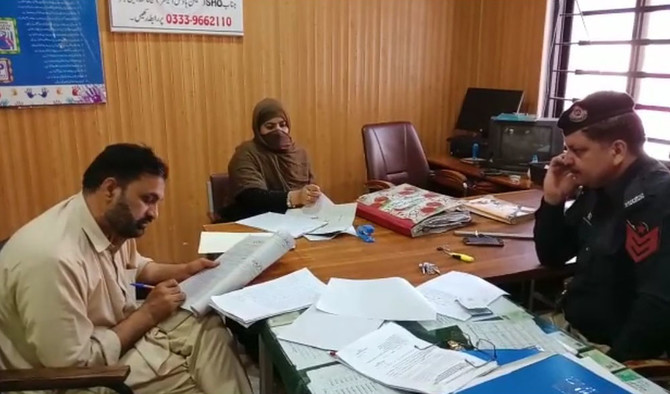
Zobia Mussarrat at work in the city of Kohat. (AN photo)
2 / 2
Zobia Mussarrat at work in the city of Kohat. (AN photo)
Updated 26 June 2018
Follow

First female duty officer at Kohat police station gives women confidence to come forth

  • Zobia Mussarrat wants to help women round-the-clock
  • KP Police set to appoint more female duty officers

PESHAWAR: Zobia Mussarrat expresses pride in being the first female duty officer at a police station in the city of Kohat in Khyber Pakhtunkhwa (KP) province.
She tends to the station’s financial and administrative matters, monitors the weapons depot, arranges food for locked-up suspects, and looks after the section where seized goods and money are kept.
Mussarrat graduated from Allama Iqbal Open University, and joined the police force in 2009. She has three children, and her husband is also part of the police department.
Mussarrat said it was always her passion to join the police. Since joining the station as duty officer in May 2018, she has resolved at least a dozen cases, most of them related to domestic violence and theft.
“We encourage people to resolve their problems without going to court. A large number of women have started approaching our police station in recent weeks, since they know there’s a female duty officer here,” she told Arab News on Tuesday.
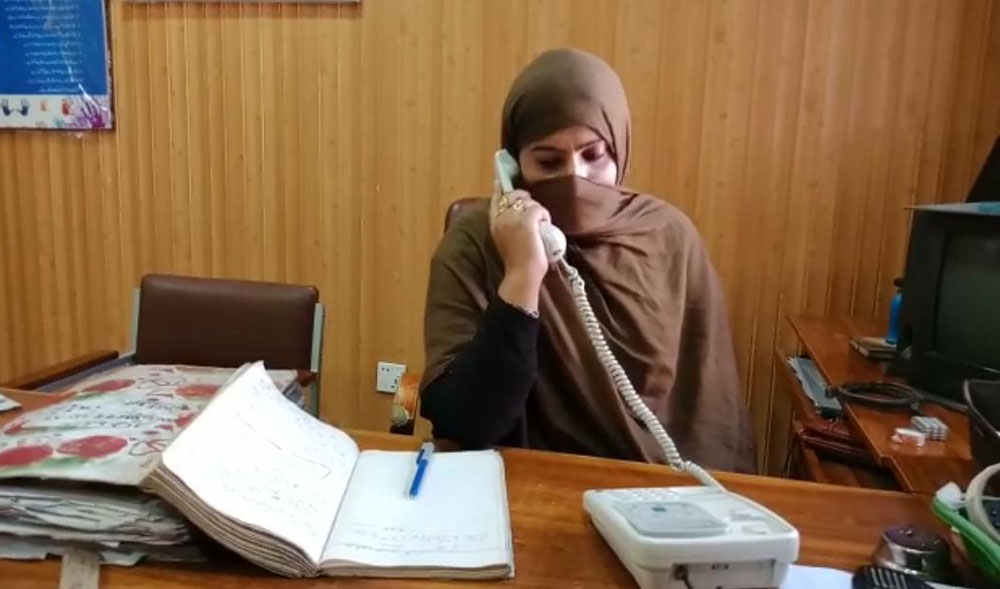


Zobia Mussarrat says she enjoys her job as duty officer as women are more forthcoming with her. (AN photo)

“These women share all sorts of information with me. Previously, many of them were reluctant to visit police stations, even when they had genuine grievances.”
Kohat’s former District Police Officer Abbas Majeed Marwat said officials in his department had held an exam to recruit a suitable duty officer, and Mussarrat came top.
“The aim of her appointment was to give equal opportunity to women in the force as well. Normally, our duty officers are all men,” he told Arab News. 
“Her appointment has encouraged female complainants to approach the police station in greater numbers and seek resolution of their problems.”
Kohat’s Superintendent Jamil Akhtar said other women are undergoing training. “Once they complete their training, they will be deputed as duty officers at various police stations,” he added. 
“We believe a female duty officer can handle issues facing women and children better, since female complainants are more willing to share information about their problems with them than with male police personnel.”
KP police has increased the role of women in recent months. A patrol force in the provincial capital Peshawar was established in 2016.
Deputy Superintendent Usman Khan said the team’s two female commandos and their male colleagues patrol the streets and help women and children in emergency cases.
“We have more female commandos on standby, and will call them whenever their services are required,” he said.

Bangladesh leader pushes for SAARC revival after meeting Indian, Pakistani dignitaries

Updated 5 sec ago
Follow

Bangladesh leader pushes for SAARC revival after meeting Indian, Pakistani dignitaries

  • Muhammad Yunus met Pakistan’s parliamentary speaker, Indian FM at Khaleda Zia’s funeral on Wednesday
  • SAARC has been dysfunctional since 2016, after India withdrew following a militant attack it blamed on Islamabad

ISLAMABAD: Bangladesh Chief Adviser Muhammad Younus this week pushed for reviving the South Asian Association for Regional Cooperation (SAARC) platform after meeting dignitaries from India, Pakistan and other parts of the region. 

SAARC has been effectively dysfunctional since 2016, when its planned Islamabad summit collapsed after India withdrew following a militant attack it blamed on Pakistan. Islamabad denied involvement, but New Delhi’s decision prompted Afghanistan, Bangladesh and Bhutan to pull out, leading to the indefinite postponement of the summit.

Younus met Pakistan’s National Assembly Speaker Ayaz Sadiq and Indian External Affairs Minister Subrahmanyam Jaishankar at former Bangladesh premier Khaleda Zia’s state funeral in Dhaka on Wednesday. The funeral also saw a handshake between the Indian and Pakistani representatives, the first high-level contact between officials of the two countries since their conflict in May. 

“During the meetings, Professor Yunus repeatedly emphasized the need to revive the South Asian Association for Regional Cooperation (SAARC),” Yunus’ account on social media platform X said.

“We witnessed a true SAARC spirit at the funeral yesterday,” the account quoted Yunus as saying. “SAARC is still alive. The SAARC spirit is still alive.”

The Bangladesh leader said apart from Jaishankar and Sadiq, representatives from South Asia who attended the funeral included Nepal’s Foreign Minister Bala Nanda Sharma, Sri Lanka’s Minister of Foreign Affairs, Employment and Tourism Vijitha Herath, and Maldives Minister of Higher Education and Labor Ali Haider Ahmed. 

Yunus said he tried to convene an informal gathering of SAARC leaders on the sidelines of the UN General Assembly in New York last year.

His statement to revive SAARC follows that of Pakistan’s Prime Minister Shehbaz Sharif, who earlier this month also called for reviving the South Asian platform. 

Sharif’s message last month came as the bloc marked the 40th anniversary of its founding charter. The Pakistani premier stressed the importance of deeper economic collaboration and collective responses to shared regional challenges such as poverty, climate-induced natural disasters, food and energy insecurity, and public-health vulnerabilities.