

Trump cuts India tariffs as Modi ‘agrees’ to stop buying Russian oil

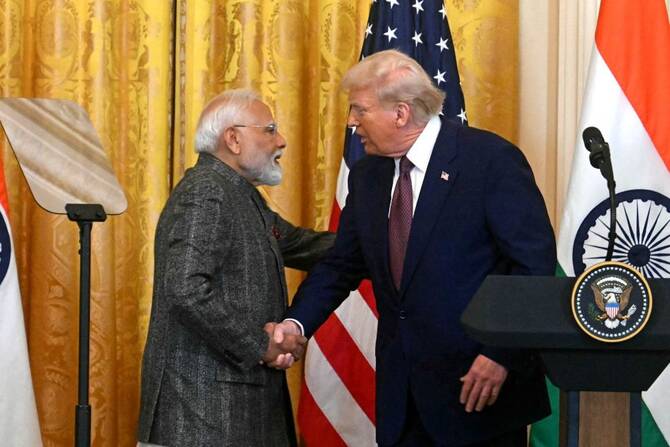
US President Donald Trump shakes hands with Indian Prime Minister Narendra Modi during a joint press conference in the East Room of the White House in Washington, DC, on Feb. 13, 2025. (AFP)
Short Url
Updated 04 February 2026
Follow

Trump cuts India tariffs as Modi ‘agrees’ to stop buying Russian oil

  • US will impose an 18 percent tariff on Indian goods, down from the earlier 50 percent punitive levy
  • Withdrawal from Russian oil may affect India’s relations with BRICS, expert says

NEW DELHI: The US and India have announced reaching a trade agreement after months of friction, with President Donald Trump saying that Prime Minister Narendra Modi had “agreed” to halt purchases of Russian oil.

In August, Trump accused India, which imports most of its crude oil, of funding Moscow’s war in Ukraine and subjected it to a combined tariff rate of about 50 percent on most of the exports.

Following a call with Modi on Monday, Trump took to social media to say that he would cut with immediate effect US levies on Indian goods to 18 percent after Modi “agreed to stop buying Russian Oil, and to buy much more from the United States and, potentially, Venezuela.”

At the same time, India, Trump wrote, would “reduce their Tariffs and Non Tariff Barriers against the United States, to ZERO,” committing to buy “over $500 BILLION DOLLARS of US Energy, Technology, Agricultural, Coal, and many other products.”

Modi confirmed the agreement on social media, saying: “Made in India products will now have a reduced tariff of 18 percent,” without commenting on Russian oil or duty-free imports of American goods.

When the US announced its punitive tariffs last year, India quickly moved forward with free trade negotiations with other countries — signing a deal with Oman and finalizing negotiations with New Zealand and the EU.

While the agreements were expected to partially offset the loss of exports to the US, economists did not expect they would immediately mitigate it, as shifting supply chains takes time.

The newly announced agreement with the US will therefore offer short-term relief for Indian exporters — especially of textiles, gems, jewelry and marine products — who were facing the threat of a market exit.

“In that case, the trade deal with the US is a welcome step. It provides short-term relief, allowing India to continue exporting to the US without being forced to exit the US market and diversify with a huge transition cost,” said Anisree Suresh, geoeconomics researcher at the Takshashila Institution.

“However, one shouldn’t look at it as a comprehensive long-term trade deal like the one India signed with the EU. The unpredictability of the Trump administration remains a major concern, regardless of whether there is a trade deal with the US ... India cannot treat this deal the same as other FTAs, as it is limited in scope and subject to reversal.”

When the US imposed its punitive tariffs on India, about 66 percent of total Indian exports were subject to that rate. Overall, India recorded a negative margin of 19.5 percent, meaning its exports were taxed more heavily than those of its competitors.

“From that point of view, Indian goods will have a larger market over there. However, there’s a problem when we talk about a 0 percent tariff on the US,” said Prof. Arun Kumar, a development economist.


“The US will be able to export a lot more to India, and therefore it will affect our production within the economy. And that will be a setback, so while exports may rise, the internal economy may actually suffer because of this decrease in tariffs on American goods. And especially if it affects agriculture.”

The sudden withdrawal from India’s partnership with Russia may not have a serious economic impact but politically could affect New Delhi’s relations, also with other countries, especially those from BRICS — a grouping that besides India and Russia includes also Brazil and China, and is the most powerful geopolitical forum outside of the Western world.

“You can always substitute Russian oil with some other oil, but I think it’s more of a strategic question, because India and Russia have had long-standing relationships, and if we bend to US pressure and reduce purchases from Russia, then it will affect in future also our relationship with Russia, because we will not be seen as a stable ally,” Kumar said.

“BRICS nations will not trust India very much in the future ... and that’s what Trump wants. He wants to disrupt BRICS. That’s what he has been doing right since the beginning to divide nations and deal with them individually.”


Tug of war: how US presidents battle Congress for military powers

Updated 5 sec ago
Follow

Tug of war: how US presidents battle Congress for military powers

  • The last official declaration of war by Congress was as far back as World War II

WASHINGTON, United States: Donald Trump’s unleashing of operation “Epic Fury” against Iran has once more underscored the long and bitter struggle between US presidents and Congress over who has the power to decide on foreign military action.
In his video address announcing “major combat” with the Islamic republic, Trump didn’t once mention any authorization or consultation with the US House of Representatives or Senate.
In doing so he sidelined not only Democrats, who called for an urgent war powers vote, but also his own Republican party as he asserts his dominance over a largely cowed legislature.
A US official said Secretary of State Marco Rubio had called top congressional leaders known as the “Gang of Eight” to give them a heads up on the Iran attack — adding that one was unreachable.
Rubio also “laid out the situation” and consulted with the same leaders on Tuesday in an hour-long briefing, the US official said.
According to the US Constitution, only Congress can declare war.
But at the same time the founding document of the United States first signed in 1787 says that the president is the “commander in chief” of the military, a definition that US leaders have in recent years taken very broadly.
The last official declaration of war by Congress was as far back as World War II.
There was no such proclamation during the unpopular Vietnam War, and it was then that Congress sought to reassert its powers.
In 1973 it adopted the War Powers Resolution, passed over Richard Nixon’s veto, to become the only lasting limit on unilateral presidential military action abroad.
The act allows the president to carry out a limited military intervention to respond to an urgent situation created by an attack against the United States.
In his video address on Saturday, Trump evoked an “imminent” threat to justify strikes against Iran.

- Sixty days -

Yet under this law, the president must still inform Congress within 48 hours.
It also says that if the president deploys US troops for a military action for more than 60 days, the head of state must then obtain the authorization of Congress for continued action.
That falls short of an official declaration of war.
The US Congress notably authorized the use of force in such a way after the September 11, 2011 attacks on the United States by Al-Qaeda. Presidents have used it over the past two decades for not only the 2001 invasion of Afghanistan but a series of operations in several countries linked to the “War on Terror.”
Trump is far from the first US president to launch military operations without going through Congress.
Democrat Bill Clinton launched US air strikes against Kosovo in 1999 as part of a NATO campaign, despite the lack of a green light from skeptical lawmakers.
Barack Obama did the same for airstrikes in Libya in 2011.
Trump followed their example in his first term in 2018 when he launched airstrikes in Syria along with Britain and France.
But since his return to power the 79-year-old has sought to push presidential power to its limits, and that includes in the military sphere.
Trump has ordered strikes on alleged drug trafficking boats in Latin America without consulting Congress, and in June 2025 struck Iran’s nuclear facilities.
Perhaps the most controversial act was when he ordered the capture of Venezuelan president Nicolas Maduro in a lightning military raid on January 3.
Republicans however managed to knock down moves by Democrats for a rare war powers resolution that would have curbed his authority over Venezuela operations.
Trump has meanwhile sought to extend his powers over the home front. Democrats have slammed the Republican for deploying the National Guard in several US cities in what he calls a crackdown on crime and immigration.