Shrines; the other invisible power in Pakistani politics

1 / 4
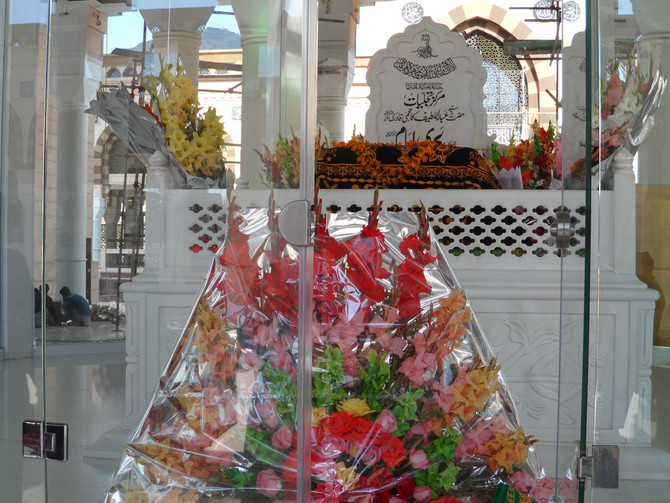
Devotees of the Sufi saint offer prayers and pay homage inside the Bari Imam shrine in Islamabad. (AN photo by Aamir Shah)
2 / 4
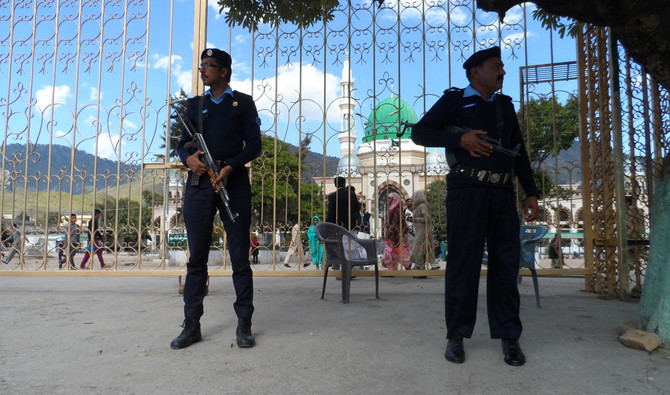
Police guard the shrine to Bari Imam shrine to17th century saint Shah Abdul Latif, in Islamabad, visited by thousands of devotees and tourists each day from across Pakistan. (AN photo by Aamir Shah)
3 / 4
Devotees bring flower bouquets to Bari Imam shrine to be placed alongside to honor the Sufi saint. (AN photo by Aamir Shah)
4 / 4
The shrine is cordoned off by barbed wire. Security personnel frisk people before letting them enter the shrine. (AN photo by Aamir Shah)
Updated 24 July 2018
Follow

Shrines; the other invisible power in Pakistani politics

  • According to research, around 64 shrines in Punjab alone have political connections
  • Political analysts say pirs change their political loyalties before elections to retain political influence and a keep a hold on followers

ISLAMABAD: Custodians of shrines, commonly known as pirs (spiritual leaders), are considered as vital part of Pakistani politics.
They enjoy a vast support of their followers both in rural and urban areas of the country that makes them power players in electoral politics.
The shrines of spiritual leaders are spread across Pakistan, especially in Punjab and Sindh provinces, besides the country’s federal capital – Islamabad.
The custodians of these shrines either contest elections from platforms of different political parties or announce their support for a particular candidate or a political party.
Their influence over the thousands of devotees make them a power players in electoral politics as devotees look to the pirs for guidance during the elections. Leaders of the key political parties visit them to seek their support.
“Basically, we are a conservative society and people still consider the pirs as their spiritual guide and take pride in becoming their devotees,” Professor Tahir Malik, political analyst and academic, told Arab News.
He said that in Punjab and Sindh provinces some pirs not only contest the elections, but are elected to the Parliament with ease as well. “They are electable candidates in their respective constituencies and change their political loyalties to remain in power and keep hold on their devotees-cum-constituents,” he said.
He added that shrine guardians participated in 1937 and 1946 elections of the subcontinent (partitioned into the two separate countries of India and Pakistan in 1947), emerging as a formidable force on the basis of their strong religious following.
“The pirs and their politics will keep thriving in Pakistan while superstitions and illiteracy persist,” he said, adding that control over the devotees is, however, waning with the increasing sway of the Internet and social media.
According to a research by Dr. Adeel Malik, a professor of development economics at the University of Oxford, there are around 64 shrines in Punjab province with direct political connections.
Multan district in Pakistan’s Punjab province has the highest number of shrine families in politics followed by Jhang, Rahim Yar Khan, Okara, Taunsa Sharif and Chishtian.
This research found that around 16 percent of the 342 members of the National Assembly that completed its five-year term in May belonged to shrine families.
For the 2018 elections, many shrine families are contesting the election from South Punjab while others support candidates and political parties of their choice.
Punjab remains the major battlefield for political parties for its number of seats in the National Assembly.
The province has 141 seats in the Lower House of the Parliament out of the 272 in which candidates contest direct elections.
It is said that the party to win Punjab can easily form a government in the center. This increases importance of the pirs and landlords in the province who emerge as the electable candidates for every political party.
The pirs, besides being guardians of the shrines, own vast extracts of agricultural land in their respective areas and collect donations from followers. This makes them virtually invincible in their constituencies.
Fayyaz Raja, a political analyst at a private television channel, said that the pirs and their followers traditionally supported two major political parties – Pakistan Muslim League-Nawaz and Pakistan Peoples Party – in the polls.
“This time the majority of them have switched to Pakistan Tehreek-e-Insaf due to the Khatam-e-Nabuwat issue,” he told Arab News.
An amendment in Khatam-e-Nabuwat (finality of Prophethood) clause, now withdrawn, prompted a row in November last year and will cost the outgoing ruling party, PML-N, in this election, Raja believes.
Custodians of some shrines are contesting elections as independent candidates, he said, adding they would become part of a political wheeling and dealing after the elections to form the government and get ministries of their choice.
Raja said that in the past couple of months, PTI chairman Imran Khan has been exploiting the issue of Khatam-e-Nabuwat and has succeeded in getting support of different shrines.
“It is quite normal for these pirs to switch political loyalties ahead of the elections,” he said, “this time they have used Khatam-e-Nabuwat as the pretext and switched to PTI to become part of the power game.”


Cold nights on Islamabad’s streets expose shelter shortages for daily-wage workers

Updated 11 sec ago
Follow

Cold nights on Islamabad’s streets expose shelter shortages for daily-wage workers

  • Overcrowded state-run shelters force laborers to sleep outdoors during winter
  • Welfare groups warn demand far outstrips capacity across Islamabad-Rawalpindi

ISLAMABAD: When 19-year-old Mubeen Khan finishes his shift as a daily-wage laborer in Pakistan’s capital, his workday does not end at home but outdoors, where he searches for a place to sleep for the night.

One evening this week, Khan spread his thin bedding on a roadside green belt near Islamabad’s Peshawar Mor, a major transport junction and bus terminal in the capital’s G-9 sector. Despite a biting winter chill that has settled over the city, he has been sleeping in the open for months.

Khan spends his days working and returns at night to nearby state-run shelters, but by the time he arrives, they are already full.

“When I come back, there isn’t any space,” he told Arab News after laying his bedding along the roadside.

“This Panagah fills up with beds by the time,” he said, pointing toward the nearby shelter. “I sleep here. It’s intensely cold, making it hard to survive, but still, we manage.”

Khan said more than 500 people try to sleep at the shelter each night, even though it has space for far less.

A daily wage worker is sleeping along a roadside in Islamabad on January 23, 2026. (AN Photo)

The plight of workers like him highlights a growing humanitarian strain in Pakistan’s capital, a city that houses senior government officials and some of the country’s wealthiest residents. As economic pressures persist, an influx of internal migrants from smaller towns is stretching Islamabad’s already limited social safety nets.

During the tenure of former prime minister Imran Khan, the Panagah initiative was expanded to provide shelter, food and beds to the destitute. However, residents and daily-wage workers say the program has lost momentum. At least one shelter in the G-6 sector has shut down, while others are so overcrowded that they are inaccessible to many laborers who need them most.

“Pakistan Baitul Mal is operating four shelters in Islamabad ..., with bedding facilities for a total of 450 people,” Qasim Zafar, Director Projects at the state-run welfare organization that provides financial assistance, shelter and food to vulnerable populations, said.

He added that each shelter provides dinner to around 400 people, while one of the facilities also serves lunch.

Zafar said Pakistan Baitul Mal also runs shelters in Karachi, Lahore and several smaller cities across all four provinces, as well as in Gilgit-Baltistan and Azad Kashmir, adding that the organization provides bedding and meals at these facilities.

For 58-year-old Abdul Qayum, however, the arrangements remain insufficient. Each night, he says, becomes a gamble between finding space on a shared veranda near his workplace or spending the night without rest.

“Sometimes there is space on the veranda, sometimes there isn’t. When it rains, a lot of people gather there,” he told Arab News, describing how people crowd into whatever covered spaces are available once the weather turns bad.

Daily wage workers sit along a roadside awaiting work in Islamabad on January 23, 2026. (AN Photo)

Qayum, who sends his meagre earnings back to his village to support his daughter’s education, said he cannot justify spending Rs 1,500 ($5.38) — his entire daily wage — on a bed.

“When it rains or a storm comes, everyone rushes toward the veranda,” he said. “Sometimes, if it’s not raining, I sleep under a tree. The veranda floor is also cold. The bedding we have is very thin ... It makes a person feel the cold.”

“Our life is just full of hardship,” he added.

Medical experts warn that prolonged exposure to winter cold poses serious health risks.

“When the temperature drops, they can suffer from hypothermia, and many deaths occur this way, though such deaths are generally not officially reported,” said Dr. Fazal Rabbi, a health expert, adding that no official data exists on deaths linked to winter exposure among people without shelter.

Beyond the immediate risk of freezing, he said, indirect illnesses such as pneumonia are increasingly affecting older people and those with underlying conditions like asthma.

“The body temperature should be kept above 36 degrees Celsius,” he said. “Otherwise, all these risks can arise.”

Daily wage workers sit around a fire along a roadside in Islamabad on January 23, 2026. (AN Photo)

Pakistan has no consolidated official data on homelessness, making it difficult to assess the scale of the crisis. Welfare organizations estimate that thousands of people across the twin cities of Islamabad and Rawalpindi face homelessness or unstable shelter each night, particularly during winter.

Some charities provide temporary accommodation, meals and blankets, but aid workers say demand far exceeds capacity.

Muhammad Javed Iqbal, a zonal in-charge at the Edhi Foundation, said his organization faces limits in accommodating temporary shelter seekers, particularly migrants arriving from smaller towns in search of daily labor. Maintaining records and coordinating with police, he said, makes it difficult to take in everyone seeking a bed.

“We cannot take responsibility for those who need temporary shelters,” said Iqbal, whose organization houses hundreds of permanently homeless people from the twin cities.

This leaves men like Qayum reliant on informal arrangements, sleeping outside closed shops once shutters come down at night, or remaining awake until daylight when no covered space is available.

“I myself have spent two or three nights like this,” he said. “There was no space in the verandas. It rained for two or three days, there were storms, and I just sat like that. Sitting there, I ended up falling asleep.”