

KSRelief 45-vehicle aid convoy heads to Hodeidah

1 / 2
2 / 2
Updated 21 June 2018
Follow

KSRelief 45-vehicle aid convoy heads to Hodeidah

  • Al-Rabeeah said KSRelief had carried out a total of 262 aid projects in all governorates of Yemen
  • Al-Rabeeah called on international humanitarian organizations to provide relief assistance to the people of Yemen.

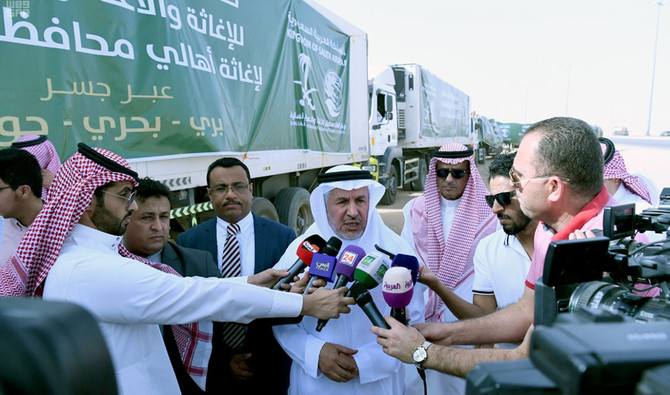
RIYADH: A 45-vehicle aid convoy carrying 924 tons of foodstuffs, medical and housing supplies left Saudi Arabia for the Yemeni province of Hodeidah on Wednesday.

Dr. Abdullah Al-Rabeeah, KSRelief general supervisor, said that 18 of the trucks were sent from Sharurah, 15 from Jazan and 12 from Riyadh.

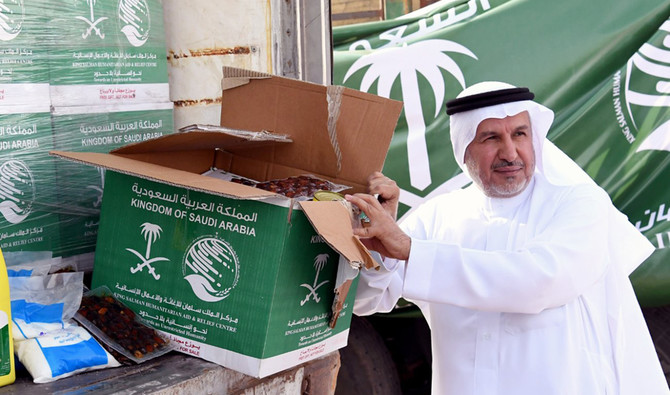
The convoy included 595 tons of food baskets, 186 tons of dates, 95 tons of medicines, and 48 ​​tons of shelter materials, tents, rugs and blankets for the residents of the province of Hodeidah.

Al-Rabeeah said KSRelief had carried out a total of 262 aid projects in all governorates of Yemen.

He called on international humanitarian organizations to provide relief assistance to the people of Yemen.

The Arab coalition has secured all Yemeni crossings for humanitarian aid to alleviate Yemeni people’s suffering caused by violations committed by the Iran-backed Houthi militias, who have been looting humanitarian aid to Yemen, Al-Rabeeah said.

 “We have been always by the side of Yemeni civilians. Our prime goal is to alleviate the humanitarian situation in Yemen in general and Hodeidah in particular. We will use all transportation means, land, air or seaports, to help our brothers and sisters in Hodeidah,” he added. 

“We are welcoming coordination with the international humanitarian organizations to have a joint effort that will definitely pour into the civilians in Hodeidah to reduce the humanitarian crisis there as the coalition has expressed its full readiness to protect the aid and facilitate the means to reach different destinations,” Al-Rabeeah said.

Abdulsalam Babood, senior official to the Yemeni government and a member of Yemeni Relief Committee, said: “On behalf of my country and the Yemeni people, I would like to express my thanks and appreciation to King Salman and the crown prince for their unmatched generosity and unwavering support to the Yemeni civilians in terms of medical supplies and food and other needed items for survival.

“Hodeidah has been suffering from the humanitarian crisis over the past three years due to the full control imposed by the Houthi militants on them. Starvation and the big shortage in medical supplies and medications and huge environmental issues are the main struggles of the people there. International reports estimate that 61 percent of people in Hodeidah are in urgent need of essential supplies. We then put a plan to cope with this humanitarian crisis.”


Rare sighting of critically endangered leatherback turtle in Red Sea

Updated 05 February 2026
Follow

Rare sighting of critically endangered leatherback turtle in Red Sea

  • Turtles travel thousands of kilometers to Red Sea
  • Nesting 6,500km away in India’s Andaman Islands

RIYADH: Saudi Arabia’s National Center for Wildlife has documented a rare sighting of a leatherback sea turtle in the Red Sea, marking a significant biological record for one of the planet’s most critically endangered marine species.

The sighting occurred approximately 30 km off the coast of Al-Qunfudhah within the Blue Holes Protected Area, a newly established marine reserve, according to a recent report from the Saudi Press Agency.

The NCW said the presence of a leatherback in these waters was an exceptional event.

Recognized as the largest turtle species on Earth, the leatherback can weigh up to 900 kilograms. It has a unique leathery, black carapace — distinguished by five longitudinal ridges rather than a hard bony shell — and able to dive to depths exceeding 1,000 meters.

Shutterstock image

Noting the species’ migratory nature, the center explained that leatherbacks travel thousands of kilometers foraging for jellyfish. The specimen likely navigated through the Bab Al-Mandeb Strait in search of food.

This is considered a remarkable journey, the NCW said, noting that the nearest known populations reside in the Indian Ocean, spanning waters from South Africa to Sri Lanka (roughly 7,000 to 8,000 km away).

The closest known nesting grounds are located in India’s Andaman Islands, approximately 6,500 kilometers away. No nesting activity has been recorded in the Red Sea.

According to the Red List of the International Union for Conservation of Nature, the leatherback is Critically Endangered in the Indian Ocean.

While data for the Red Sea and Arabian Gulf is scarce, recent isolated sightings include a juvenile recorded in Jordan in December 2025 and another off Djibouti in 2019.

The NCW emphasized that these rare appearances highlight the ecological importance of the Kingdom's marine conservation efforts in the Red Sea.

The center pointed to the Farasan Islands Marine Protected Area, along with the new Blue Holes and Ras Hatiba reserves, as critical sanctuaries that could support the expansion in range of such endangered species.