Pakistan, Afghan bilateral trade on decline in recent years

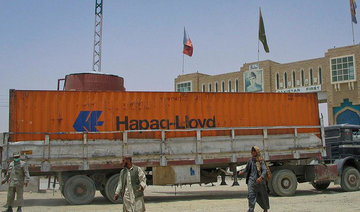
Bilateral trade volume between Kabul and Islamabad has seen an unremitting decline and this year trade volume has been at its lowest in recent years. Sarhad Chamber of Commerce and Industry says it dropped from $3 billion to $500 million in four years. (AFP)
Updated 04 June 2018
Follow

Pakistan, Afghan bilateral trade on decline in recent years

  • Bilateral trade volume between Kabul and Islamabad has seen an unremitting fall and this year trade volume was $930 million till April 2018, the lowest in recent years.
  • Imposition of regulatory duty on imports, the return of US and NATO forces from Afghanistan have also affected trade.

PESHAWAR: Trade between Pakistan and Afghanistan has declined significantly in recent years, mainly because of disturbing political ties and some administrative issues related to commerce, a government official and a trade body office bearer told Arab News.
Trade with Afghanistan decreased from $3 billion to $500 million in 2018, Sarhad Chamber of Commerce and Industry President Zahidullah Shinwari told Arab News.
Khyber Pakhtunkhawa Collector Customs Muhammad Saeed Jadoon agrees that the trade volume between both countries has decreased sharply, but the Government he has other (DOESN’T MAKE SENSE) figures to tell from the government records.
“Bilateral trade volume was $1.6 billion during 2014-15, $1.22 billion during 2015-16, $1 billion during 2016-17,” Jadoon said.
He added: “this year (trade volume was) $930 million till April 2018,” which clearly shows sharp decline.
“There are several reasons behind the deteriorating Afghan trade, including the imposition of regulatory duty on imports, the return of most of the US and NATO forces from Afghanistan and the Af-Pak Transit Trade Agreement on which the chamber of commerce was not (??) taken onboard,” said Shinwari.
“In the presence of the NATO forces, almost 80 percent of our exports to Afghanistan included construction material and 20 percent used to be food items, but this trade decreased considerably when a big chunk of the US forces left Afghanistan, and the need for goods there also reduced,” he added.
Another issue, he said, was with quarantine certificates required for food items.
“It is exceedingly time-consuming to get quarantine certificates all the way from Karachi for the import of food items; and fresh fruit in particular goes rotten,” Shinwari added.
While agreeing about some legitimate concerns, Jadoon said: “Now fresh fruit was allowed to cross the border without quarantine certificates to prevent the food from perishing.”
Along with the issues mentioned above, another one preventing the trade process from taking place seamlessly is the visa policy.
“Either there shouldn’t be a visa policy for Afghan traders who have been interacting with our country for decades, or their visas should be provided to them on arrival at the border,” Shinwari said.
On the other hand, India is exporting its products through the Chabahar port in Iran, while imports are being transported via air.
“Iran and India have captured the market in Afghanistan because Afghan traders face numerous hurdles in Pakistan now,” he added.
Director of the Pak-Afghan Joint Chamber of Commerce and Industry Ziaul Haq Sarhadi told Arab News that the recently launched Web-Based One Customs (WeBoc) system also delays trade from Pakistan.
But additional Collector Customs at Torkham border Ziaullah Shams told Arab News that the system brought transparency to trade activities with Afghanistan.
“The system has also helped eliminate any ‘gray area’ that may previously have existed,” Shams said.
A Peshawar-based analyst on economy, Riaz Khan Daudzai, said that tax barriers such as duty/levy and non-tax barriers such as geo-political situation have both affected trade with Afghanistan.
“India and Iran have capitalized on the poor relations between Pakistan and Afghanistan,” he added.
Early this month a high-ranking ministerial delegation from Afghanistan led by Deputy Minister for Commerce Kamila Sidiqi had a meeting with Mohammad Younus Dagha, secretary commerce and officials at the Ministry of Commerce on May 8.
During the meeting, both sides expressed the desire to enhance trade relations between the two countries by overcoming existing challenges.
“It was agreed that the institutional mechanism between both the countries needs to be strengthened and the holding of the much awaited 7th Afghanistan Pakistan Transit Trade Coordination Authority Meeting by the Afghan side was the need of the hour,” Pakistan’s Ministry of Commerce said in a statement.
During the visit of Kamila Sidiqi both sides agreed that “the economy should not be linked with politics and business must continue to prosper as usual,” an official statement said.


Family of Palestine Action hunger-strike detainee warn she could die 

Updated 6 sec ago
Follow

Family of Palestine Action hunger-strike detainee warn she could die 

  • Teuta Hoxha, among 8 people held on remand for over a year, has not eaten in 43 days
  • Campaigners slam treatment of pro-Palestine prisoners on hunger strike 

LONDON: A Palestine Action prisoner in the UK could die if the government does not step in over her hunger strike, her family have warned, amid claims that authorities have been “deliberately negligent” in the treatment of other detained hunger strikers.

Teuta Hoxha, 29, is on day 43 of her strike, having been held on remand in prison for 13 months over charges relating to a break-in at an Israel-linked arms manufacturing facility in August 2024. 

She is one of eight people on hunger strike who were detained for their part in the incident at the Elbit Systems UK site.

Her sister Rahma said she can no longer stand to pray, and suffers from headaches and mobility issues. 

“I know that she’s already instructed the doctors on what to do if she collapses and she’s instructed them on what to do if she passes away,” Rahma, 17, told Sky News.

“She’s only 29 — she’s not even 30 yet and nobody should be thinking about that,” Rahma added. “She’s been on remand for over a year, her trial’s not until April next year and bail keeps getting denied.”

The eight hunger strikers charged over the Elbit Systems break-in, who deny all charges against them, are demanding an end to the operation of weapons factories in the UK that supply Israel.

They are also calling for Palestine Action, which is banned in the UK, to be de-proscribed, and for their immediate bail.

They are not the only members of Palestine Action in prison carrying out hunger strikes. Amu Gib, imprisoned over a break-in at a Royal Air Force base earlier this year, was taken to hospital last week, having not eaten in 50 days. 

Gib was initially denied access to a wheelchair after losing mobility, and campaigners said it was “completely unacceptable” that this had led to a missed doctor’s appointment, adding that Gib was also denied access to the vitamin thiamine.

Campaign group Prisoners for Palestine said: “At this trajectory, the hunger strikers will die unless there is urgent intervention by the government.

“It is completely unacceptable and deliberately negligent to pretend the hunger strike is not happening, or to dismiss the prisoners’ demands.

“They are in the custody of the state, and any harm that comes to them is a deliberate outcome of the government’s negligence and the politicisation of their detention.”

A relative of Gib told The Independent: “We wouldn’t know if Amu is in a coma or had a heart attack. I’m the next of kin and it’s on Amu’s medical record that I am to be contacted in the event of their hospitalisation.

“But it’s been complete agonising silence for 57 hours. I’m furious and outraged that the prison was withholding thiamine from the hunger strikers, without which they are at high risk of brain damage.”

The treatment of the hunger strikers has drawn high-profile criticism, with Dr. James Smith, an emergency physician and lecturer at University College London, telling The Independent that they “are dying” and would require specialist medical help.

Around 900 medical professionals in the UK have written to government ministers David Lammy and Wes Streeting urging them to facilitate medical treatment for the strikers.

Jeremy Corbyn, former leader of the governing Labour Party, posted on Instagram that he had visited Gib in prison.

Seven hunger strikers have so far been hospitalized since Nov. 2, when the first prisoners began to refuse food.

Jon Cink and Umar Khalid both ended their strikes for medical reasons, having been hospitalized, while Kamran Ahmed told the Sunday Times last week that dying for his cause would be “worthwhile.”

He added: “Every day I’m scared that potentially I might die. I’ve been getting chest pains regularly … There have been times where I felt like I’m getting tasered — my body’s vibrating or shaking. I’ll basically lose control of my feelings.

“I’ve been scared since the seventh day when my blood sugars dropped. The nurse said: ‘I’m scared you’re not going to wake up (when you go to sleep). Please eat something.’

“But I’m looking at the bigger picture of perhaps we can relieve oppression abroad and relieve the situations for my co-defendants … Yes, I’m scared of passing away. Yes, this may have lifelong implications. But I look at the risk versus reward. I see it as worthwhile.”

Under UK law, time limits are set out for those in custody awaiting trial to prevent excessive periods in pre-trial detention.

But UK Prisons Minister Lord Timpson said in relation to the Palestine Action detainees: “These prisoners are charged with serious offences including aggravated burglary and criminal damage.

“Remand decisions are for independent judges, and lawyers can make representations to the court on behalf of their clients.

“Ministers will not meet with them — we have a justice system that is based on the separation of powers, and the independent judiciary is the cornerstone of our system.

“It would be entirely unconstitutional and inappropriate for ministers to intervene in ongoing legal cases.”

Rahma says her sister calls her from prison every day, despite her predicament, to help with her studies.

“Our mother passed away when I was really young. Teuta took care of me and my siblings and made sure to read us bedtime stories.

“She’s always there for me and even from prison, she’s helping me do my homework and revise for exams.”

Rahma added: “My sister is a caring and loving person It feels like the state has taken a piece of me.”

She continued: “The only form of resistance she has is her body and that’s what she is using against the state.”