KARACHI: Bilateral trade between Pakistan and Afghanistan is constantly declining after measures taken by Pakistan at the Pak-Afghan border to check the inflow of terrorists from Afghanistan.
Increasing trade by India via Iran’s Chahbahar port and air routes is another cause, Junaid Esmail Makda, President of Pakistan-Afghanistan Joint Chamber of Commerce and Industry, told Arab News.
Pakistan and Afghanistan have been enjoying cordial trade relations but owing to increasing Indian penetration in the Afghan market, bilateral trade between two old partners has been on the declining trend for the past two years.
“In 2014-15 the bilateral trade was $2.7 billion but it has come down to $1.6 billion to date,” Makda told Arab News.
He said the Indian government is subsidizing their exports that enjoy greater excess to Afghanistan. “The Indian government is providing exporters with a subsidy to capture the market. They are exporting goods via air but are being charged freight of ship,” said Makda.
Pakistan exports a number of items to Afghanistan including sugar and sugar confectionery, salt, sulfur, stone, plaster, lime and cement, milling products, malt, wheat gluten, animal and vegetable fats and oils, articles of iron or steel and ready-made garments. However, many goods are now being supplied by Pakistan’s arch-rival, India.
New Dehli is using Iranian port of Chahbahar to transport its goods to Kabul, which also led to the trade volume decline between Pakistan and Afghanistan, Makda added.
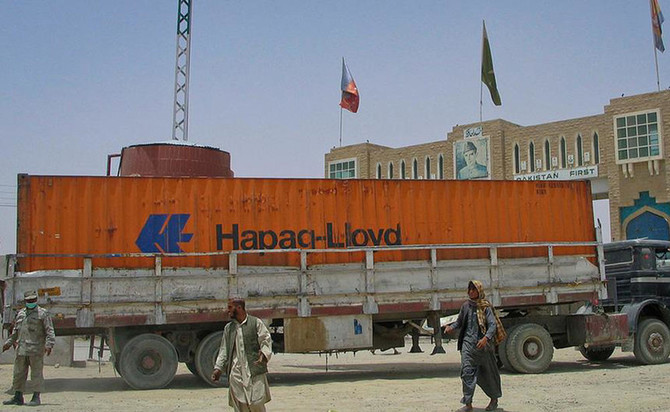
Pakistan also extends a transit facility in the form of Afghan Transit Trade to the landlocked Afghanistan which, according to the traders and transporters, have also substantially declined over the past two years.
According to transporters, around 15,000 vehicles are engaged in the transportation of goods between Pakistan and Afghanistan. “Due to trade decline, the ATT cargo transportation has declined to 25 to 30 percent,” Hanif Marwat, general secretary of the Supreme Council of All Pakistan Transporters, told Arab News.
Around 3,000 vehicles are used to transfer goods to Afghanistan through the Quetta-Chaman border and that is the only sources of transporters’ livelihood. “Those who ply on this route are increasingly losing their livelihood,” Marwat said.
However, some of the transporters hope that with the increase of US troops in Afghanistan, their activity will pick up again.
“We were supplying goods to NATO forces in Afghanistan which has also substantially declined, but with the increasing troops we hope that our business will also increase,” Israr Shinwari, spokesman of All Pakistan Oil Tankers Association told Arab News.
Until the recent past, Afghanistan has been depending on Pakistan for its flour requirements but things have now changed.
“Russian states have overtaken Pakistan in supplying wheat and flour to Afghanistan. In the process, around 100 mills have been shut down,” said Chaudhry Ansar Jawed, chairman of Pakistan Flour Mills Association. However, after the $120 per ton rebate given by Pakistan government, the export of flour to Afghanistan has somewhat resumed.
Pakistani businessmen are not losing hope as they said that owing to the engagement of top officials of both countries, a solution to problems will be found that will lead to the normalcy of trade.
Pakistani traders see a bilateral trade potential of $5 billion between the two neighbors. Pakistan Bureau of Statistics data show that exports to Afghanistan declined from $1.44 billion in the fiscal year 2016 to $1.271 billion in 2017. Export worth $319 million was recorded in the first quarter of the current fiscal year 2017-18.


![]()
Pak-Afghan trade volume declines as India increases its share
Pak-Afghan trade volume declines as India increases its share
Latest updates


© 2026 SAUDI RESEARCH & PUBLISHING COMPANY, All Rights Reserved And subject to Terms of Use Agreement.