


ARAR: It weighs little more than a tablespoon of water, measures barely 15 centimeters from beak to tail, and travels thousands of kilometers each year between the Arctic tundra and the warmth of equatorial Africa. Yet the red-throated pipit (Anthus cervinus) has much to say about the health of the land it crosses — and this season it has been saying it in Saudi Arabia’s Northern Borders Region.
The bird has been spotted in the open meadows, marshes, and irrigated fields that stretch across the north of the Kingdom, its appearance a quiet but telling sign that the region’s ecosystems are robust enough to sustain wildlife at a critical moment in the annual migratory calendar, according to the Saudi Press Agency.

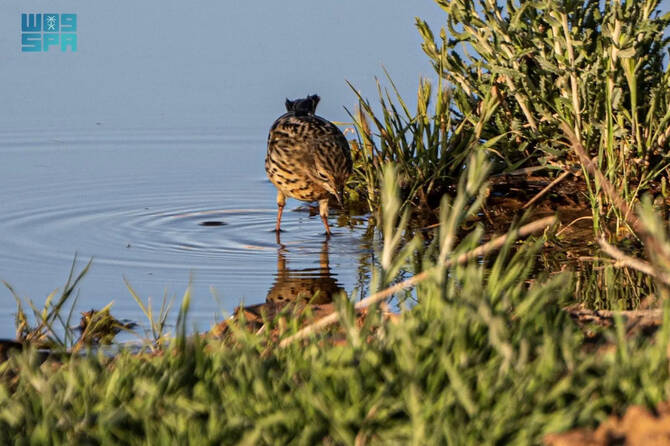
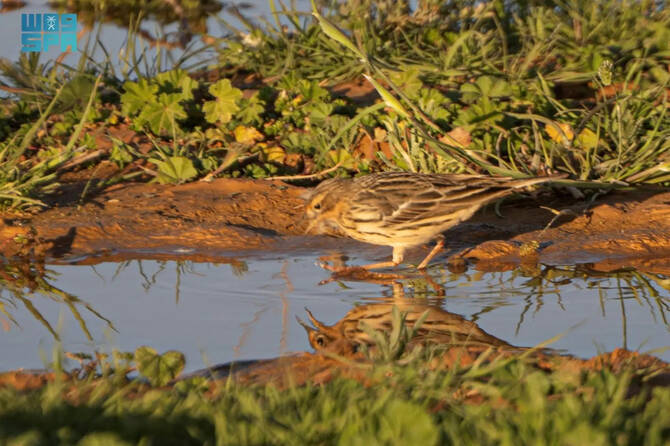
The red-throated pipit forages by day across damp, muddy, and sparsely vegetated terrain, probing for flies, beetles, caterpillars, spiders, earthworms, and grass seeds. (SPA)
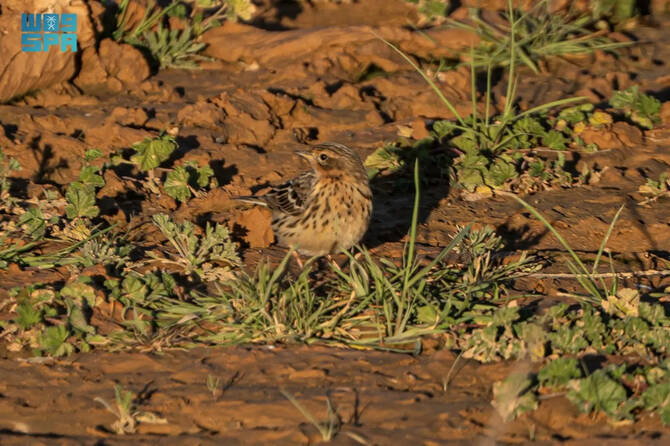
What makes the bird immediately recognizable is its coloring. During autumn, adult birds wear a warm reddish-brown flush across the face and breast — a blush that gradually fades as winter deepens. Birders and ornithologists distinguish it from similar species by listening for its high-pitched, piercing flight call and by watching for the bold dark striping that runs along its rump and flanks.
By habit, the red-throated pipit is a creature of the ground. It forages by day in damp, muddy, and sparsely vegetated terrain, searching for flies, beetles, caterpillars, spiders, earthworms, and grass seeds. Its nimble, terrestrial movement shows a highly specialized adaptation to wetland-edge environments wherever it stops along its route.
“The presence of the red-throated pipit in the Northern Borders Region serves as a vital indicator of ecological health and rich biodiversity,” the SPA report said.
The bird's presence here is no accident of geography. Saudi Arabia occupies one of the world's most strategically significant positions on the global migratory map — a vast land bridge where three continents converge across more than two million square kilometres of terrain. Every spring and autumn, that geography funnels enormous numbers of birds through the Kingdom's skies.
Between late March and May each year, the Northern Borders Region witnesses a surge of northbound migrants returning from their wintering grounds in Africa to breeding territories in the Northern Hemisphere. Doves, cranes, storks, warblers, quail, and harriers all use this corridor, pausing at suitable sites to feed and rebuild the energy reserves depleted by long overwater and overland crossings.
The Northern Borders Region stands out as one of the principal annual migration corridors within the Kingdom, its balanced environment, diverse terrain, and natural vegetation drawing both migratory and year-round resident species in significant numbers.


