

Celebrities arrive at Britain’s royal wedding/node/1305671/art-culture
Celebrities arrive at Britain’s royal wedding
1 / 3
British actor Idris Elba (R) arrives with his fiancee Sabrina Dhowre (2R) followed by Prince's Harry's friend, British singer James Blunt (L) and US talk show host Oprah Winfrey (2L) for the wedding ceremony of Britain's Prince Harry, Duke of Sussex and US actress Meghan Markle at St George's Chapel, Windsor Castle, in Windsor, on May 19, 2018. / AFP / POOL / Chris Radburn
2 / 3
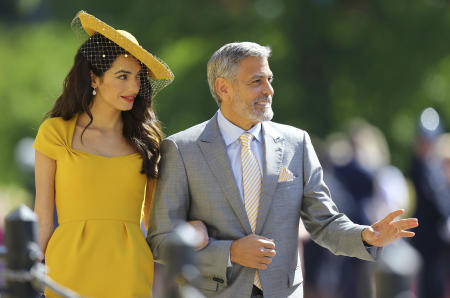
Amal Clooney and George Clooney arrive for the wedding ceremony of Prince Harry and Meghan Markle at St. George's Chapel in Windsor Castle in Windsor, near London, England, Saturday, May 19, 2018. (AP)
3 / 3
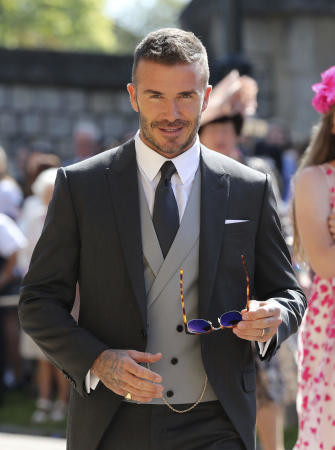
David Beckham arrives for the wedding ceremony of Britain's Prince Harry, Duke of Sussex and US actress Meghan Markle at St George's Chapel, Windsor Castle, in Windsor, on May 19, 2018. (AFP)
DUBAI/WINDSOR: Stars including Oprah Winfrey, Amal and George Clooney and David Beckham arrived at Britain's ancient Windsor Castle on Saturday for the wedding of Prince Harry and Meghan Markle.
Winfrey, the US talk show queen, was seen strolling through the grounds of Windsor Castle ahead of the service, as was Elba, the British actor who is a star on both sides of the Atlantic for his roles in “The Wire” and “Luther.”
Celebrities from Britain and North America took their places among the 600 guests the chapel, including US former actress Markle’s co-stars in the TV legal drama series “Suits.
Bollywood star Priyanka Chopra and the cast of US TV show "Suits" arrived in style, while Harry’s ex-girlfriends Chelsy Davy and Cressida Bonas were also seen going in.
The three siblings of Harry’s mother Diana, princess of Wales, have been invited.
Earl Charles Spencer, who spoke memorably at Diana’s funeral on behalf of his family, was seen entering the church.
His sister Jane Fellowes was to read from the Song of Solomon during the service.
Singer James Blunt, famous for his hit “You’re Beautiful” and like Harry an army veteran, took his place in the Gothic chapel.
Blunt has performed at the Invictus Games, an international competition for military veterans set up by Harry.
Nicholas Soames, a grandson of wartime prime minister Winston Churchill and a close friend of Harry’s father Prince Charles, was also among the guests.
Following the service, Queen Elizabeth II was to host a lunch in the castle’s St. George’s Hall for the 600 guests.
Charles, the heir to the throne, will be hosting 200 family and close friends from among the guests at an evening reception at Frogmore House.
Politicians have been left off the guest list, meaning there was no invite for US President Donald Trump or British Prime Minister Theresa May.
CNC president outlines France’s role in advancing Saudi cinema
Updated 17 December 2025
Afshan Aziz
JEDDAH: Saudi Arabia’s film industry is rapidly evolving, and Gaetan Bruel, president of the French National Centre for Cinema and the Moving Image, or CNC, sees potential for collaboration with France.
Speaking to Arab News after the Red Sea International Film Festival, which he attended, Bruel said: “Saudi Arabia has, in just a few years, put in place everything it needs to become a major film country. The first films are already appearing in major international festivals, including ‘Norah,’ selected in Cannes in 2024. Cinemas are opening at an extraordinary pace, new producers and talents are being trained, and local films are already making waves internationally.”
Bruel emphasized that France and Saudi Arabia’s respective entertainment industries are drawing closer, recalling the executive program for cultural cooperation agreement signed a year ago between both ministries of culture. Under that agreement, the Saudi Film Commission and the CNC pledged to cooperate.
“Our two countries are already building a strong partnership. France can be a real partner in Saudi Arabia’s journey to becoming a major film nation,” Bruel said.
Faisal Baltyuor, CEO of the Red Sea Film Foundation, on the left, with Gaetan Bruel, President of National Center of Cinematography and the moving image (CNC), on the right, at the 5th edition of Red Sea International Film Festival in Jeddah. (AFP)
From the CNC’s perspective, France’s long-standing support for cinema provides a blueprint that could inspire Saudi initiatives. “The key feature of France’s model of supporting cinema relies on one simple idea; downstream finances upstream. Everyone who benefits from the work contributes to making it,” Bruel explained. He added that the CNC now supports the entire film ecosystem, from writing to distribution, including theaters, post-production, festivals and training.
Bruel also highlighted France’s expertise in talent development. “What’s transferable from our model is expertise in training because we have developed schools among the best in the world. We’ve launched a €450 million ($530 million) plan to train top talent in all areas of moving-image creation, series, animation, video games, and even VR,” he added. The investment is primarily implemented in France through French film schools and institutions, but Saudi talent can benefit through exchange programs, co-productions and training initiatives.
Independent filmmaking is another area Bruel believes can form the backbone of collaboration. “What we are able to share is the very idea that creators and independent producers must stay at the center. We support producers when they are independent from distributors, and we protect their right to retain intellectual property. Retaining IP is the only way to produce truly independent works and bring forward local voices.”
Bruel also sees opportunities for Saudi filmmakers to benefit from France’s international experience through a network of French cultural “villas” abroad, created by France to promote French culture, cinema and creative exchange internationally.
These villas are designed to support writers and filmmakers, providing programs, residencies and collaboration opportunities.
Drawing on his work establishing Villa Albertine in the US, he highlighted the newly opened Villa Hegra in AlUla. “With Villa Hegra, France and Saudi Arabia now have the means to develop a truly distinctive programme, one that can help Saudi writers and filmmakers take the next step in a process that’s already well underway.”
This week, Villa Hegra, in collaboration with Film AlUla, launched a specialized filmmaking program to develop cinematic skills and support creative talent.
Training, heritage and co-production are key pillars of CNC support for Saudi cinema. “France has 130 years of cinematic know-how, and Saudi Arabia has an extraordinary pool of human and creative talent. Bringing those two strengths together is essential,” Bruel said. “We also have a long history of preserving, restoring and promoting film heritage, and we are honored to share that experience with our Saudi partners.”
Looking ahead, Bruel is optimistic about co-productions between the two countries: “We want French producers to meet their Saudi counterparts so that ambitious projects can emerge in the coming years. Our flagship fund, Aide aux cinemas du monde, is very open to Saudi projects as long as a French producer is involved from the start in a genuine organic co-production.”
Bruel also mentioned cinema’s cultural importance in building deeper ties between France and Saudi Arabia. “Cinema is under real pressure globally, with audiences declining and cheap, low-effort content flooding the market. But it’s often in moments like this that the strongest and most lasting partnerships are built.
“Saudi Arabia’s rise in arthouse cinemas and the work being done here shows a shared ambition; keeping cinema both ambitious and truly accessible,” he said, pointing to the likes of Hayy Cinema and Cinema Al-Balad in Jeddah, and Cinehouse in Riyadh.