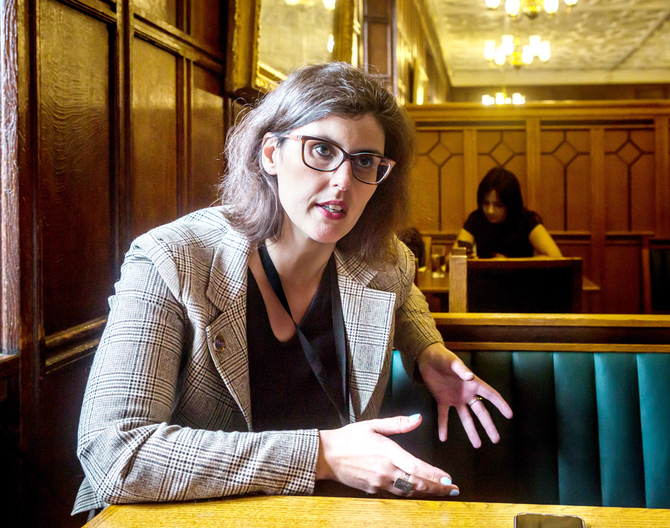

LONDON: There could hardly be a more pertinent moment to interview Layla Moran, the first British member of Parliament of Palestinian descent.
The 35-year-old Liberal Democrat tends not to overplay her Arab heritage. “I’m me, it’s part of me but it is not all that I am,” she told Arab News. Her mother, Randa, is a Christian Palestinian from Jerusalem. She has an aunt still living in the West Bank city of Ramallah.
Since her British father’s diplomatic career took the family all over the world — she has lived in Belgium, Greece, Ethiopia, Jamaica and Jordan — Moran hesitates to call herself a Palestine expert.
But the horrific violence in Gaza on Monday, which killed 60 people, has affected her deeply.
“The whole family is distraught. For many second-generation people like me, our emotions are tied up with our parents and grandparents. So when I speak about it I channel them because they lived there. It was their home. I’ve only ever heard the stories, although I have been,” she said.
Moran was elected to Parliament in last year’s snap election, ousting the Conservative incumbent who had a substantial majority in the constituency of Oxford West and Abingdon.
A former maths and science teacher, she is her party’s spokeswoman on education, science and youth. Increasingly, however, she finds herself speaking out on issues concerning the Middle East and foreign policy.
“It would be remiss of me not to use my personal connection,” she said.
In a debate this week in the UK’s lower house of Parliament she urged Alastair Burt, the Foreign Office minister for the Middle East, to recognize the state of Palestine.
“Were it not for the Nakba, perhaps I would not be here,” she told him, before going on to say that any hope for peace died with the protesters in Gaza this week — a statement she now regrets.
Moran is clear-eyed and coolheaded about what needs to happen next. She told Arab News that “Hamas needs to go” because its dominance over Gaza’s political scene is allowing the US and Israel not to engage in dialogue with the Palestinians.
“The political agenda has been hijacked by extremists on both sides. There is a bizarre international rhetoric around the mythology of the peace process. There is no peace process,” she said.
If the peace process is revived, it cannot solely involve Israel and Palestine, she added. “As long as Palestinians are not equals in that partnership, it is not fair to put the onus of negotiation just on those two countries. The international community has to be involved,” she said.
But who in particular? “I firmly believe Britain has an obligation under Balfour. You know — you broke it, you buy it. I’ve been very frustrated this year, during this 100th anniversary (of the Balfour Declaration), that Britain has not grabbed hold of this historic responsibility and instead left it to other partners, and in particular America, which used to be an ally (of the Palestinians) because they were the ones Israel would actually listen to. Unfortunately, now we’ve (Israeli Prime Minister Benjamin) Netanyahu and his best friend (US President Donald) Trump. It’s like two men licking each other’s ego. It’s disgusting to watch.
“I don’t know what the US is trying to achieve. More and more the US rhetoric is basically a version of peace whereby the Palestinians just keel over.”
As for the transfer of the US Embassy to Jerusalem, which happened amid much fanfare on the eve of the Nakba anniversary, Moran believes that was Trump — in the absence of progress toward peace — wanting to deliver something concrete, regardless of the repercussions.
“He doesn’t give a hoot about ordinary people in Palestine,” said Moran. “He was told in no uncertain terms that it would lead to bloodshed and he went ahead anyway and even moved the date forward so it coincided with the protests. Apparently it was originally meant to happen later.”
The tragedy, she says, is that Jews and Palestinians share so much. From her own relatives scattered all over the world, from Vermont to Jordan, she knows that there is a huge Palestinian diaspora, just like the Jewish one.
“And they have done well in the world,” she said. “Some of the Israelis I meet make that parallel. They don’t all agree with Netanyahu by any means. The path to peace — and I feel really strongly about his — is in recognizing how much we are cousins.”
But she is increasingly fearful of a loss of Palestinian identity. “In all the speeches about the embassy, the word ‘Palestinian’ was never used. They spoke about ‘the other side.’
“Our identity is being stripped hollow and that, in some tiny way, is where I can help by saying who I am and what I am,” she said.