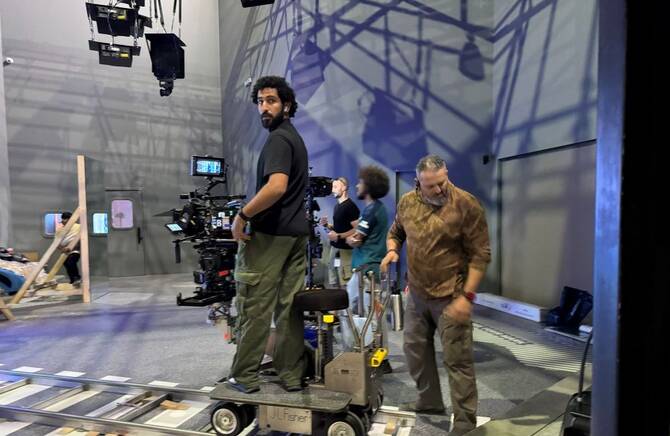
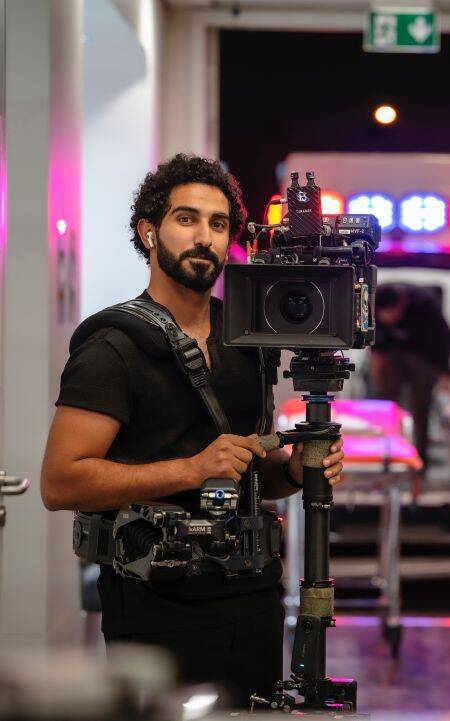

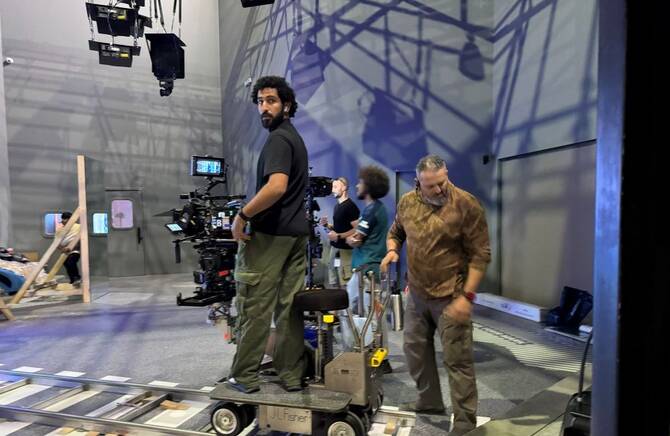
RIYADH: B-camera operator Ali Khalid Al-Ghamdi was one of 106 Saudi talents who helped bring the script for the Kingdom-backed Hollywood film “7 Dogs” to life on the screen.
The movie hit the headlines regionally and globally when it was released on May 27, with some hailing it as one of the biggest, most action-packed productions to emerge from the region.
Al-Ghamdi said his professional journey on set was filled with life-altering learning experiences, explosive action, fun moments with the cast and crew, and the creation of some unforgettable memories.
He is full of praise for directorial duo of Bilall Fallah and Adil El-Arbi, the filmmaking team who previously worked on movies such as “Bad Boys: Ride or Die” and “Gangstas,” as well as the superhero TV series “Ms. Marvel.”
“They’re two directors but they are one mind,” he said. “They are terrifyingly in sync. They are crazy personalities with incredibly high energy levels, so they gave the set so much energy and vitality.”
He recalled his first day on set, when he had to shoot a scene with actor Martin Lawrence and one of the directors instructed him to use a “dutch tilt,” an angled camera technique that is used to generate suspense.
A little intimidated, Al-Ghamdi thought the director was asking him to pay attention and avoid any camera tilt, so he checked several times and said: “Nothing is tilted, man.” Then the director clarified: “Give me dutch.”
“I was filming on sets for at least three years at that point and no one had ever requested a dutch angle from me,” Al-Ghamdi said. “It was a weird request for me but after I did that I started using that technique. They brought me out of my box on so many levels.”
That was just one of the many things he said he learned on the film set. Another learning opportunity came from the chance to work with the second unit director of photography, Andrew Banwell, who had extensive experience in using a steadicam.
“This is the camera stabilizer I use, so I offered my device for free for them to use on set,” he said. His goal was not to get paid for renting out his equipment, though he did later receive a fee, it was to gain experience from watching an expert use it.
“In return, it’s a masterclass for me,” he said. “You can offer what you have, sometimes, and the return is way bigger than you expect.”
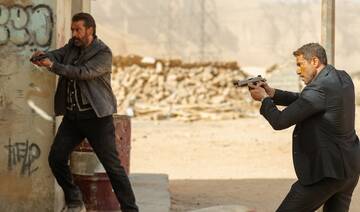
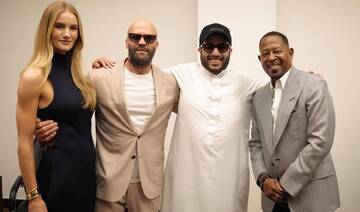
“7 Dogs” is considered one of the largest Arab cinematic productions to date. It was filmed in Riyadh and features a distinguished cast of leading Arab actors alongside international stars such as Lawrence, Monica Bellucci, Giancarlo Esposito and Salman Khan.
An action-thriller, its story centers on a complex mission that teams an Interpol agent with a member of the “7 Dogs” gang in a confrontation with a criminal network involved in drug trafficking.
The movie set a Guinness World Record for the largest on-screen explosion in cinema history, measured at 170.7 tonnes of TNT equivalent, and Al-Ghamdi was there to help capture it on film.
“The feeling of seeing this explosion happen in front of you can’t be described,” he said. “The world is shaking around you, and at the same time I have to hold my camera position knowing that there’s no second take. This is the shot of the film — it has to be done.”
He added that an important factor that helped ensure the scene was so successful was the amount of safety precautions: “The team was really vigilant in making sure we moved around safely on set.”
In addition to such big, dramatic moments, Al-Ghamdi also shared some of his lighter, funny moments with the actors, including the time he got a little too close to Esposito, which taught him that camera operators need to be ready to react to actors’ movements even if they shift off their marks.
“7 Dogs” was not Al-Ghamdi’s first time on the set of a big movie; he was previously a trainee-turned-camera assistant on the Anthony Mackie move “Desert Warrior,” which was shot in Neom, and “Sisu: Road to Revenge,” which was filmed in Estonia. He has also worked on Saudi productions, including the films “Alhamour H.A.” and “Sattar,” and the TV series “Shabab Albomb.”
The biggest difference between working on a Saudi production compared with an international one is the extent of the order and discipline, Al-Ghamdi said. For example, the call sheets for many Saudi productions only outline the time for filming and the scenes to be shot, while those for international productions also detail everyone’s duties during shooting.
He also had some sound advice for young Saudis interested in following in his footsteps and building a career in filmmaking.
“The biggest thing I would highlight to anyone who wants to work in the field is not to rush the learning experience,” he said. “For ‘Desert Warrior,’ all I did was fetch coffee and food, clean filters and lenses, but I wanted to learn. You have to learn in order to get to where you want to go.
“And don’t be afraid to ask questions or say what you want. There are a million ways to do things that you can’t learn from a curriculum.”
Saudi entertainment companies work to prioritize the inclusion of local talent on the sets of productions filmed in or funded by the Kingdom, so that the can gain experience and are exposed to every stage of the filmmaking process, from production planning to filming, location management and all of the supporting artistic elements that are essential to any fully realized cinematic work.
The Saudi participants in the production of “7Dogs” were distributed across several specialized teams, including 11 in production, six in directing, five in camera operations, four in art direction, four in makeup and hair, four in costume design, two in sound, two in behind-the-scenes support, and eight in other supporting departments. They also included 60 male and female trainees, reflecting the commitment to expanding hands-on learning opportunities.
“I always say, there are Saudis that can do the job,” Al-Ghamdi said. “There are a lot of people in Saudi Arabia, even, who doubt that, but there are … and I’d like to thank the guys at (production company) Sela Studio for pushing for us in these big Hollywood productions.”