


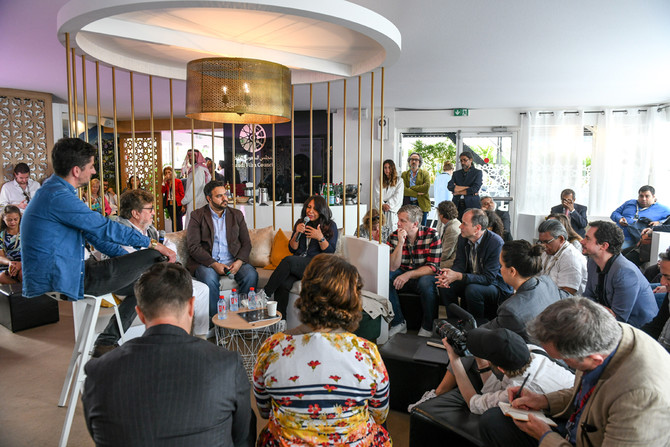
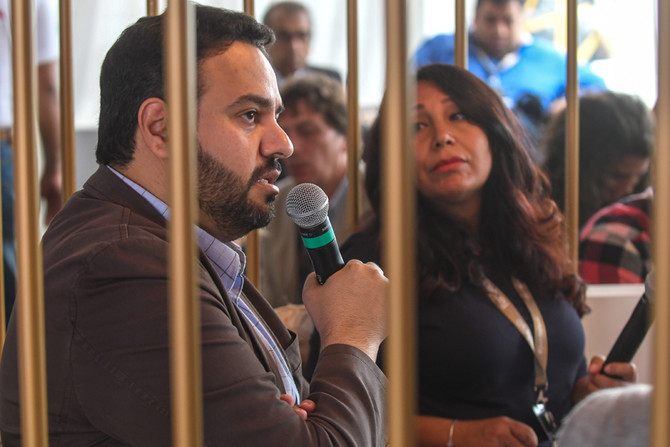


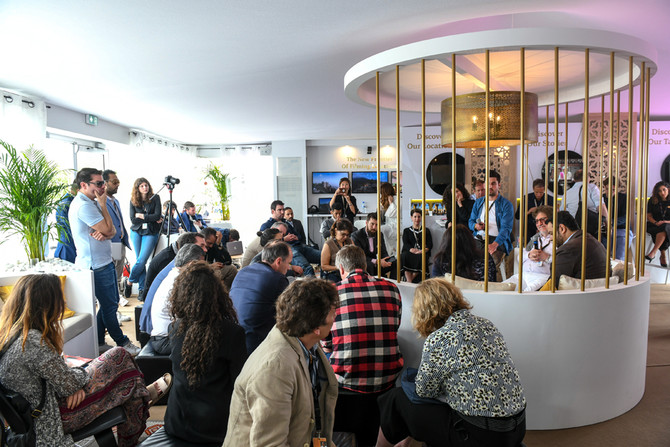


CANNES, France: Two of Saudi Arabia’s leading filmmakers, Haifaa Al-Mansour and Abdullah Al-Eyaf, appeared on a panel in the Saudi pavilion at the Cannes Film Festival on Saturday, where the topic of debate became whether the country needs an international film festival.
“I’m not a big fan of film festivals,” said Andres Gomez, an Oscar-winning Spanish producer on the panel. “I think it’s more important that the Saudi films travel outside to other festivals abroad. It’s more important that the pavilion is here in Cannes for the next 50 years than you have a festival in a remote town of Saudi Arabia where filmmakers from all of the world come to show their films. If Saudi films want to be present outside of Saudi Arabia, for example a week in New York, that will be more effective for Saudi films than a festival in Saudi Arabia.”
Last month, the Dubai International Film Festival announced the cancellation of its 2018 edition, promising to come back in a smaller, unspecified form in 2019 and then once every other year. Filmmakers from across the region and world have lamented the loss of the festival.
Both Abdullah Al-Eyaf, director of the documentary “Cinema 500 km,” and Haifaa Al-Mansour, director of “Wajdja” and the upcoming “Mary Shelley,” disagreed with Gomez, insisting that the Kingdom should have an international film festival that goes beyond the small Saudi Film Festival run by Ahmed M. Almulla in Dammam since 2008.
“A Saudi international film festival would not not just be a place to screen international films, it would be the only chance for us to screen certain kinds of Saudi films,” said Al-Eyaf. “It could be the only place in the region to see semi-professional films."
Gomez said he believes that international festivals benefit international talent that would come to Dubai or Saudi Arabia more than it does the homegrown talent itself, which Al-Mansour pushed back on.
“Dubai International Film Festival was a hub for all the filmmakers to come and see each other and exchange ideas. ‘Wadjda’ was where I was able to develop this film at the Dubai Film Market, contact producers and all that. It provided a platform for young filmmakers to develop their ideas and their scripts,” said Al-Mansour.
“I’m sure we will have a film festival in Saudi that has this part of it—the development part is focused on providing a place for filmmakers to grow.”
Al-Mansour said she believes that Saudis would wholeheartedly support the screening of Saudi films either with wide distribution or at a prospective festival, believing that the popularity of homegrown Saudi social media content shows that people are hungry to see more of their own stories told on the big screen.
In an interview with Arab News, Ahmad Al-Maziad, CEO of the General Culture Authority, said yesterday that it intentionally did not begin with a film festival, instead wanting to start with the development of the broader industry. "We're not doing what others have done with an international film festival, we're starting from the bottom. We're doing training, we're doing education, we're working on infrastructure, we're working on talent, production—all the elements of building an actual sustainable industry in Saudi.”


