KAMRA, Pakistan: The sprawling complex at Kamra, west of Islamabad, reverberates at the thundering take-off of a Mirage Rose-1, the latest aging fighter jet to have been gutted and reassembled by the Pakistani Air Force.
Fifty years after Pakistan bought its first Mirages, many planes in the venerable fleet are still being patched up, overhauled and upgraded for use in combat, years after conventional wisdom dictates they should be grounded.
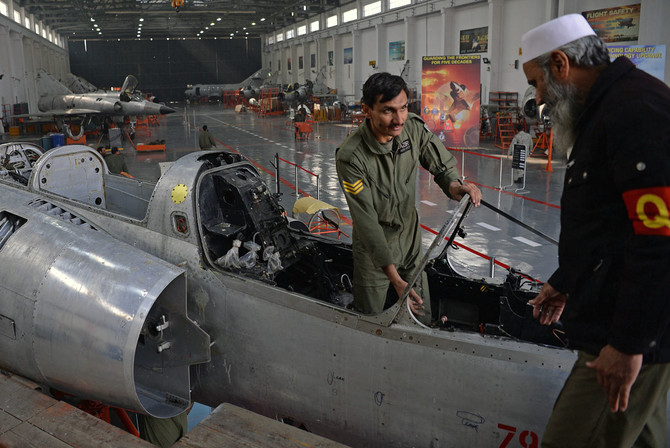
That includes one of the first two planes originally purchased from France’s Dassault in 1967, which was in a hangar at Kamra after its record fifth overhaul when AFP visited recently.
The techniques they have developed are reminiscent of — but far more high-tech and lethal than — the improvised methods used to keep classic American cars running on the streets of Havana.
“We have achieved such a capability that our experts can integrate any latest system with the aging Mirages,” says Air Commodore Salman M. Farooqi, deputy managing director of the Mirage Rebuild Factory (MRF) at the Kamra complex.
Pakistan bought its first Mirages to diversify its fleet, which in the late 1960s largely consisted of US-built planes: F-104 Starfighters, T-37 Tweety Birds and F-86 Sabres.
The Mirage became a popular choice, with the Air Force buying 17 different variants in later years, eventually owning the second-highest number of the fighter jets after France.
They performed bombing missions during Pakistan’s war with India in 1971 — one of the shortest conflicts in history, lasting just 13 days and leading to the creation of Bangladesh.
But Mirages flew on, also carrying out reconnaissance missions in India, and intercepting and shooting down Soviet and Afghan planes that violated Pakistani airspace during the Soviet war.
Usually, the jet has two or three life cycles, each spanning around 12 years. But overhauling them abroad was expensive for Pakistan, a developing country whose budget is already disproportionately tilted toward its military and which has historically received billions in military assistance from countries such as the US.
So, with the help of experts from Dassault, the air force decided if you want something done for the right price, you’ve got to do it yourself.
The Mirage Rebuild Factory was established at the Pakistan Aeronautical Complex (PAC) in 1978, and in the years since has saved “billions” of dollars for Pakistan, according to Group Captain Muhammad Farooq, in charge of one of the maintenance hangars — though he said the exact figure was difficult to pin down.
The planes take some seven weeks to be overhauled and repainted, he said, adding that usually the MRF has the capacity for more than a dozen planes a year. Its calendar for the next decade or so is already booked up.
At least eight different Mirage variants, including the Mirage 5-EF, Mirage III-DP and Mirage-III Rose-I, were in one of the maintenance hangers when AFP visited.
Engineers and technicians were dismantling cockpit instrument panels and landing gear while undertaking a “non-destructive inspection,” essentially an X-ray to detect faults in the wings and airframe.
Dozens of engines awaiting overhaul were piled in one hangar. Even planes that had suffered accidents such as fires breaking out have been patched back together at the facility.
Pakistan has also been buying up discarded Mirages from other countries to bring through the facility, said retired Air Marshal Shahid Lateef.
The most important technological improvement, developed with the help of South Africa, is the ability to integrate air-to-air refueling, Farooqi said.
The “identification of friend and foe” (IFF) system, which detects when a Mirage has been locked on to by the system of another plane, was also a key development, he said.
But even with the improvements and cost-saving measures, the aging planes are becoming more difficult to maintain.
“They have outlived their lives... after their overhauls (they) have become highly unreliable, we even met with lots of accidents,” Lateef said.
The best option to replace them would be the Rafale, as neighbor and arch-rival India — which has also flown and maintained Mirages for decades — is doing, signing a deal with Dassault in 2016.
The price tag is too much for Pakistan, however, retired Air Commodore Tariq Yazdani said.
Instead Pakistan plans to replace them with the JF-17 Thunder aircraft that it co-developed and co-produced with China, the original manufacturer.
Even as it becomes more urgent to phase them out, Mirages’ status as the grand dames of Pakistani military aviation cannot be dismissed, Yazdani, who has logged 1,500 hours flying them, told AFP.
It is a “very agile aircraft capable of penetrating deep into the enemy’s territory without being detected by radar, which makes its sole mission -– to drop bombs on the enemy’s position -– quite easy,” he said.
“It is an old aircraft,” said aviation writer Alan Warnes, author of two books on the Pakistani air force. “But Pakistani pilots have been flying this plane with the utmost accuracy and expertise.”


Thrifty at 50: Pakistan keeps aging Mirages flying


Thrifty at 50: Pakistan keeps aging Mirages flying


WHO chief says reasons US gave for withdrawing ‘untrue’
- US Secretary of State Marco Rubio and US Health Secretary Robert F. Kennedy Jr. announced in a joint statement Thursday that Washington had formally withdrawn from the WHO
- And in a post on X, Tedros added: “Unfortunately, the reasons cited for the US decision to withdraw from WHO are untrue”
GENEVA: The head of the UN’s health agency on Saturday pushed back against Washington’s stated reasons for withdrawing from the World Health Organization, dismissing US criticism of the WHO as “untrue.”
Tedros Adhanom Ghebreyesus warned that US announcement this week that it had formally withdrawn from the WHO “makes both the US and the world less safe.”
And in a post on X, he added: “Unfortunately, the reasons cited for the US decision to withdraw from WHO are untrue.”
He insisted: “WHO has always engaged with the US, and all Member States, with full respect for their sovereignty.”
US Secretary of State Marco Rubio and US Health Secretary Robert F. Kennedy Jr. announced in a joint statement Thursday that Washington had formally withdrawn from the WHO.
They accused the agency, of numerous “failures during the Covid-19 pandemic” and of acting “repeatedly against the interests of the United States.”
The WHO has not yet confirmed that the US withdrawal has taken effect.
- ‘Trashed and tarnished’ -
The two US officials said the WHO had “trashed and tarnished” the United States, and had compromised its independence.
“The reverse is true,” the WHO said in a statement.
“As we do with every Member State, WHO has always sought to engage with the United States in good faith.”
The agency strenuously rejected the accusation from Rubio and Kennedy that its Covid response had “obstructed the timely and accurate sharing of critical information that could have saved American lives and then concealed those failures.”
Kennedy also suggested in a video posted to X Friday that the WHO was responsible for “the Americans who died alone in nursing homes (and) the small businesses that were destroyed by reckless mandates” to wear masks and get vaccinated.
The US withdrawal, he insisted, was about “protecting American sovereignty, and putting US public health back in the hands of the American people.”
Tedros warned on X that the statement “contains inaccurate information.”
“Throughout the pandemic, WHO acted quickly, shared all information it had rapidly and transparently with the world, and advised Member States on the basis of the best available evidence,” the agency said.
“WHO recommended the use of masks, vaccines and physical distancing, but at no stage recommended mask mandates, vaccine mandates or lockdowns,” it added.
“We supported sovereign governments to make decisions they believed were in the best interests of their people, but the decisions were theirs.”
- Withdrawal ‘raises issues’ -
The row came as Washington struggled to dislodge itself from the WHO, a year after US President Donald Trump signed an executive order to that effect.
The one-year withdrawal process reached completion on Thursday, but Kennedy and Rubio regretted in their statement that the UN health agency had “not approved our withdrawal and, in fact, claims that we owe it compensation.”
WHO has highlighted that when Washington joined the organization in 1948, it reserved the right to withdraw, as long as it gave one year’s notice and had met “its financial obligations to the organization in full for the current fiscal year.”
But Washington has not paid its 2024 or 2025 dues, and is behind around $260 million.
“The notification of withdrawal raises issues,” WHO said Saturday, adding that the topic would be examined during WHO’s Executive Board meeting next month and by the annual World Health Assembly meeting in May.
“We hope the US will return to active participation in WHO in the future,” Tedros said Saturday.
“Meanwhile, WHO remains steadfastly committed to working with all countries in pursuit of its core mission and constitutional mandate: the highest attainable standard of health as a fundamental right for all people.”


