

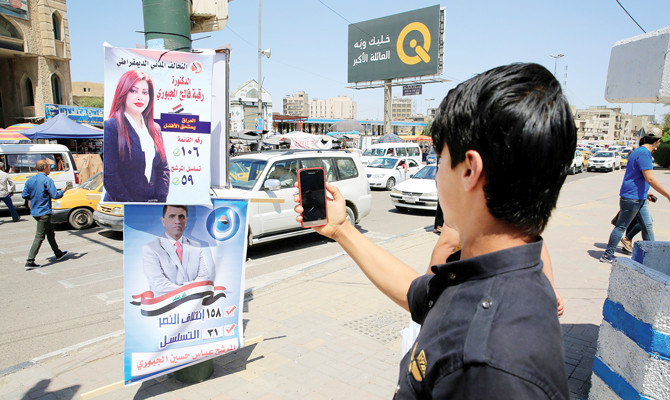
Female candidates shake up Iraq election

Around 7,000 candidates have registered to contest the May 12 election, with 329 parliamentary seats up for grabs. (AFP)
Updated 27 April 2018
Follow

Female candidates shake up Iraq election

  • ‘I will vote for one of the beautiful candidates and I do not mind if she has robbed me,’ soldier tells Arab News
  • Provocative posters and billboards of female Iraqi parliamentary candidates have sparked a heated debate about the role of women in the country’s male-dominated political system

BAGHDAD: Iraqis will go to the polls on May 12 to elect 329 MPs — the fourth parliamentary vote since the 2003 US-led invasion toppled the regime of Saddam Hussein. 

With security better in much of the country than it has been for several years, the election has led to a surge of interest in a new generation of female candidates.

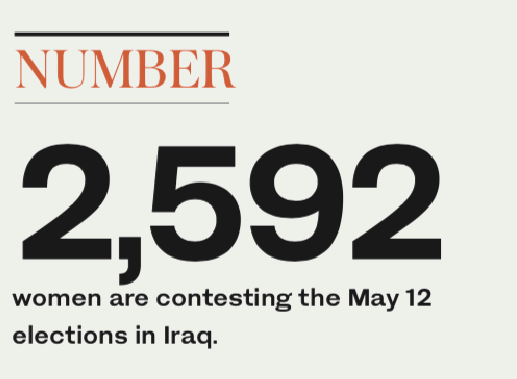
A total of 2,592 women are standing for office across the country and in Baghdad many of them have shunned the nation’s conservative traditions to run socially liberal and occasionally glamorous campaigns unlike anything Iraq has seen before.

Some posters depicting female candidates in make-up and without Islamic headscarves, have provoked a mixed response from an electorate more accustomed to voting for unsmiling religious clerics.

While some voters said the images were a welcome change to the dry, male-dominated campaigns of old, others accused the women of lacking “political depth” and relying on their looks to woo the public. The candidates themselves have defended their unorthodox approach as just another way to generate interest in the election.
In an interview with Iraqi news agency, Al-Manar Press, Mannal Al-Mu’atassim, said she hoped her fashionable image would motivate more young people to support her in the polls. She told Arab News that while she was “not betting” on her looks to win her more votes, she regarded her appearance as more important than her ability to debate conventional political issues.

“I believe that Iraqi voters are heading toward choosing new faces, so there is no need for an electoral program or slogans,” she said. 

Under the terms of the Iraqi constitution, 25 percent of the seats in the national Parliament are reserved for women. 

This is the first time, however, that the participation of female candidates has generated such widespread public interest among an electorate used to taking a cynical view of more established politicians linked to corruption and sectarian violence.

Ziena Al-Shimari, another female candidate in Baghdad, told Arab News she had been granted permission to run by the head of her tribe and was now determined to stand up for the rights of a new generation of Iraqis.

“I am calling on us to unify the Arab tribes because they support the young while the state does not,” she said.Since campaigning began on April 14, the images of the women have given rise to a range of reactions, from anger and mockery to adulation and pride.

“I will vote for one of the beautiful candidates and I do not mind if she has robbed me” Murtadha Zayer, a soldier, told Arab News. “If a beautiful thief robs me in front of my eyes it is better than having an ugly thief who continues to trick me all the time.”

Some of the pictures showing the female candidates have been torn by infuriated voters, while others have been defaced to give the women beards and mustaches.

Salah Ahmed, a political activist, criticized many of the women for lacking “cultural or political depth” and targeting “ignorant voters”.

“If we asked them to participate in electoral debates to identify their visions, plans and ways of thinking, we would find they had nothing to offer. So to compensate for this shortage they are focusing on their make-up and changes to their appearance,” he said.

Bushra Zuwini, a former minister of women’s affairs, told Arab News political factions are using female candidates who lack knowledge of important issues to trick the electorate.

“The big blocs now have experience in how to defraud voters, so they brought in new faces that do not understand politics and do not have any programs or visions,” she said. “This phenomenon will reflect negatively on women.


Volatile security blocks UN from Syria Daesh-linked camp

Updated 6 sec ago
Follow

Volatile security blocks UN from Syria Daesh-linked camp

  • Schmitt said: “UNHCR was able to reach Al-Hol for the past three days but has not yet been able to enter inside the camp due to the volatile security situation“
  • A former employee said most associations withdrew on Tuesday “due to the deteriorating security situation“

RAQQA, Syria: Poor security at a camp in Syria housing thousands of suspected relatives of Daesh group militants has prevented UN agency staff from entering, days after Kurdish forces withdrew and the army deployed at the site.
Two former employees at the Al-Hol desert camp told AFP on Friday that some of its residents had escaped during an hours-long security vacuum.
Thousands of suspected militants and their families, including foreigners, have been held in prisons and camps in northeast Syria since 2019, when the Kurdish-led Syrian Democratic Forces (SDF) defeated Daesh with the support of a US-led coalition.
This year, the SDF had to relinquish to Syrian government control swathes of territory they had seized during their fight against Daesh, and on Tuesday withdrew from Al-Hol.
In Raqqa province, Kurdish forces who formerly controlled a prison housing Daesh detainees were bussed out on Friday under a deal with the government, as a four-day truce neared expiry.

- Returning today -

Celine Schmitt, the UN refugee agency’s spokesperson in Syria, told AFP that “UNHCR was able to reach Al-Hol for the past three days but has not yet been able to enter inside the camp due to the volatile security situation.”
“UNHCR is returning to Al-Hol today, with the hope of resuming the bread delivery that had stopped for the past three days,” she said.
On Sunday, Syrian President Ahmed Al-Sharaa announced a deal with SDF chief Mazloum Abdi that included a ceasefire and the integration of the Kurds’ administration into the state, which will take responsibility for Daesh prisoners.
A former employee of a local humanitarian organization that operated in Al-Hol told AFP on condition of anonymity that most associations withdrew on Tuesday “due to the deteriorating security situation.”
Some camp residents fled during the “security vacuum” between when the SDF withdrew and the army took control, they said, without providing a number.
A former employee at another organization working there said “escapes were reported, but the exact number is unknown.”
“The camp is fenced, but without security, anyone can easily cross it and flee,” they said, also requesting anonymity.
Both ex-employees said camp residents torched centers belonging to aid organizations operating in the camp, where humanitarian conditions are dire.
Before the turmoil, the camp housed some 23,000 people — mostly Syrians but also including around 2,200 Iraqis and 6,200 other foreign women and children of various nationalities, the camp’s former administration told AFP.
Roj, a smaller camp in the northeast still under Kurdish control, holds some 2,300 people, mostly foreigners.
The Kurds and the United States have repeatedly urged countries to repatriate their citizens but foreign governments have generally allowed home only a trickle.

- Al-Aqtan prison -

The SDF has withdrawn to parts of Hasakah province, its stronghold in northeast Syria.
A fresh four-day ceasefire was announced on Tuesday, while the following day the United States said it had launched an operation that could see 7,000 Daesh militant detainees moved from Syria to Iraq, with 150 transferred so far.
US envoy Tom Barrack, who has said the purpose of Washington’s alliance with SDF has now largely expired, held talks this week with Abdi and senior Kurdish official Elham Ahmad.
On Friday, Syria transferred Kurdish fighters away from the Al-Aqtan prison on the outskirts of Raqqa city.
An AFP correspondent in Raqqa saw buses and cars heading away from the Al-Aqtan prison, escorted by government vehicles.
Syrian state television reported the transfer came “after five days of negotiations” and that the fighters would go to the Kurdish-held city of Ain Al-Arab, also known as Kobani, on the northern border with Turkiye.
The SDF later said that with coalition support, all the fighters had been transferred “to safe locations,” while the interior ministry said authorities had taken control of the facility.
A government source told state television that around 800 SDF fighters were to leave, while Daesh detainees would be managed “according to Syrian law.”
The army said the Al-Aqtan transfer was “the first step in implementing the January 18 agreement.”